
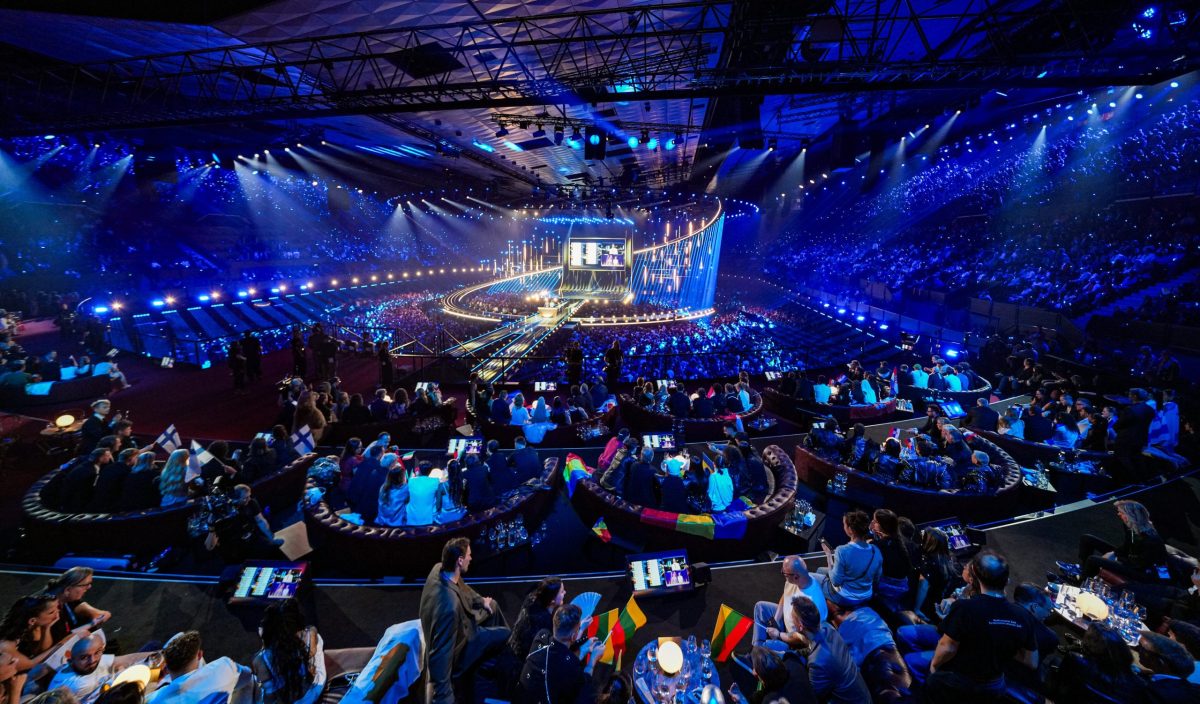
As official technical suppliers to host broadcaster ORF for the 70th anniversary edition Eurovision Song Contest (ESC) 2026, Sennheiser deployed its largest Spectera set-up to date at Vienna’s Stadthalle. This included pre-production samples of the yet-to-be-launched Spectera handheld transmitter; Riedel Communications resumed its long-standing relationship and enlisted newly acquired ARRI to capture the action.
A total of four active base stations handled around 150 live streams covering wireless microphones, in-ear monitoring and control data, in what is widely regarded as the best live sound ever achieved for ESC, delivered by technical production company Agorà. Sennheiser’s technical application engineering (TAE) team, led by Jonas Næsby and Volker Schmitt, were on site to support the wideband system and the new workflows it enables.
Schmitt commented: “In addition to the live television magic and creativity that ESC radiates, its scale and complexity have always invited the industry to bring – and often unveil – its latest and greatest technology. That applies not only to Spectera in Vienna, but also to video, lighting, lasers – you name it.”
Valerio Motta, ESC Project Lead at Agorà, added: “Eurovision is a fast-paced, dynamic and highly demanding production. Everything feels calm if everything works, and having Sennheiser involved in such a delicate project made the entire audio team feel supported and confident. We all knew that even if any issues had arisen – which they didn’t – the manufacturer’s support would have been there to help resolve them in the best possible way.”
Behind the scenes, technical crews, artists and broadcasters worked on every detail. The Stadthalle’s sound room, led by Head of Sound Gerhard Jansa, handled microphone audio, in-ear monitor audio, artist audio preparation and audio distribution to the OB trucks. The sound room accommodated two independent mixing desks, each with its own operator.
The same principle of fail-safe reliability informed the deployment of six Spectera base stations. While four were active for audio and control data, operating on individual RF channels, a fifth unit was dedicated to continuous 24/7 spectrum scanning, while remaining fully preconfigured as a hot spare, linked to all antennas. A sixth base station served as a fully redundant backup.
View this post on Instagram
“We needed coverage across the entire venue,” recalled Schmitt. “We started with two Spectera DAD antennas at stage right and green room left per base station, which gave us full transmit and receive coverage for the hall.
For additional resilience, we then added a further two antennas per base station. A firmware variant developed specifically for the event also provided a preview of upcoming functionality required on site, which included a level recorder.”
An RF control centre in the sound room provided continuous oversight of the Spectera wireless microphones and in-ears via Spectera WebUI and the Sonoros app. Næsby highlighted the simplicity Spectera brought to arena cabling: “We used a fibre run from the sound room to FOH, converting back to copper using standard IT media converters. This gave us full performance from the remote antennas, without the usual compromises associated with RF-over-fibre systems used in conventional wireless setups.”
Spectera DAD antennas were also installed behind the stage to ensure complete coverage when artists entered from behind the video wall. Eurovision songs are limited to three minutes, and just like the stagehands working out of camera shot, the audio team had only 42 seconds for each changeover. With a maximum of six performers on stage per act, the team implemented a rotation system comprising six Spectera handhelds, six SEK bodypacks configured for in-ear monitoring only, and an “all-in” configuration of six bodypacks with headset microphones and in-ear monitors.
“For artists opting for a hands-free solution, we used the bidirectional Spectera bodypack with a cardioid Headmic 4. This mic contributed significantly to the overall sound quality, performing extremely well in front of the PA and wind machines. For those preferring a handheld, we supplied pre-release Neumann KK 105 A capsules. This super-cardioid design helped reduce pickup from adjacent sources and room ambience,” Næsby noted.
Schmitt concluded: “Overall, Spectera earned praise from engineers, production teams and delegations alike for its crystal-clear audio, flawless wireless performance and exceptional RF stability in one of the most demanding and celebrated live music broadcasts in the world.”
Sennheiser WMAS developers Jan Watermann and Sebastian Georgi were also on site. “A truly unique event, and we were delighted to see the system deployed at ESC for the first time,” said Georgi. “ESC in Copenhagen in 2014 was the birth of Spectera,” recalled Watermann. “It was there that we decided to address fading issues from a completely new angle. With standard wireless systems, adding more antennas does not solve the underlying problem of fading notches and cancellations. We wanted to eliminate those at the root.” He further highlighted another often-overlooked challenge: “The second issue we addressed was phase alignment and clock synchronisation in digital systems, where multiple signals can cancel each other out when they converge.”
He added: “A classic example is a broadcast host using both a headset microphone and a handheld at the same time. The engineer receives two unsynchronised signals, and on the mixing desk this creates comb filtering and phase cancellation. The sound can become thin or ‘out of tune’ for a few seconds before the issue is corrected.”
Georgi noted: “With Spectera, we needed synchronisation for the TDMA architecture anyway, so we can now synchronise the internal clock of the microphones as well. That means engineers can mix all microphones without phase issues. This isn’t theoretical – we built a demonstrator and tested it with five open microphones, and listeners noticed there was no phasing.”
This is where Spectera comes “full circle”, the developers concluded: “Development began as a response to the fading challenges posed by ESC, and in its 2026 edition Spectera has arrived at ESC, resolving these issues, streamlining workflows and delivering audio for artists and audiences alike.”
Riedel and ARRI bring cinematic live production to Eurovision
COMMUNICATIONS AND CAMERAS
Riedel Communications has been involved with ESC since 2006. This year, the company supplied over 160 Bolero beltpacks, 60 MediorNet frames, around 700 analogue and digital radios, 80 network switches and over 120 intercom panels, spanning 15km of fibre across the arena. This year’s edition also marked the first deployment from newly acquired ARRI, which provided its ALEXA 35 Live system to capture the action.
“MediorNet was the video backbone,” stated Riedel Communications’ Jeffrey Stroessner, who has played a key role in supporting the project within Riedel’s Managed Technology Division from the very beginning.
“It also connected special camera systems – including cable cameras, telescopic cranes, wireless Steadicam rigs and remote dollies – alongside intercom, tally and return signals, ensuring that the new ARRI camera platform could be integrated without compromising the deterministic, low-latency signal layer required during the live show.”
The international commentary workflow was supported by 35 commentary (via Artist intercom) panels and incorporated Riedel’s new Desktop SmartPanel Commentary Panel App. Preparation begins months in advance. “Our experience of the event helps us,” said Riedel Communications’ Serkan Güner, speaking to TPi ahead of ESC’s first semi-final. “We always aim to demonstrate new technologies and innovations.”
This year, enhancing the cinematic elements of the production was a key priority. The company’s relationship with ARRI dates to founder Thomas Riedel’s work renting ARRI lighting as a DJ in the 1990s, and a successful collaboration at the Lillehammer Olympic Games opening and closing ceremonies. “There is an emotional connection,” Güner said.
As widely acknowledged, Eurovision is a production like no other, requiring a specific mindset and its own technical and creative language. “We are technical enthusiasts, and like Riedel, ARRI – in addition to providing visual artistry, culture and aesthetics – helps extend communication capabilities. Together, we aim to preserve that heritage while enabling new cinematic approaches for technically advanced productions such as Eurovision,” he added. “Exploring new fields and partnerships is something we are excited about, and this is only the beginning.”
Stroessner added: “Without communication, there is no show. It begins with a blend of analogue and digital radio systems, distributing the relevant parties to meet communications requirements. For production communications, everything is centred on our Artist intercom matrix, utilising up to 120 SmartPanels in different formats depending on requirements.”
For roaming personnel, there are around 160 Bolero panels plus additional infrastructure for commentary, all connected via the Artist and MediorNet systems distributed across the arena. In total, around 26 positions house small racks with 60 MediorNet frames, redundantly connected and feeding broadcast trucks.
On the camera side, around 24 ALEXA 35 systems were deployed. Eight in standard broadcast chains with fibre adapters feeding directly to the trucks, while the remaining 16 were a mixture of handheld, wireless and speciality camera systems, including cranes, which were all connected via MediorNet racks to the production trucks. Stroessner explained: “It becomes a fully integrated ecosystem in which each technical department and manufacturer plays its part in making this scale of production possible.”
Riedel is often described as the central nervous system of Eurovision, with all departments passing through its communications backbone. “With Riedel’s infrastructure combined with ARRI’s imaging expertise, and supported by Sennheiser and NEP, we can deliver a seamless execution,” Stroessner said, noting that ORF’s involvement has been instrumental in Riedel’s development of the Artist intercom systems.
“There has always been a close relationship with ORF as a client. Sennheiser, as a family-owned company, is heavily involved in the same way as Riedel, and for the 70th anniversary edition we are introducing ARRI’s cinematic camera capabilities, supported by NEP. Cinematic live is not new, but the gap between broadcast and live touring is narrowing, and this event demonstrates that it is more than theory.”
Güner concluded: “To have three strong, family-owned German companies – Sennheiser, ARRI and Riedel Communications – working on the world stage sends a powerful message to the industry. Eurovision is one of our favourite annual events. ‘Uniting through music’ matters more than ever, offering collective escapism and a shared experience in a challenging world.”
Words: Jacob Waite
Photos: Adrian Almasan and ORF

