
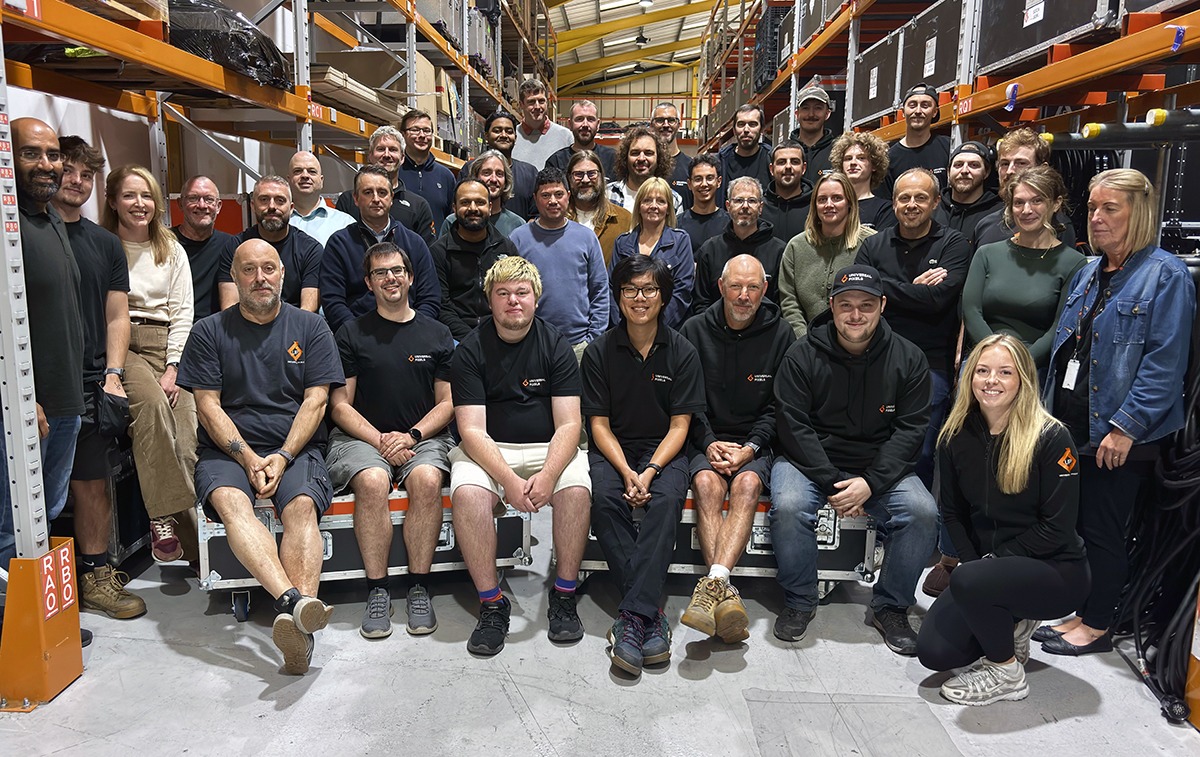
How does a company grow without losing what made it good in the first place? Over the past decade, UP has grown into a 40-plus-person operation working internationally across music, theatre, film and television, while remaining a specialist focussed solely on video. The scale and scope of the company has changed considerably, doubling in size since 2024. Having spent the day at its Tring HQ, TPi explores how the underlying approach has been maintained through that growth – moving from values shared by osmosis to a more defined and structured approach.
“We’ve survived 10 years… getting to this point is an achievement and not something we take for granted. It’s been an interesting journey, which feels like it’s gone by in a flash,” Phil Mercer, Commercial Director at Universal Pixels said, welcoming TPi to UP’s Tring headquarters amid plans to double the footprint of the space by moving into the facility next door. Universal Pixels was established by people who felt there was a better way to approach video production: answering the brief properly, preparing thoroughly, investing in the right equipment and people and taking responsibility for delivering the job well. “That’s what we’re about,” Mercer stated. “We embrace the challenge.”
Initially, many of those standards were maintained directly by the founders and passed through a small team almost instinctively. As the business grew, that became more complicated. Mercer believes that being “brave, adventurous and disciplined” and taking “calculated risks” underpin UP’s approach. “We wouldn’t propose anything that wasn’t a solution. We stand behind what we agree to take on and promise to do, and that’s never changed,” he said.
UP remains independently owned and focussed solely on video, with Managing Director Gareth Jeanne and Commercial Director Phil Mercer closely involved in its day-to-day running. Despite increasingly competing with much larger multinational organisations, the company has retained its specialist approach. “We specialise and we don’t generalise when it comes to video,” Mercer explained. “Our lane is narrow, and as we’re not the largest company we can sit in the middle of it and occupy it,” added Jeanne.
That specialist approach has seen UP work with artists including Robbie Williams [the company’s first and longest-running client], Radiohead, Roger Waters, Oasis, Massive Attack, Depeche Mode, Chemical Brothers, Hozier and Dave. Its theatre credits include American Psycho, Beetlejuice, Mean Girls and The Lehman Trilogy, while the company recently supported the Opening and Closing Ceremonies of the Commonwealth Games in Glasgow.
Beyond touring and theatre, UP’s film and TV work kept the company in good shape through the lockdown’s live music shutdown, while the company has more recently explored opportunities in the trade rental market. “Coming out of COVID, we realised we needed to be in other markets. Over the past year, we’ve explored the trade rental market,” he added. “We are part of a wider ecosystem and we all need one another.”
STAFFING
As UP has grown, so too has the importance of passing its standards and values on to a new generation of staff. Over the past three years, UP has developed a leadership team responsible for decisions in the business. “This industry provides wonderful opportunities, and they have grabbed them with both hands. We are starting to see another generation of talent like Katie, among others, coming through the ranks. It’s great being able to promote from within,” said Jeanne.
Katie Whiting joined Universal Pixels as a Projects Administrator before moving into marketing 13 months later. Six months after that, she began a Marketing Executive Apprenticeship, completing it in early 2026. “It’s an interesting and unique industry,” Whiting commented. “I’m looking forward to the US expansion and learning how different markets operate globally.”
Like Whiting, most of UP’s recent hires are people under 30 and from outside the industry. “We have reaped the reward from that,” Mercer said, happy to offer opportunities that he was once granted. “I’m proud of taking a crew, new to us, and watching them become an integral part of the team.”
According to Jeanne, in addition to recruitment, retention and development are key markers of a healthy work environment. “There is nothing more satisfying than watching people step up and succeed. Diversity in the industry is something we are conscious of and are trying to address, working with colleges to bring students through. As an industry, we are not so good at promoting ourselves, even at an educational level we remain invisible, which is a shame as it’s such a welcoming and neurodiverse community and sector. Fundamentally, we all benefit from fresh ideas and perspectives built from lived experiences.”
Recently, Universal Pixels supported The Music Industry Therapist Collective (MITC)’s Pay It Forward Fund, helping make specialist mental health support more accessible to artists and crew working on smaller tours. “It’s so important and one of the few areas underrepresented,” Mercer added.
SUSTAINABILITY
That sense of responsibility also extends to sustainability. “We are fortunate to work with artists that care about sustainability,” Mercer said. “There is an unspoken and unwritten understanding that we do the best we can.”
UP has formalised its commitment through B Corp Certification, something often associated more with consumer-facing brands. Stuart Walton, Head of People and Sustainability – a role uncommon for small companies – was crucial to landing the certification.
Like many companies, however, UP’s journey to Net Zero is tied to airlines and service providers. “B Corp Certification drives decision making, and not sustainability for sustainability’s sake,” Gareth Jeanne, Managing Director of Universal Pixels, explained.
TRENDS
Alongside its commitments to people and sustainability, UP’s specialist approach is reflected in its investment in technology and its relationships with manufacturers. “I see manufacturers as partners,” Mercer said. “We are prepared to work with new and small manufacturers, which come at a great risk, but the reward is seeing the innovation and creative capabilities of equipment that has a benefit beyond cost.” As well as relationships, the technically complex projects which require “head scratching” and experimentation such as the 2025 Radiohead Tour are equally satisfying.
Jeanne elaborated: “We’ve always been an industry that takes technology built for one purpose and uses it for another, which comes with a level of risk. We like to push beyond the cutting edge but within reason, mitigating failure with R&D and testing.”
Mercer cited the rise of cinematic cameras in touring as a trend worth monitoring. “Cameras are to the video creative what a moving light is to a lighting designer nowadays; they are specific about what look they want to achieve and why, and I love it. This is where we come into our own and embrace it and invest in it as a video-focussed company.”
For Robyn and Lorde’s recent respective tours, UP provided full sensor Sony and ARRI cameras. “We have learned so much in that colour management and live, cinematic filming space over the past 18 months,” Mercer noted.
The creation of super transparent screens like ROE Visual Vanish Air, and the emergence of Acoustic LED panels are also gaining traction. While it is easy to do this in a controlled environment with an installation, more shows like Indochine in Paris and Harry Styles’ Together Together at Madison Square Garden, are recent examples referred to by Mercer. “Concert design is going to change, it’s always been bookended by these two slim line arrays, so we will see larger screens which is music to my ears and maybe audio changes because of that, distributed audio behind screens.”
However, technology is not the only thing changing. The international live entertainment market is evolving too, creating new opportunities and challenges. Like TPi, UP is interested in the growing influence of artists performing in languages other than English.
“The world is changing and with the rise of artists like Bad Bunny and BTS, across South America and in Asia, some of the spectacles are huge and they’re really pushing outer limits of size, scale, creativity and execution away from western Europe and North America.”
On the flip side, the European live scene is suffering from the prices that artists can charge in North America, so understanding where UP fits in is important. “Music routing will change and where tours visit. India, for example, is huge and has a young population. We are going to see different demographics attending shows, but the wider industry needs to be careful to not price people out,” Mercer forewarns.
An example of UP’s involvement in these developing markets came through Dave’s first headline shows in Nigeria, held in Lagos and presented by Live Nation in partnership with local promoter MASSIVE Dynamics.
THE FUTURE
So, what will the future hold for UP? While recent headlines decree the end of civilisation at the hands of AI, spending the day with UP, it’s apparent that this sector, for all its invisibility and unquantifiability by the powers that be, is relatively AI proof. “While AI and machine learning may be utilised to supplement and improve processes, fundamentally, we are a people industry,” Jeanne said earnestly. “It’s an evolving world and we are open about the fact that we don’t know and understand everything…”
Mercer added: “Humanoid robotics will certainly help with manual tasks, but nothing can replace human connection.”
For UP, the next chapter is about increasing capacity without diluting what has made the company successful. Expansion in the US, more space at its Tring HQ and continued investment in people and technology will support that growth, while the business remains specialist and focussed solely on video. Reflecting on the company’s first decade, Mercer said: “There are so many amazing moments and highlights over the past 10 years. It’s a really rewarding industry and we are proud to play our part.”
This story originally appeared in TPi Magazine #296.
Words: Jacob Waite

