
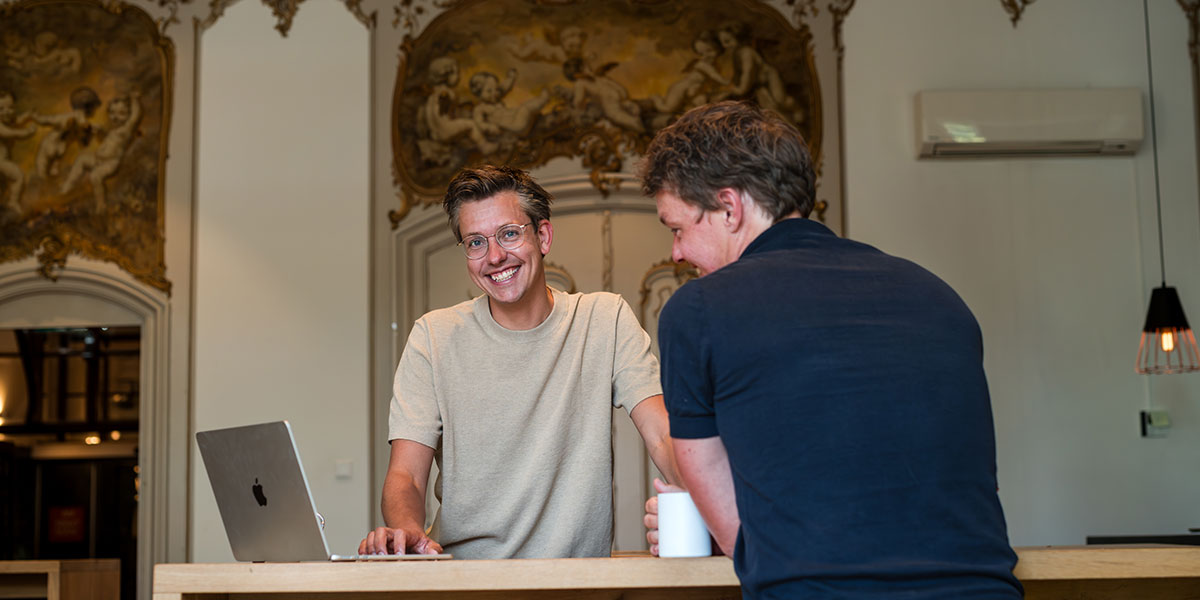
There is a familiar story behind successful technology companies: a person encounters a problem, becomes frustrated by the lack of a solution and decides to build one from scratch. For Roy van den Broek, founder and CEO of Rentman, that problem, as TPi discovers, was crewing for projects.
Having established an AV rental business as a teenager, touring the circuit in the Netherlands, van den Broek soon realised that keeping track of freelancers, equipment and schedules was becoming increasingly difficult. “Communication among the staffing of freelancers was always the biggest problem, which is where the idea for Rentman came from,” he said, reflecting on the 11-year journey that has taken him from a teenage AV rental business to a global software platform used by more than 50,000 people.
With a background in computer science, van den Broek began considering how software could replace the endless stream of phone calls and text messages required to tell crew where they needed to be. “I thought of creating a portal whereby users could log in and see where they needed to be,” he recalled. “I soon realised that with a portal, I also needed something to plan them, which is how it started.”
What followed was not, initially, a masterplan to build a software company. Rentman, he says, was simply a solution to a problem van den Broek was experiencing. “I created it to scratch my own itch,” he explained. “I started with the crewing side, solving the time of calling around, but I also noticed similar problems for centralising equipment, so I began creating space for logging and keeping track of equipment.”
The turning point came when other companies began investing. “It was only when 40 other companies began to invest in the platform that I realised that there might be a future, so I sold the audiovisual company I had and went all in on the software.”
GOING ALL IN
In its early years, van den Broek was operating as the hub for sales, development, marketing and everything in between. Today, Rentman employs 130 people and has more than 50,000 daily users across 140 countries. “The difference couldn’t be any more contrasting,” the founder and CEO remarked, speaking to TPi from Rentman’s bustling Utrecht headquarters.
The company’s ambitions are equally different from those early days. “Our plan is to double in the next three years,” he said.
He admits, however, that the impressive scale of Rentman’s growth was never part of the original plan. “I didn’t consider 12 years ago that this would become a truly global company,” he said, modestly. “It started in a little garage in the Netherlands, and, at some point, we realised that the global industry could benefit, and not just Dutch clients.”
Germany was the first international market cracked, with Rentman using the now defunct Prolight + Sound in Frankfurt as an early springboard. “I would never have imagined or expected the success of where we are now. In the early days, it was just looking at short-term growth rather than the bigger picture.”
PIVOTING AND PEOPLE POWER
However, like much of the live event and touring ecosystem, Rentman was hit hard when the COVID-19 pandemic brought productions with in-person audiences to a grinding halt. “We run on a monthly subscription basis,” he explained. “In the first month, we saw revenue go down immediately which was a massive decrease in revenue.”
Yet this disruption also exposed a new market. As live events stopped, production companies pivoted towards streaming and broadcast, creating a demand for the same inventory management capabilities required for traditional events. “We realised that our solutions were required to locate and send cameras for a livestream, as you would any other equipment.”
Rentman subsequently expanded beyond its original focus on lighting and sound companies, with broadcast now forming part of its wider customer base. “Now, we offer services to broadcast and live events sectors,” he reported.
The pandemic also accelerated another shift in the industry – the recognition that people, rather than equipment, are often the biggest operational challenge and driving force of innovation. The exodus of workers from the events industry created a shortage of talent and forced companies to rethink crewing, HR and workforce management. “When we did sales before, people cared about equipment,” van den Broek commented. “Suddenly, there was a scarcity of talent, and people started to realise that the market was underpaying talent.”
As the industry returned, the change in mindset became increasingly evident. “People now realise that half of the money spent on production is spent on people,” he added. “Before, they were only considering inventory.”
Rentman’s acquisition of CREWZONE in February has strengthened its capabilities in this area, supporting businesses with crewing as well as inventory and operational management. Historically, van den Broek believes, that side of the business has been massively “undervalued”.
FROM QR TO RFID
Across the sector, technology in the warehouse is evolving, too. Van den Broek points to the growing adoption of RFID as companies look to reduce the time spent tracking and packing equipment. “We are seeing more companies making the switch,” van den Broek shared.
This trend is part of a broader push towards automation across event operations, an area where van den Broek sees significant potential for Rentman. The company’s proposition is based on bringing multiple operational functions together in a single platform, combining crewing, inventory, quoting and financials.
“What sets us apart is one platform with multiple products – the combination of crewing, inventory and quoting and financials,” he said. “People really love that.”
Just as important, he highlights, is Rentman’s understanding of the industry it serves. “We came from the industry, and we pride ourselves on our support with real humans who can support you through the process and provide training,” he said.
That industry knowledge feeds directly into product development, with customer feedback helping to shape a deliberately simplified interface. “We understand the difficulties of events, so we employ people who understand that and are focussed on making the lives of our customers easier.”
THE NEXT PHASE
The company’s mantra is straightforward: “Software that is from the industry, for the industry.” For van den Broek, however, the next major shift is already arriving. AI, he believes, will fundamentally change how production businesses interact with software, taking more repetitive processes away from users and allowing them to spend less time at a computer. “If you look at two years from now, AI is going to change a lot,” van den Broek said. “Software is becoming more sophisticated and technology is rapidly evolving.”
The opportunity is not simply about automation. Van den Broek sees AI as a route towards better predictions, more intelligent workflows and, ultimately, greater creative freedom. “More of the processes will be automated, leading to less time at the computer, better predictions or results, and more creativity,” he said, optimistic about the future.
There is also an acknowledgement that such rapid technological change brings uncertainty. “It’s up to us to leverage this new wave of AI, but it’s equally terrifying, as it’s going to change the way we operate.”
Words: Jacob Waite

