
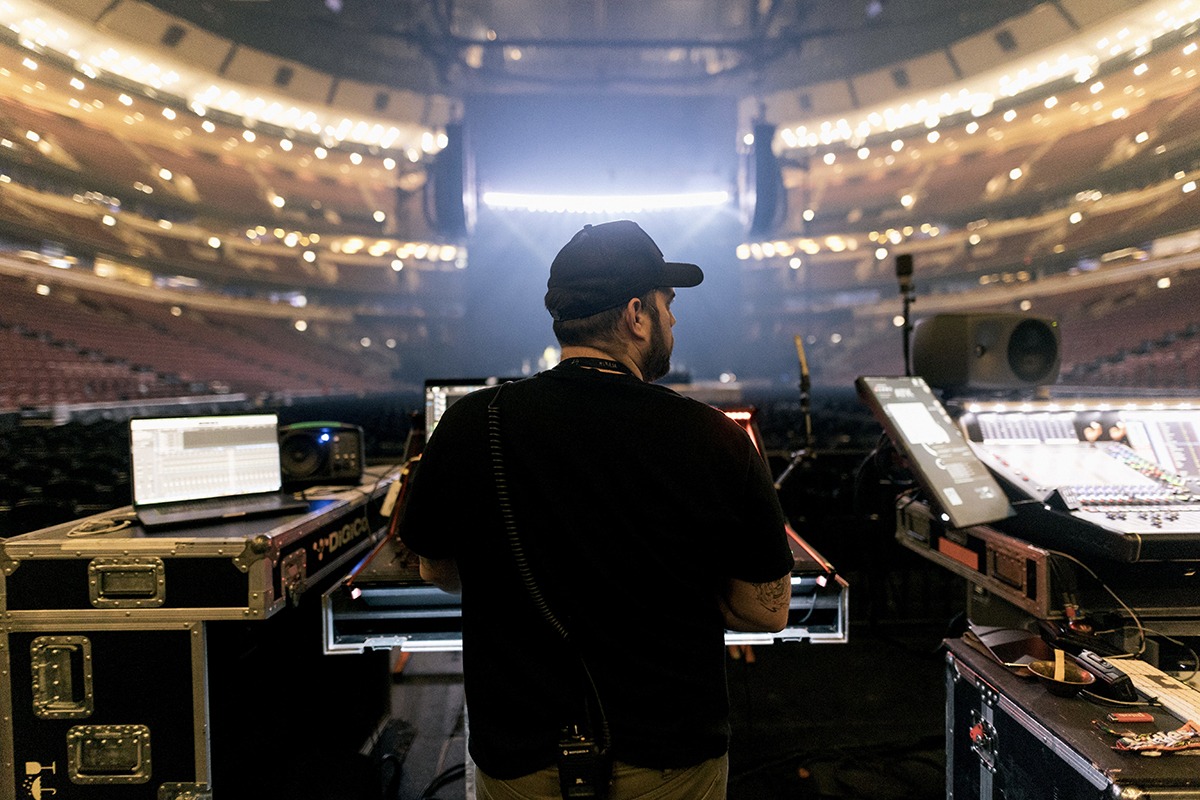
Born in Caracas, Karl Milan relocated to Miami in 2010 at the age of 18 after his father moved to the US and sponsored his move from Venezuela. Although proud of his Latin roots, his entire professional career has been built in the United States, dedicated more than 16 years to mixing artists and bands within Miami’s thriving Latin music scene.
“I started out mixing in the corporate world, working in bars, smaller venues and weddings – the typical rite of passage – before I got my first opportunity working with an artist,” he recalled, speaking to TPi from Nashville amid a US tour.
Since then, Milan has worked with a host of leading artists, including Iván Cornejo, Xavi, Natanael Cano, Justin Quiles, Yahritza y su Esencia, Tainy, Álvaro Díaz, Mariah Angeliq, Claire Rosinkranz, Ivy Queen, Gabito Ballesteros, Myriam Hernández, Cristian Castro, Michael Franti & Spearhead, Claire Rosinkranz and Elena Rose, among others.
“Once you’re in that circle, you’re in,” he said, highlighting Miami’s vibrant live music ecosystem. “The city has been the decisive factor in who I mix. Venezuela and Miami are deeply interconnected. There are a lot of Venezuelans in Miami, and the live music scene is heavily influenced by Latin music, although it has become more Americanised over time.”
Originally, Milan aspired to become a guitarist and study music professionally. However, he quickly realised that Miami was home to an abundance of exceptional musicians and, by his own admission, he was unlikely to compete at that level.
Prior to moving to the US, he spent a year studying audio engineering in Caracas before pursuing a career in live sound. Opportunities soon followed, and Milan found his niche mixing live sound. “It was about recognising the gaps in the market and understanding where I could thrive,” he reported, modestly. “Latin music teaches you to understand the concept behind what you’re mixing. Once you understand that concept, you can mix merengue, Latin pop, salsa or any genre. As long as you can immerse yourself in the music and translate its intent on stage, you can make it work.”
Milan believes there are two distinct approaches to mixing Latin music. The first is the urban and reggaeton style, often centred around a backing track and lead vocal. “It has to be super clean,” he explained. “Sometimes you’re working with no more than three channels, and the goal is to make it sound like the biggest thing coming out of the PA. With a left-right track and vocal, you must find a way for the vocal to sit within the track. It sounds simple, but it needs to be powerful. The music was created in the studio without live sound in mind, so you have to wrangle the vocal and make it work.”
At the other end of the spectrum are large salsa productions, often featuring more than 60 inputs, multiple musicians and extensive microphone counts. “That style of mixing forces you to pay attention to every channel,” he continued. “You have to evaluate how you’re approaching each instrument and build a world where everything can coexist within the mix. Preparation comes down to understanding the concept and being intentional, making sure everything has its place while still translating to the audience.”
In the current climate, Milan believes cultural representation is more important than ever. At a time of social and political uncertainty, providing a platform for regional Latin music and recognising the people behind it carries significant cultural value. Although he has lived and worked in the US for close to two decades, Milan acknowledged that the current political landscape has affected how many members of the Latin community view their place within the country.
“I became a US citizen eight years ago, but I know a lot of people who are worried,” he said, before praising the impact of Bad Bunny’s Apple Music Super Bowl Half Time Show and hugely successful global tours by Latin artists like Karol G. “The biggest thing is representation,” he stated, earnestly. “Our culture is being represented. We can all see parts of ourselves in artists like Bad Bunny or Karol G. These are huge stars putting our culture, language and perspectives on some of the biggest stages in the world.”
According to Milan, Bad Bunny performing on one of the largest televised live music performances is greater exposure for Latin music and culture. “It struck a chord with so many people,” he reported, enthusiastically. “It represented Puerto Rico. Hearing a cuatro and traditional Puerto Rican folk music – music that shares similarities with Venezuelan and Colombian traditions – on one of the world’s biggest stages was special.”
In addition to mixing live sound, Milan founded Milan Global in response to growing staffing challenges within the Latin touring market following the COVID-19 pandemic.
“A lot of people who worked in the industry realised they didn’t have to leave home, travel constantly or miss important family occasions and life milestones,” he acknowledged.
“Many chose different career paths. At the same time, many of the clients I was working with were just beginning their careers, so I was able to bring people in and support the community. It grew out of a shortage of available staff and a desire to help other professionals break into the industry.”
For Milan, gatekeeping remains one of the industry’s biggest obstacles to growth. He elaborated: “If you’ve been in the industry for a while, there’s no need to gatekeep information. I’d encourage people to share knowledge and help each other. Nobody is going to take a job away from you because you taught them something, and if they do, then maybe that opportunity wasn’t right for you in the first place. The more you teach, the more relationships you build. Your network grows, and new opportunities emerge from that.”
Looking ahead, Milan believes the future of Latin live music will be driven by two key factors: expansion and representation. Regional music continues to serve as a powerful connection to heritage for the Latino diaspora. In challenging times, strengthening cultural ties through music can foster a sense of identity and optimism. “The biggest artists are becoming less afraid to show their roots and celebrate the music they grew up with,” he noted. “We’re seeing artists move from trap into salsa and other genres that are more connected to their heritage.”
While English continues to dominate streaming platforms, music in other languages is experiencing remarkable growth in recent years. “The biggest names in Latin music can do whatever they want creatively, and I think they’re beginning to realise they don’t need to emulate American music. What they are doing is already connecting with millions of listeners and thousands of fans in the crowd. If anything, it’s making them bigger,” Milan said, radiating optimism about the future of the sector. “I’m passionate about live music. I love mixing a show and seeing the audience react in real time. My goal is to be of service – to help translate what the artist and musical director have in mind and deliver it through the loudspeakers in a way that creates an emotional response.”
Words: Jacob Waite
Photos: Milan Global

