
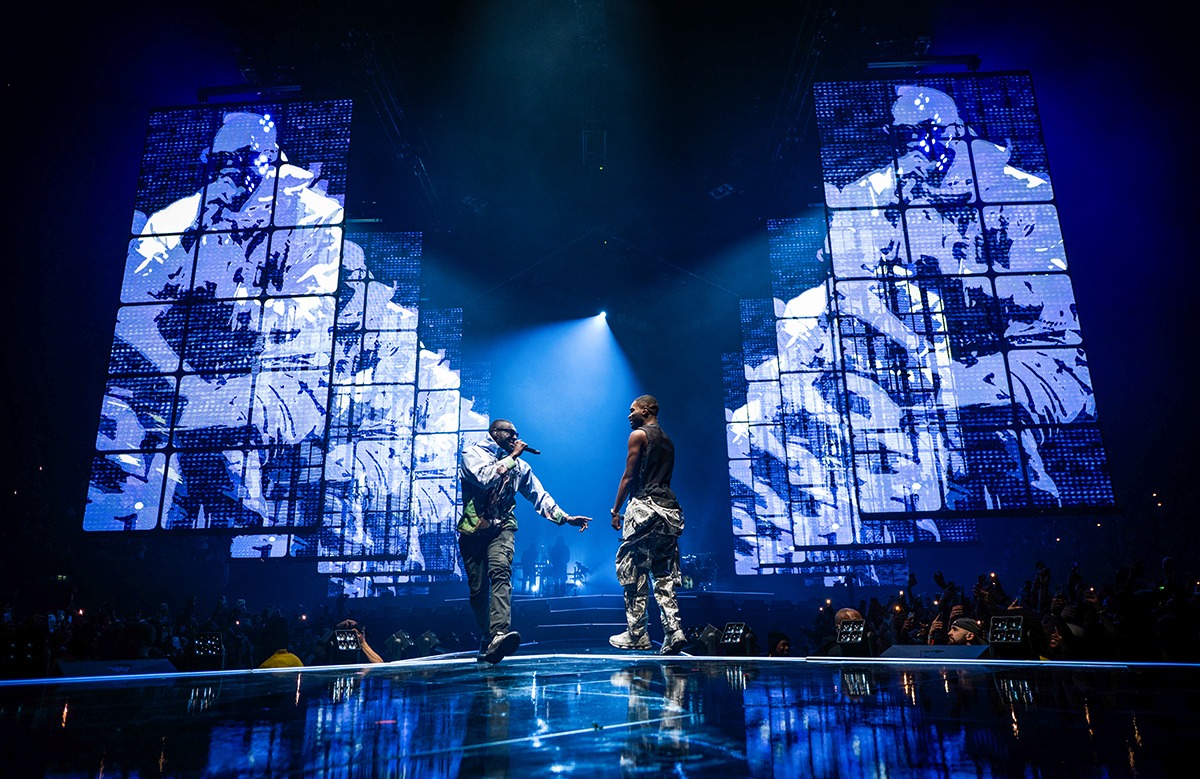
Few manufacturers have shaped the touring LED landscape as visibly as ROE Visual. Its ‘transparent’ LED screens have become a familiar fixture on arena and stadium productions worldwide, now embedded in inventories of rental warehouses across the industry. That position, however, has been built as much on unwavering operational responsiveness as product development, leveraging its unrivalled supply chain and partnerships with global rental companies to meet the demands of modern productions.
The industry, as ROE Visual’s teams point out, rarely runs to a nine-to-five schedule. Technical issues, freight challenges, and last-minute production changes are commonplace. “It’s not unusual for our technical team to be taking calls at all hours,” said Marina Prak, Marketing Manager at ROE Visual Europe. “That’s just the reality of how live production works. Support must be available when people are loading in or troubleshooting on site.”
The company operates with around 1,200 staff globally, with offices across China, the US, Japan, Australia and the UK. This distributed structure is designed less as a corporate expansion strategy and more as a practical response to client demand. “We want to stay close to the customer,” Prak said. “Having regional teams means support can come from within the same time zone, rather than everything routing back through Shenzhen.”
Manufacturing and assembly remain centralised in China, where ROE Visual’s engineering teams continue to drive product development. ROE Visual Europe’s Chief Commercial Officer Matthijs Meijer highlighted the company always being ahead of the curve – keeping flexibility optimal – whatever the circumstances. “It’s about finding whatever gets the job done on time.”
One of the defining elements of ROE Visual’s position in the market is its close relationship with global rental partners. That feedback loop, according to Meijer, is fundamental to product development rather than an afterthought. “It’s the most important relationship we have,” Meijer said. “Rental companies tell us what their day-to-day challenges are, they give feedback on ideas, and some R&D is based on those conversations.”
This bond was highlighted during the record-breaking Adele in Munich residency [see TPi #283], where rental partner Solotech entrusted ROE Visual as the only LED specialist that could supply such a huge single batch of inventory, leveraging its global supply chain expertise and partnership – to cater to the unique demands of the show.
In addition to the 244m by 18m high, 4,625 sq m of CB5 MKII LED panels on site, staff from ROE Visual’s Chinese manufacturing facility were also invited to attend the show. “It’s rare, but it meant a lot,” Meijer said. “The people building the products got to see them deployed at that scale. That connection between manufacturing and touring is something we value highly.”
Having graced some of the biggest productions on the planet [pictured above], ROE Visual positions its LED systems firmly within the touring sector, where durability and repeat usability are as important as image performance. “We’re aware of the price point,” said Prak. “However, these systems are designed to be used repeatedly, in demanding environments. Longevity is where the value comes back.”
That sentiment is echoed across the engineering approach. “It’s not just about electronics,” Meijer added. “Mechanical design is just as important. These systems are built around the way rental companies work. Every component is stress-tested because it must survive constant touring cycles. We are renowned for our unrivalled panel mechanics; a lot of rental houses use ROE Visual solutions for that reason.”
Ergonomics also play a role, particularly in high-pressure load-ins where time is limited. “Even details like handle design are considered around crew workflow. We adjust where needed, but without compromising reliability. Touring doesn’t allow for fragile design.”
REACTING TO CREATIVE DEMAND
Testament to ROE Visual’s success in the market is the company’s ability to meet and react to creative demand and customer requirements. From the beginning of ROE Visual, this has resulted in stunning designs. From providing a massive 200ft by 45ft LED screen amid U2’s 2017 and 2019 The Joshua Tree tours and the proliferation of CB5 LED tiles which made up the distinctive, towering plectrum-shaped screens and stage halos on Ed Sheeran’s record-breaking ÷ (Divide) Tour between 2017 to 2019 [see TPi #227]. “This is where ROE Visual is uniquely positioned,” Prak said, looking back fondly. “There’s a wealth of expertise, but also profound trust from our customers that we deliver on our promise.”
Meijer added: “Some of the most useful developments haven’t just been about resolution. They’ve been about how quickly systems can be deployed and reconfigured.”
He also highlighted the importance of contrast performance in modern LED design. “Black levels and contrast are often overlooked but they make a significant difference in how content reads on stage, especially in mixed lighting environments.”
As LED technology becomes more embedded in stage design, the boundaries between lighting, video and scenic design continue to blur. Meint Arjen Gerding, Technical Support Engineer at ROE Visual Europe, believes this is already changing how productions are being conceptualised. “In the past, lighting and video were separate disciplines,” Gerding commented. “Now you are seeing designers approach shows as one visual environment rather than individual departments.”
Gerding supports customers through training and pre-production via ROE Academy. “The technology is pushing people to think differently,” he added. “It’s less about individual fixtures or screens, and more about how everything integrates.”
Recent developments in touring production have placed increasing demands on LED manufacturers: higher brightness, finer pixel pitches, lighter structures and faster deployment times, all while maintaining structural integrity in addition to the uptake of cinematic cameras in live event production environments and the demand it puts on video screens. ROE Visual recently supported the launch of Unit1 Studio, an independent avatar concert production facility, including a showcase featuring KT Tunstall. “It shows where things are heading,” said Prak. “The line between live performance and digital production is becoming more fluid, as was further demonstrated amid the Eurovision Song Contest 2026.”
Today, ROE Visual estimates its work is split roughly 80/20 between live touring and AV integration and virtual production applications. Moving forward, the focus is on modularity, sustainability and continued refinement of LED systems designed for creative and practical demands of modern productions, such as the Vanish Acoustic, an LED solution with acoustic qualities, recently launched at InfoComm 2026.
Words: Jacob Waite
Photos: Nathan Reinds, ORF, Jorrit Lousberg, Timmsy and Alex Waespi

