
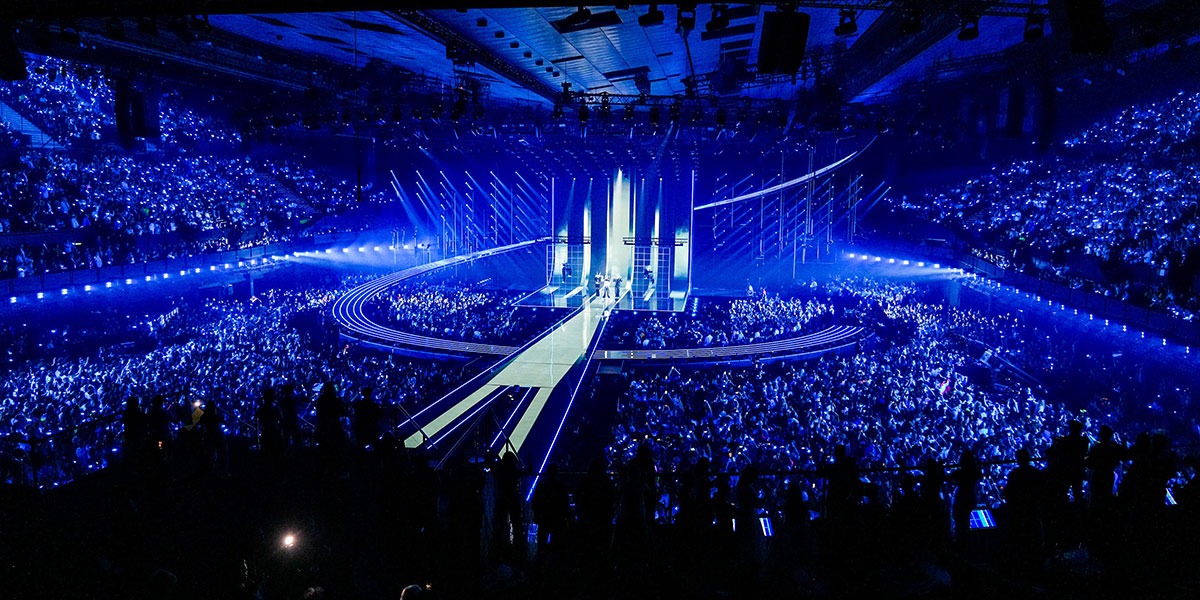
Powered by 11 grandMA3 consoles and over 3,000 fixtures, Eurovision 2026 celebrated its 70th anniversary with a spectacular lighting production
Lighting designer Tim Routledge and a brilliant team – including moving and effects light programmers Alex Mildenhall and Martin Higgins and key light programmer Marc Nicholson – chose a grandMA3 system to deliver a stunning production lighting design for the 2026 Eurovision Song Contest (ESC), staged at Wiener Stadthalle, Vienna and broadcast / streamed live to millions around the globe.
The multi-camera environment show was produced by the European Broadcasting Union (EBU) and host broadcaster Österreichischer Rundfunk (ORF), and it was the third time that Routledge and his team have created the event’s lighting.
They utilised eight grandMA3 full-size consoles between them. Each of these three programmers worked on a main and backup console – and the other two grandMA3 full-sizes were utilised by the ‘late programming’ team of Olly Martin and Manfred Nikitser, who started their shifts around 3 p.m. working into the night updating the showfile with the copious notes from that day’s rehearsals.
Another three grandMA3 light consoles were used as roaming focus / tech desks, making a total of 11 grandMA3 consoles.
These were controlling over 3000 physical fixtures running on 450 universes, constituting an impressive 181,181 parameters of control.
Completing the network were 28 grandMA3 processing unit Ls and 9 x grandMA3 processing unit Ms.
Routledge’s associate lighting designers were Morgan Evans and James Scott; Louisa Smurthwaite called follow spots and playback video producer Sam Lisher was also integral to the team, together with Tim’s gaffer and crew chief, Keith Duncan. The lead network architect was Richard Shout.
Lighting equipment was supplied by rental company Neg Earth Lights from the UK, with whom Routledge also worked on the ESC 2025 event in Basel, Switzerland and on his first ESC as lighting designer, in Liverpool, UK, in 2023.
For the most flexible workflow, Mildenhall and Higgins worked in one grandMA3 session dealing with all the effects lighting, while Nicholson worked in a separate session.
Mildenhall and Higgins divided their fixtures into A and B rigs, broadly split according to fixture types and how they were being used for each of the 35 competing delegations’ performances. This strategy enhanced the overall dynamics of the programming, allowing Higgins and Mildenhall to swap roles between songs.
They split the delegations – each with their own creative team – between them to streamline the logistics of working simultaneously on the same sets of fixtures, making it a more straightforward process with maximum creativity potential.
The A parts of the rig were more broadly involved in creating beam, spot, wash and general automation looks and effects onstage, while the B parts included more pixel fixtures, vast lengths of pixel tape delineating various set pieces, and lights that tended to be more related to building reverse looks and audience illumination.
This workflow ideally suited both Mildenhall and Higgins, who have a similar programming and operating style.
“The rig split and the swapping between songs really assisted the creative process this year,” commented Mildenhall, explaining that it allowed either to take the lead on generating the look and effects for a song, “however, within that structure, we worked very closely, each checking the other’s work and critiquing it, etc., so it was properly collaborative.”
A grid of 80 KINETIC LIGHTS winches, each with a moving light on the end of it, was also controlled via DMX from the grandMA3s, so they could regulate the height and speed of the different winch formations AND apply Phasers across these, unlocking some extremely cool and fluid movement effects.
As key lighting programmer, Nicholson concentrated on lighting the performers on stage and in the Green Room, together with set elements and the show presenter links. He also co-ordinated everything follow-spot related and anything to do with light panels and persons on stage. This involved numerous performers, eliminating Steadicam ‘shadows’ lighting around the kinetic elements above the stage.
The key lighting was critical to generally building the mood and style of each performance as the delegation teams wanted.
Nicholson primarily utilised 62 Robe iFORTE fixtures with the high CRI LED engine for this and could also take control of any other fixture and program it himself or assign it to one of the two Follow-Me systems on site, so any light could become a follow spot if needed.
He found that he mostly took control of the Ayrton Rivales on the winches and the EagleStrikes dotted around the mid arena overhead curved trusses.
The Green Room area was lit with Martin MAC Encore Twos, with Ayrton Khamsins for backlighting.
In addition to his main and backup grandMA3 full-sizes for all the key lighting, Nicholson used a grandMA3 light as a focusing console around the room, plus the MA webremote system for initially focusing the green room lighting, as he could walk around with an iPad, choosing the best fixtures for each position without being tied to the console.
The choice to use grandMA3 was a “no-brainer,” stated Higgins. It is the platform in which the whole programming team specialise, and what the team had used for the previous two ESCs, for which Routledge has been the lighting designer (Higgins was the late-night programmer in 2025 and Mildenhall was again a main programmer).
“ESC is an extremely demanding show,” explained Higgins. “you need to know the console as well as the concept and be able to work extremely fast.”
Mildenhall stated, “Without question, there’s currently no other platform that could handle a show of this size and complexity!”
For Nicholson, grandMA3 is a “Super flexible solution allowing for fast programming and playback. The interface is intuitive and I love the quick access to playback buttons and faders.”
He observed that it is highly scalable, from dealing with the smallest setup to the largest, most complex systems, and highlights the many different control inputs – Timecode, MIDI, PSN, OSC, etc. – which “make grandMA3 great for every situation.”
Approximately 5 weeks of pre-vizing in Depence4 took place, where Higgins, Mildenhall and Nicholson spent around 3 hours building shows for each delegation from their initial brief and notes.
As the plan started to develop for lighting each song, Nicholson would determine which follow spots would work best, if there were any set pieces to light and whether any Steadicams would be onstage.
For the first time this year, the pre-vis renders, complete with video content and some basic camera cutting, were sent to each country for their feedback before the team arrived in Vienna.
Once onstage there, the lighting team had a further 40 minutes with each artist to go through their number and deal with all the real-time updates and inevitable ‘translation’ elements. In that short time, they must also add in any special cues for the camera, so this is extremely intensive.
Of all the various MA software features used in ESC 2026, Recipes was right at the heart of the operation for Mildenhall and Higgins, with a total of 37,614 in the final showfile.
“Alex and I programmed purely in Recipes, so there were no hard values in the cues, and we could see exactly where data was coming from,” noted Higgins. This enabled, with the application of Phasers, the ability to swap fixture purposes, colours, effects, etc., very smoothly and swiftly.
It’s not the first time they have structured a grandMA3 environment like this of course, working with Recipes is a well-proven approach that helps programmers to be extremely reactive when working under pressure.
Most fixtures on the rig were XYZ calibrated, which took time and effort in setting up for Higgins and Mildenhall, but once completed, it massively enhanced the creative programming process with each light calibrated to four separate points.
This approach worked particularly well, given that the lighting design was based on a series of semi-circular and spherical trusses for all the main fixture positions.
This complemented Florian Wieder’s dramatically flourishing set design, defined by a large, sweeping ‘signature’ passerelle feature starting on stage left at ground level, circling around the middle of the room in front of the stage, curving upwards at stage right in an elegant loop that completed its trajectory high up in the roof once again on stage left.
With this performance space architecture, XYZ programming was a fantastic solution for dealing with all the different positional angles involved in rigging lights on curved and spherical trusses. It brought precision uniformity to the calculus.
“Once the calibration is completed, producing complex moves onto objects, set pieces, mirror balls, etc., with everything perfectly aligned is really straightforward – you just grab your lights and move your co-ordinates,” confirmed Higgins.
Mildenhall agreed: “When you wanted to grab all lights and get a large parallel straight beam look across the whole rig from every camera angle, XYZ was a massive help.”
Using the grandMA3 system was also highly effective for programming the KINETIC LIGHTS winches themselves as well as the moving lights attached to them.
PSN data from the winches was fed directly into the grandMA3 consoles, so as the height of the winch was known, the fixture’s pan and tilt were automatically updated – via the XYZ programming – so everything worked in unison for all camera angles.
Intricate effects like ‘penny rolls’ could be effortlessly achieved as when the winches and all the moving lights were simultaneously moving, everything stayed perfectly aligned. This feature was something much appreciated by Routledge, who explained that by the grandMA3 system crunching that positional data, a quantity of winches could be moved into any shape and the luminaires will still stay pointing at their preset positions.
Selection Grids were another grandMA3 feature used extensively to program this show, something which Higgins reckons they would have struggled without, as it is one of grandMA3’s most powerful and unique tools, especially when working in three-dimensional spaces. They pair naturally with Recipes, allowing fixtures to be mapped in a spatial grid across all three dimensions.
Multi-user allowed Mildenhall and Higgins to work as they did, but alternate the A and B rigs between songs so they could be more adaptable and imaginative, and very importantly, take the time to ease the pressure slightly – if one built an effect, the other could share it very easily, so they could multiplex simultaneously.
They used MATools plugins to optimise the workflow for syncing beat-perfect cues with the MA system.
Specifically, during pre-viz MArkers were implemented to manage and convert Reaper DAWs into time-coded sequences, maintaining identical cue lists and data across the separate sessions that were rapidly and seamlessly synced in the master showfile.
Nicholson really appreciated being able to write custom macros or Lua scripts to solve issues. “This was super helpful” when patching the extra control channels and Follow Me control channels he needed for taking control of the Rivales and EagleStrikes. “I could change the patch via the command line for multiple fixtures, which saved masses of manual input entry!” he declared.
Mildenhall stressed the importance of the ‘late night’ programmers Manfred and Olly, who worked in their own grandMA3 session with a copy of Mildenhall and Higgins’ showfile in Depence, addressing some of the notes from that morning or the previous day.
Once the current evening rehearsal was finished, they utilised MATools Trader this time to import all these notes into the main showfile, and the two would remain in the arena into the early hours, either updating more notes or tidying up focuses.
“This is an invaluable role in the production that allows us to address so much of the feedback from Routledge and the delegations so comprehensively,” elucidated Mildenhall.
The biggest programming challenges on a show like ESC are always keeping up with the epic number of notes and endless feedback in the given timeframe, stated Higgins, whilst also keeping abreast of focusing the 3000+ lights and making sure everything is as neat as possible.
Considerable time is devoted to dressing lighting in for each camera shot. The lighting team have access to LiveEdit the camera cutting system, so lighting can be synced precisely to frame cuts, which, as Mildenhall noted, “helps hugely when we need to add in lights from the back of the arena or when we are working on a reverse Steadicam shot – as lights that would hit the LED video wall on a front shot can be instantly turned off!”
Nicholson mentioned that with over 40 different performances to manage – including interval, opening acts, etc. – finding time to make changes to already timecoded elements is a major undertaking, requiring time and concentration. “But this is all to make each performance the very best it can possibly be and look exactly as the artists want – so is it also very rewarding,” he concluded.
Good communication between all involved is at the essence of working on a show like this, which involved intense and complex work with multiple inputs against constant deadlines, and with the majority of Routledge’s team working on their third Eurovision, synergy, understanding all roles involved and working as a team are essential.
Higgins admitted that working with Mildenhall and Nicholson was one of the most enjoyable factors of the event for him, along with the rest of Routledge’s crew, and as well as being highly polished and dedicated programmers, they all kept one another sane during the evolution!
For Mildenhall, again it was “working with such a great team! And the privilege to work on a show as massive and challenging as this one!” The support from the local MA distributor and the MA Lighting network also underlined the show’s success.
Nicholson relished the creativity of problem solving for each performance, whether it was finding the right style, creating drama with lighting, technical idiosyncrasies or managing multiple performers all over the stage at the same time. “The workload is unlike any other project I’ve worked on, but it’s so satisfying once we get a finished performance that delights everyone!”
Lighting an ESC event is a massive collaboration that requires trust, harmony, and a careful combination of the best skills with the right personalities.
Routledge assembled a fantastic team to imagine yet another fabulous lighting aesthetic – full of colour, movement, energy, and rhythm – with the help of the power and flexibility of the grandMA3 system, creating a slick and memorable showcase for the Eurovision Song Contest’s 70th anniversary.

