
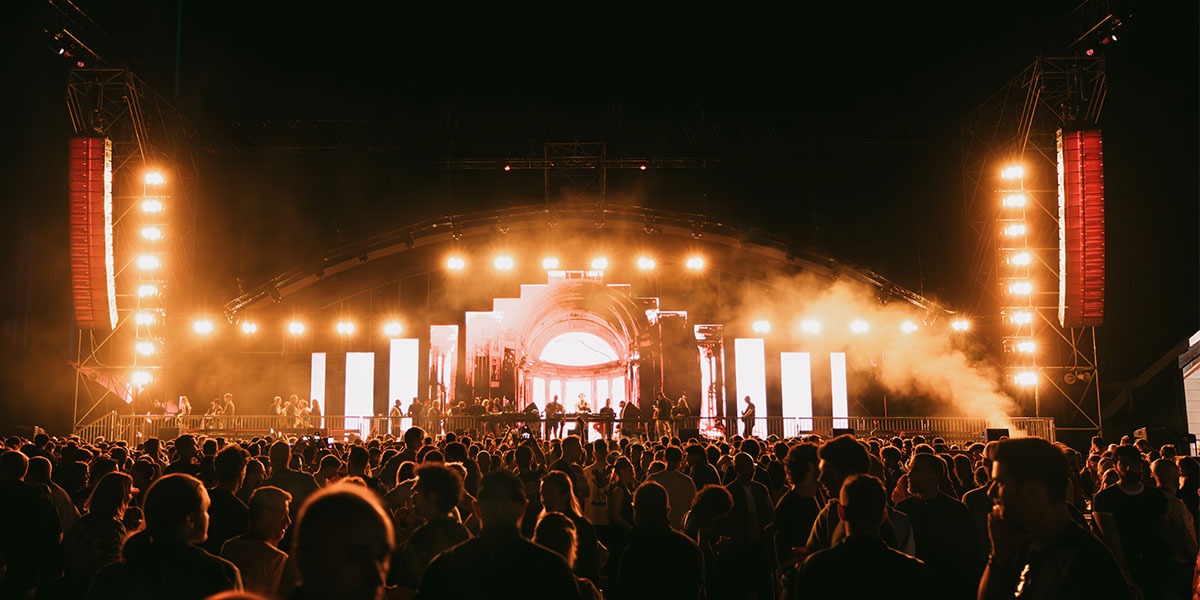
Adriatic Sound Festival (ASF) returned to Fano Airport on the Adriatic Coast of Italy for the second time with a production featuring performances by Fisher, Anotr, Honey Dijon, and more. Far from conventional, ASF Founder, Luca Lewis, may just be the first person to pivot from a career as a professional footballer to festival organiser. Speaking exclusively to TPi, he shares how he enlisted the support of STUFISH Entertainment Architects to translate the Roman history of Fano into the creative vision for an electronic dance music festival.
“I grew up in Pesaro, and I was driving one of my friends home to Fano when we passed the airport and we just discussed how it would be the perfect place for an event. We were shocked that it didn’t already exist,” Lewis recalled. “I was a professional footballer and on a completely different path, but I just couldn’t stop thinking about it since that day. When I decided to stop playing football, I pitched the idea to the Mayor, who was interested.”
Lewis, who hadn’t so much as “planned a birthday party” before taking on the festival, was introduced to Marco Marchesi, who suggested contacting STUFISH. “They loved the creative direction behind the event, and a week later we met in Fano to see the site,” Lewis recalled. “We then did extensive research on the Roman architecture left in Fano, which was special considering it is the second city after Rome with the most ruins from that timeframe. After that, it was about merging the worlds of electronic dance music with the rich history of Fano.”
For STUFISH’s Zarya Vrabcheva and Ric Lipson, the intention behind the festival was to create a space that was unique to Fano, providing a different dancefloor and audio-visual experience through production. Vrabcheva explained: “The main stage, which we called ‘The Temple’, became an immersive 360° arena, where the artists played from the centre out to the crowd, embraced by a monumental sculpture that was inspired by Roman architecture. We took the idea of the arch as a fundamental and iconic architectural element, preserved through the ages and had one side of the Temple resemble that, whereas the other became an inverted arch and represented something other earthy and contemporary. In that way, we created a parallel between past, present and future, where music and uniting people through it would always be there.”
A second stage was created in front of three aircraft hangars, a nod to the site of the festival, Fano Airport. “This wide stage used the large canvas of the hangars as the backdrop with some additional screen elements added to complement the architecture,” Lipson added. “The two stages provided multiple levels and ways for the audience to see the artists and experience the music, from more intimate and elevated areas, to large, rave-like open crowds.”
Lipson and Vrabcheva collaborated with Denso on the lighting design, with Order Studio for video, SuperFX for special effects as well as BBR Projects and Innscena for structures, allowing ASF to reuse them for future editions. “Putting Fano on the map” was key to the festival’s programming. “It isn’t about creating a random theme, in a random place,” Lewis said. “Faro is steeped in history, and it is very meaningful to me, especially because I am from the area. I want to teach the world that Fano is absolutely a place to visit, and what better time to come than when the festival is on.”
Coming from the footballing world into live events isn’t a traditional path, but one that Lewis is grateful he took. “I wasn’t enjoying football the way I used to, so being able to build something from the ground up has been an enjoyable challenge to undertake,” Lewis commented. “We are already seeing it grow massively in year two and are grateful. It was important to us to listen to the experts, and we’re thankful to our suppliers for believing in us from the beginning.”
Lipson echoed: “It is rare for us to have the opportunity to be part of designing a new festival, so much of the creative of what the iconography of the festival will be known for comes out of the design that we create for the stage architecture and site.”
He added: “When making these designs, the hope is that the festival is a massive success and that it can return year after year and build on the audience, artists, duration and scale. Being able to be part of this and develop a relationship with the ambitious founders of the festival is very special, and we have been very proud and excited to be able to be at the start of this now world-famous event, which is now globally recognised as one of the most exciting places to go for this genre of electronic music.”
Adriatic Sound Festival is scheduled to return in 2027, with Lewis looking forward to what the third edition of the event has to offer. “We want to get the wider city involved. Something we began this year was giving an opportunity to local acts from Fano and neighbouring towns to play at the festival, which is giving back to that local community, and in 2027, we want to extend that further,” Lewis revealed in closing. “We also want to add additional elements to the festival, so watch this space…”
Words: Alicia Pollitt
Photos: Adriatic Sound Festival

