
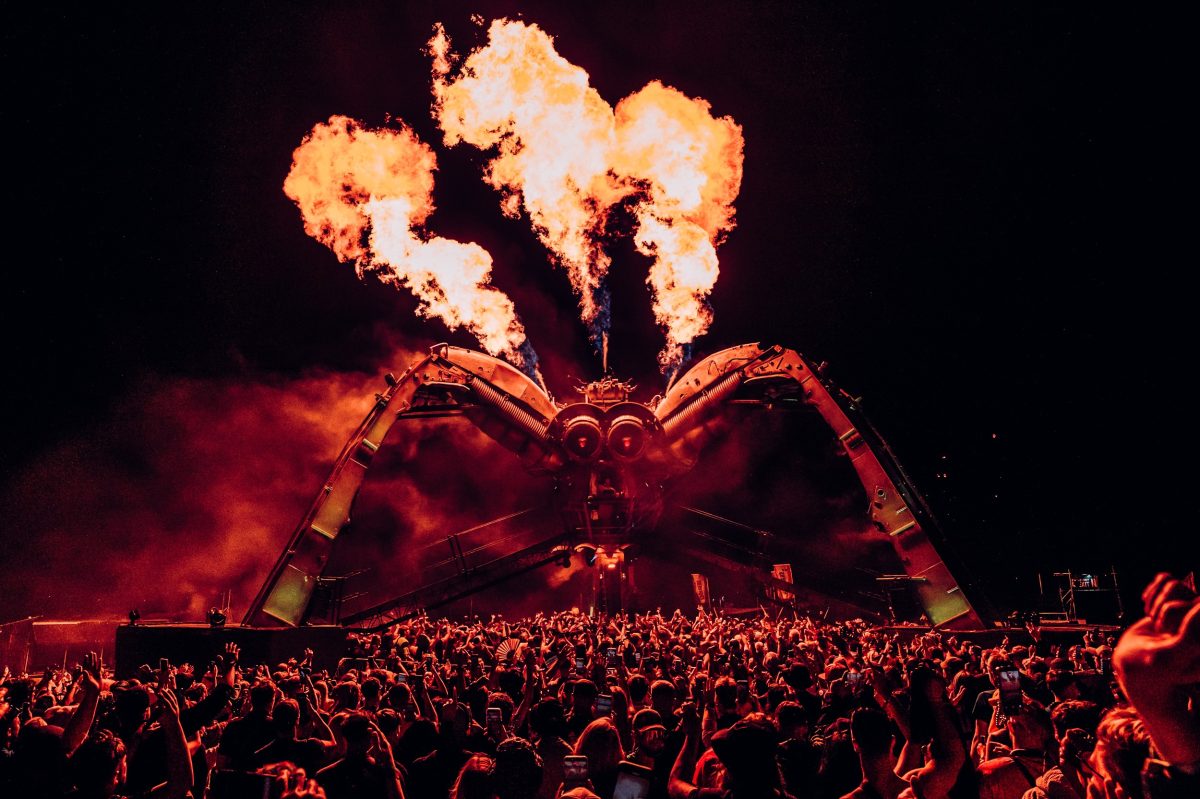
At Forbidden Forest 2026, the Upmix Engine helped Arcadia improve how standard stereo DJ content translated across the Spider’s nine-point L-Acoustics system, without asking artists to change how they delivered their sets.
The tenth edition of Forbidden Forest took place this year at Belvoir Castle near Grantham, UK. The three-day electronic music festival, which featured six stages, multiple genres and more than fifty artists, marked a decade in existence by hosting the Arcadia Spider as its centrepiece.
Arcadia is not a conventional festival experience. It’s an arts company known for transforming recycled military hardware into sculpted, large-scale performance stages, forging unity from the relics of conflict. Iconic among these is the Spider, a 50-tonne immersive performance environment where sound, light, fire, engineering, performance and audience movement are all part of the same experience. Those in attendance gather around the structure from every angle, moving through the space as the show unfolds around them.
A traditional stereo system is built around a left and right relationship, with the audience positioned in front of the PA. The Spider reverses that: the audience surrounds the structure, and the sound system has to serve the entire arena rather than a single forward-facing crowd.
For Forbidden Forest 2026, the project team deployed Arcadia’s first 9-point L-Acoustics system, supplied by AF Live, with nine outer towers arranged around the performance area and an additional inner sound field beneath the Spider itself.
The challenge: stereo content without a fixed sweet spot
Most DJ content still arrives in stereo. It remains the practical standard for playback and live production, allowing artists and engineers to work from familiar setups without preparing bespoke multichannel show files.
But on a circular, inward-facing loudspeaker system, stereo behaves very differently. It relies on a defined left and right image, and there is no single listening position in the Spider. The audience is constantly moving, with different parts of the arena hearing different combinations of loudspeaker sources.
“The unconventional positioning of multiple loudspeaker arrays introduces additional challenges,” explained Bryan McLean, System Designer at Dirt Sounds Ltd. “As signals overlap, constructive and destructive interactions occur, leading to phase issues, comb filtering and variations in frequency response.”
The challenge was not simply to reproduce stereo content at scale, but to maintain clarity, consistency and impact as people moved through the space, while also controlling sound propagation beyond the audience area.
A system shaped around the show
The loudspeaker system was designed around the way audiences experience the Spider. Each of the nine outer towers carried four L-Acoustics K2 and a KS28 on the upper platform, with a further two KS28 and six Kiva II below. Under the Spider itself, the inner sound field was built from three points, each made up of two SB28 and three Kara II.
Distributing the same stereo signal to more loudspeakers doesn’t, on its own, produce a coherent result. Without careful processing, a multi-point system can draw attention to individual arrays, while tonal balance, level and perceived image can shift as listeners move between coverage zones. Resolving those interactions across nine outer towers and the inner field was one of the harder parts of the design.
“There’s no front or back of house — the audience surrounds the structure from every angle,” said McLean. “The aim was a consistent sound field delivered to the entire audience, rather than energy focused toward a single listening area.”
The goal was a unified field, rather than stereo simply spread across a ring of loudspeakers.
Introducing the Areal Upmix Engine
Areal became part of the project as the team explored how to get more from the loudspeaker architecture without asking artists to change how they delivered their content.
“As we developed the Spider’s 360° audio concept, it became clear traditional stereo playback wasn’t making full use of the loudspeaker architecture,” McLean said. “Managing the interaction between multiple sources was one of the key challenges.”
The Areal Upmix Engine is a dedicated hardware processor built around RISE (Realtime Immersive Stereo Expansion), which redistributes spectral elements from a stereo source across multiple channels in real time, without requiring multitrack stems or object-based mixes.
Working on the system side rather than changing Arcadia’s creative or loudspeaker design, the Upmix Engine helped stereo content translate more naturally and coherently through the existing system.
By changing how the signal was distributed, it helped create shared listening zones where multiple sources could overlap with fewer compromises, improving coverage consistency and helping the sound field feel more open and connected.
The DJs performing on the Spider didn’t need to change how they delivered their sets. The technical team controlled how that stereo signal was expanded and optimised for the loudspeaker layout.
Areal’s UK distributor, POLAR, supported the supply and demonstration of the Upmix Engine for the project.
View this post on Instagram
Practical integration in a live workflow
“Following a series of listening tests, we settled on a Quad-Core configuration using a Left/Centre/Right approach around the Spider,” McLean explained. “The objective was to balance coverage consistency and localisation within the geometry of the 360° system.”
The Upmix Engine was integrated via the DiGiCo console, giving the front-of-house engineer control over how much processing was applied to the programme material in real time and allowing it to be blended into the master bus according to the content and performance requirements.
Microphones were routed through separate mono buses rather than through the Upmix Engine, preserving vocal clarity and image stability while the musical programme material benefited from the wider sound field.
The result was a practical live workflow that added flexibility without forcing artists or engineers into a new production method.
What changed for the engineers
From a system-engineering perspective, one of the biggest improvements was the reduction of negative interactions between loudspeaker sources. The Upmix Engine helped overlapping coverage areas work together more effectively, smoothing transitions between listening zones. Instead of feeling tied to individual towers, the system behaved more like a coherent field.
McLean also reported a reduction in lobing beyond the intended sound field, contributing to better control of sound propagation outside the audience area. The on-site noise management team specifically commented on how controlled the system was.
For a production like Arcadia, that balance — scale and impact alongside clarity, consistency and environmental control — is critical.
What changed for the audience
For the audience, the result was a sound experience that felt more connected to the space.
“One of the most noticeable effects was how intimate the system felt despite the scale,” McLean said.
Because transitions between listening zones were smoother, the audience could move around the Spider without experiencing dramatic changes in tonal balance or energy. The sound field felt more enveloping throughout the space.
Arcadia is built around the idea that the audience is inside the action. When stereo content can be distributed through a multi-point system in a way that remains coherent as people move around it, the sound becomes part of that experience rather than something projected from its edges.
A practical model for future productions
Bespoke multichannel production offers significant creative possibilities, but it isn’t always practical in a festival environment where artists and DJs arrive with established stereo workflows, and production teams have limited time to adapt incoming content.
The Upmix Engine offers another route: artists continue to deliver in stereo, while the system engineer controls how that material is expanded and optimised for the loudspeaker system.
At Forbidden Forest, that allowed Arcadia’s 9-point system to make better use of familiar stereo content while retaining a practical festival workflow. The result was greater consistency across the arena, better control of interactions between sources and a sound field more closely aligned with the scale and spatial character of the Spider.
Project credits
- Audio supplier: AF Live
- Upmix Engine supply and demonstration support: POLAR
- Technology: Areal Upmix Engine
- Photography: Chris Cooper, Shotaway.com; Matt Eachus
- Technical contributor: Bryan McLean, System Designer

