
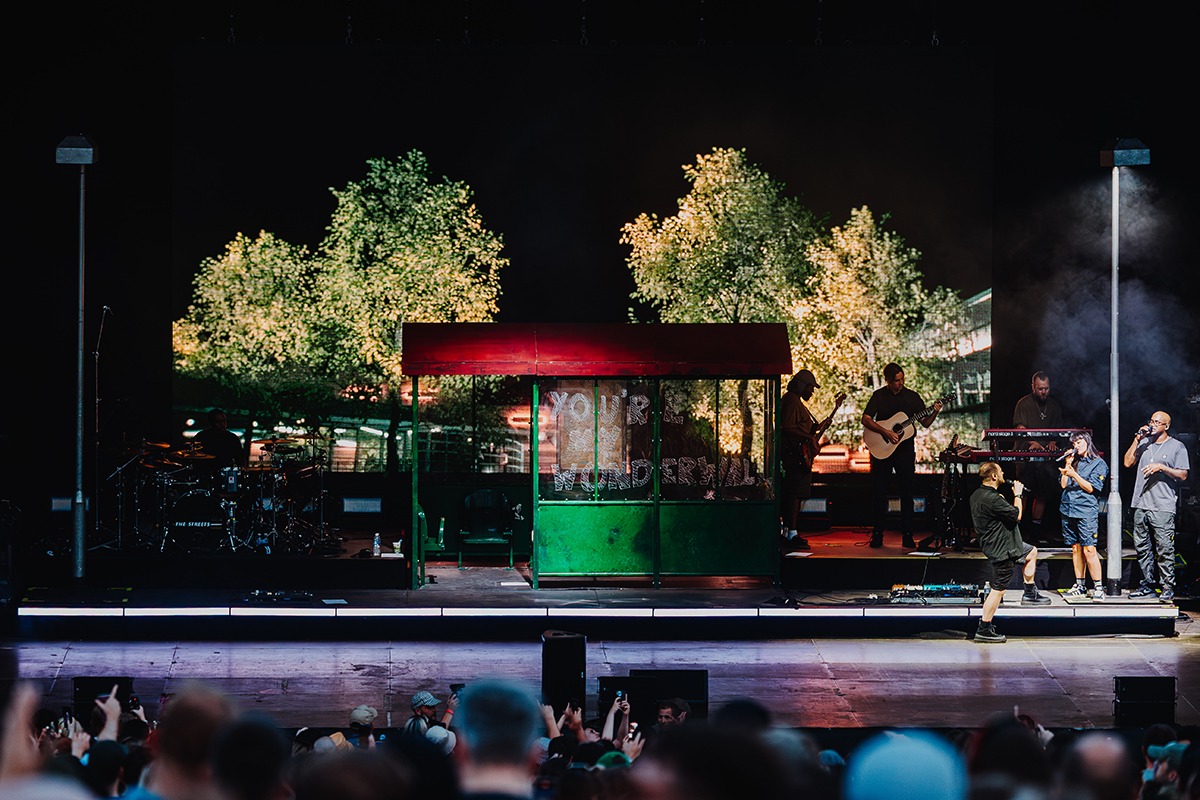
Over two decades ago, The Streets released A Grand Don’t Come for Free. Music theatre meets garage, the seminal concept album follows Mike Skinner’s relationship with Simone, sidetracked by the devastating loss of £1,000 from right under his nose. The album has soundtracked countless long drives and encapsulated early-2000s British culture like few records, so it was a pleasure to track down the vendors and touring crew tasked with building a production befitting the brief.
Production and Tour Director Will Driscoll of 24/7 Productions enlisted trusted suppliers Boxcat Studio (content creation), CSE Crosscom (radios), FOMO London (band rehearsals), Gravit8 Travel (travel agent), KB Event (trucks), Mission Control (RF coordination), Opto Live (playback), Ox Event House (set fabrication and scenic), Phoenix Bussing (buses), Production Freight (freight), Production Park – The Mill (production rehearsals), Solotech (audio), and Zeal (lighting).
“We went through a number of revisions before settling on the final design, somewhere between the dream and the reality,” Driscoll said, speaking to TPi at London’s Alexandra Palace. “I’m really pleased with the team we have on this project. Everybody is multi-rolling and it’s admirable.”
It was an unconventional show for The Streets: a theatre-style production in which the first half was a theatrical performance before moving into a rock ’n’ roll gig, complete with Skinner’s signature crowd interaction. The main challenge was scaling the show for academy-sized venues. “I think we’ve nailed it and the whole team has stepped up to do so,” Production and Stage Manager, Richard ‘Cookie’ Cook, reported. “The economy of space was the biggest challenge. We couldn’t compromise on the set because of the size of the bus stop, so getting it into Glasgow’s Barrowland Ballroom with a 1ft gap between the artist and the bus stop was the compromise. Even getting the team to carry everything up the flights of stairs with a smile was commonplace at the Barras.”
Reflecting on the success of the tour, Cookie praised the influence of the crew and vendors: “The gear was fantastic, they all had been wonderful to collaborate with, and the support had been great. Dublin’s Olympia Theatre show stands out as highlights.”
A ‘LESS IS MORE’ APPROACH
The show’s video content followed a continuous journey from day into night. For outdoor performances such as Ally Pally, it mirrored the changing ambient light, gradually darkening as the festival site moved into evening. At the centre of the stage was a bus stop, a nod to the album artwork, complete with an authentic Birmingham bus map, grounding the show in the city’s visual language and the band’s roots. The graffiti scrawled across the bus stop changed each night, featuring a different slogan at every performance.
Famed for crowd interaction, Skinner did not acknowledge the audience during the first part of the set. Instead, choreography became a visual representation of the lyrics, reinforcing the storytelling, most notably during Fit But You Know It, which recreated the familiar scene of people queuing outside a kebab shop.
Production and Lighting Designer, Liam Tully, programmed the show at his home in Newcastle, using an MA Lighting grandMA3 light console with Recipes. The design was drawn in Vectorworks and previsualised using Syncronorm Depence software, before the show narrative was developed during five days at Production Park’s The Mill rehearsal facility.
“The idea of the show was the album in full,” Tully explained. “The bus stop is only lit from one side at the start of the show; the rig progresses throughout the set, going from day to night, starting at stage right and finishing on stage left.” The rewind sound on Empty Cans at the end of the show, and the floor lighting package, burst into life upon Skinner’s discovery of the £1,000. The only departures from the day-to-night structure came during anthemic Blinded by the Lights and Fit But You Know It, and greatest hits section.
Steve Hough of Zeal, who supplied the lighting, had previously toured as the band’s Lighting Designer and had worked with The Streets since their stage return in 2018. “It’s a theatrical show, providing something special for fans,” he said.“I love working with Zeal,” Tully added. “They have a great apprenticeship scheme, their equipment is perfect, and they are designers in their own right.”
The rig included flown Martin Professional Aura XIPs, Viper XIP units on the floor, while ACME PIXEL LINE IP 500s were housed inside the bus stop and lampposts. SGM Q-8 fixtures provided backlight, complemented by three Robe Robin FORTE followspots on a RoboSpot system. Further ACME Lighting PIXEL LINE IP and LINE 500 strips lined the stage risers.“It’s nice to not have loads of lights flashing,” Tully noted. “It’s a two-truck tour, so less is more. Some of the best looks are generated by just one light.”
Hough expanded on the ‘less is more’ approach: “It is arguably one of the hardest things to do as a designer. You have to have a level of confidence and assurance in your design and the performers, and I think this show leaned into that, using negative space tactfully,” he said. “On the other hand, there were still elements of energetic lighting design towards the end of the show, which was the genius of Liam’s design, providing both the theatrical moments and the party at the end. It felt collaborative and not transactional, pulling together and pitching in to present a great gig.”
In Australia and New Zealand, a floor package and video wall replaced the bus stop, with Boxcat Studio recreating the environment in Unreal Engine across the production. Resolume media servers and in-house LED allowed the production to tie the video content seamlessly into the lighting.
“It’s an ever-evolving show,” Tully noted, reflecting on the experience of designing one of his favourite albums. “My favourite moment is Empty Cans. It’s the crescendo of the show, straddling both the theatrical and anthemic elements. There are so many highlights across the nine greatest hits.”
In preparation for the production, the design and carpentry team measured real-life bus shelters, timetables and seats to create the show’s central prop. However, everything built by Ox Event House had to be modular and tourable, navigate tight spaces, fit festival stages and roll on and off trucks partially assembled. “We came up with off-the-shelf material designed to allow it to transport and attach the decking with stock wheels and deck,” Ox Event House’s Ben Levitt explained. “We also repurposed lampposts we had as hire stock and implemented lighting fixtures to fit the brief. We are fans of The Streets, so it was a cool and well-received project.”
Ox Event House scaled the bus stop to fit stock risers. It broke down into 2D panels across 10 sections, which were aircraft-pinned together and bolted to deck bases for safety. The bus shelter could be built in around 30 minutes and occupied 8ft of truck space across three travel carts.
Polycarbonate window glass was lowered to accommodate the new winch system at Glasgow’s Barrowland Ballroom, allowing the structure to be moved up the centre of the venue’s stairs. “Modifications allowed it to break down small to fit tough venues like Dublin’s Olympia,” Ben Levitt continued. “We also made it so it could fit in three four by eights, so you could roll the middle and the two middle-left and right sections off a truck on a festival site and fit that together with ‘space couplers’ for our in-house system. It fitted together seamlessly.”
Fiona Levitt added: “We were able to recreate the shades of the iconic album artwork bus stop, and relished the opportunity, matching colours and reference imagery to make it as realistic as possible. It’s heart-warming to see The Streets’ relationship with the bus stop and Carpenter, Jack, who Mike Skinner refers to as ‘Bus Stop Jack’.”
‘EVERY DETAIL MATTERS’
“You don’t just recreate an album like this – you become its custodian for a while,” Musical Director and Playback Technician, Oliver Twiby, commented. “Every decision was made with one question in mind: would the audience believe this was the record they knew and loved? That philosophy ran through every department. Every detail matters, and there’s no shortcut. It’s about understanding the feel, attitude and emotion behind the music, not just recreating the notes.”
Having spent nine years with The Streets, Twiby described the campaign as one of the biggest technical and musical challenges the team had undertaken. The album was never designed for full live recreation; many of the songs had never been performed live, and significant amounts of the original source material no longer existed. The team, therefore, rebuilt large sections of the record while remaining faithful to the original.
The process began with a forensic analysis of the album, identifying which assets remained, what could be restored and what had to be recreated. The team met to discuss arrangements, instrumentation and the approach to each song before moving into months of studio programming, recording and rebuilding alongside Cassell ‘The Beat Maker’ (drums), Wayne Bennett (bass), Gabriel Piers-Mantell (keys), Max O’Donnell (guitar), Kevin Mark Trail (vocals) and Roo Savill (vocals).
The playback system was supplied by Opto Live. “This one of the best touring rigs that I have ever worked with,” Twiby commented. “Andy Hamwee and the Opto Live team have built an incredibly reliable system that’s perfectly suited to modern touring.”
The rig featured dual Apple MacBook Pro M5 playback computers and RME MADIface XT interfaces, with a DirectOut PRODIGY handling the first 32 channels of audio and Ferrofish A32 providing the remaining outputs, for 40 analogue outputs. “The audio department wanted to keep the playback system entirely analogue, and delivering 40 discrete outputs reliably is no small task,” Twiby continued. “The combination of the PRODIGY and Ferrofish makes that incredibly straightforward while maintaining excellent audio quality.”
MIDI over MADI was achieved from the PRODIGY, meaning whichever playback machine was active automatically became the active MIDI source. From there, everything was distributed via an iConnectivity mioXL and Opto Live’s proprietary Kenton Line Driver stage boxes, providing an “extremely robust” touring network.
Ableton Live 12 alongside AbleSet was used for show control, with everything controlled from an AKAI LPD8, giving Twiby “quick, tactile access” throughout rehearsals and live shows. “It’s flexible, completely redundant and, most importantly, dependable, which is exactly what you need when you’re carrying so much of the production,” he said of the solution.
The audio department was equally important. “FOH Engineer, Rob Sadler completely understood the sonic direction from the outset,” Twiby said. “He trusted the arrangements, stayed true to the dynamics and character of the record, and let the songs tell the story.”
CSE Crosscom supplied 15 Motorola DP4600e radios, configured and delivered in a Peli transport case for transportation and deployment. CSE Crosscom’s Dan Howroyd commented: “With clear audio, durable construction and proven reliability, the DP4600e radios were ideally suited to the challenges of touring, helping the team maintain effective communications throughout.”
The crew included Tour Managers, Keith O’Neill and Phillippa ‘PJ’ Jeffrey; Stage Manager, Pete Hamilton (June); Monitor Engineer, Sam Downes; Stage Technicians, Martin Worsnip and Dean Bellamy; Backline Technicians, Jonathan ‘Baz’ Barrett, Art Smith, Roger Davis and Tom Pryce; Lighting Operators, Otis Benjamin and Alex Knowles; Lighting Technicians, Alex Knowles and Lewis Williams; Set Carpenter, Jack Stevens; and Production Assistant/Wardrobe, Millie Gorringe.
“It’s not just the technology or the production values; it’s about a group of people who genuinely enjoy working together,” Twiby stated. “Seeing almost 30,000 people across two nights at Alexandra Palace singing every word of an album that still means so much to them was one of those moments I will never forget. It reminded all of us why we do this. I am incredibly proud to have played a small part in bringing this record back to life, and I am even prouder to have done it alongside such an exceptional group of people.”
The production adopted an unusual approach to audience egress as devised by Production and Tour Director, Will Driscoll. “We pause at the end of the show, the band leave, and we try to operate like a theatre load-out,” Driscoll explained. “Lights go back to a pre-show state, and music is played during egress. It means the lasting memory people have is of the show, instead of roadies in high-vis, floodlights and PA announcements impeding the atmosphere.”
The approach also made egress faster. Driscoll cited the ‘Robert Miles effect’ in closing, referencing the music played at the end of club nights in Ibiza to bring heart rates down and encourage people to leave safely.
Words: Jacob Waite
Photos: Luke Dyson

