
How did you first enter the industry?
“I studied set design at NIDA in Sydney, and early in my career I had the opportunity to work on the Sydney 2000 Olympics. It was an incredible introduction to designing for live audiences on a huge scale, and really set the course for everything that followed – television, live music, award shows and eventually Yellow Studio.”
What stands out about the 2026 GRAMMYs and the Super Bowl Halftime Show?
“They were both incredibly special projects, but completely different experiences. The GRAMMYs is a show I know well and have loved reinventing each year, while the Super Bowl was an opportunity to create something on an extraordinary scale for a huge global audience. Both are massive collaborations, which is part of what makes them so rewarding.”
Tell us about the creative direction behind both of these events…
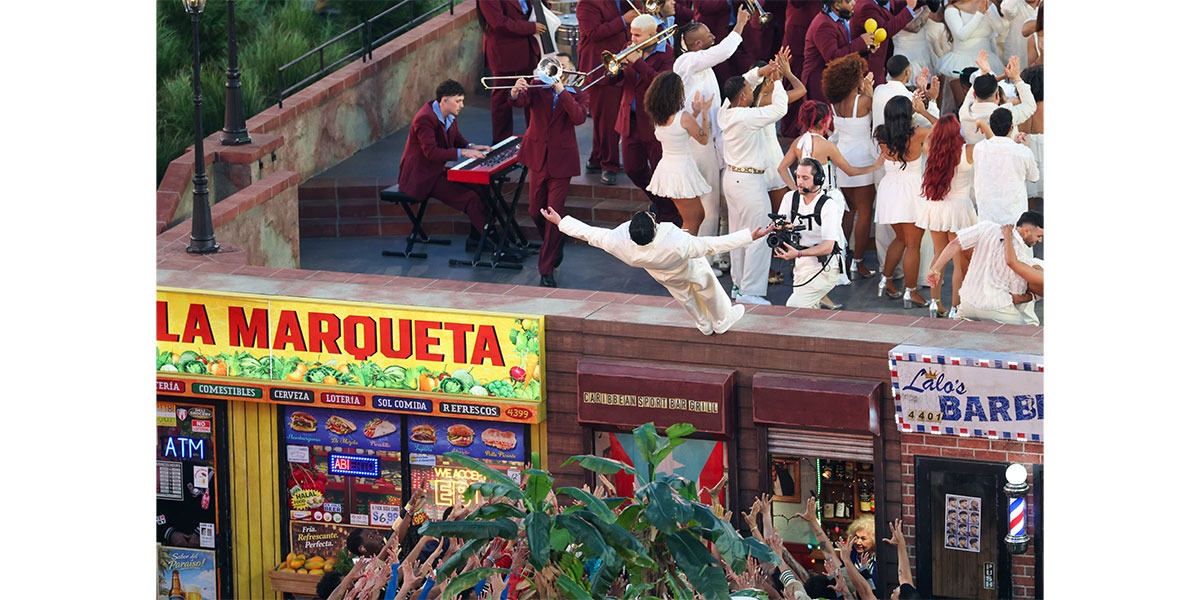
“For the GRAMMYs, we wanted to create something warm, intimate and sophisticated – moving away from a traditional awards-show environment and creating more of a beautifully designed room. For the Super Bowl, the design was rooted in Bad Bunny’s world and Puerto Rican culture. We created a series of recognisable, layered environments rather than one monumental piece of scenery, making it feel authentic while still reading at the scale of the stadium.”
How did you achieve the overall look of the show?
“It always begins with the story. From there we research, sketch, develop the architecture and then work very closely with lighting, video, staging and production to bring everything together. The details are incredibly important too – materials, finishes, furniture, plants and lighting are ultimately what make an environment feel real.”
What are some of the biggest challenges you and the team faced?
“Scale and time are always the biggest challenges. With the Super Bowl in particular, you’re creating an enormous world that has to appear, perform perfectly and disappear again in minutes.”
Do you have a standout moment from these projects?
“The highlight is always that moment in rehearsals when the performers, lighting, cameras and scenery finally come together and something you’ve been looking at on a screen for months suddenly becomes alive.”
Has the world of stage design transformed in recent years?
“Audiences are much more visually sophisticated now, so there’s an expectation to see something they haven’t seen before. I also think we’re moving away from technology simply for technology’s sake – a giant LED screen alone isn’t necessarily exciting anymore. People respond to ideas, storytelling, physicality and detail. And now we’re designing simultaneously for the person in the venue, the television audience and someone watching a ten-second clip on their phone.”
How does it feel to be recognised for your work through the two Emmy nominations?
“It’s incredibly meaningful, especially because these shows are such enormous collaborative efforts. I’m very proud of the Yellow Studio team and all the work that happens behind the scenes. To have two very different projects recognised in the same year makes it particularly special.”
What’s next for Yellow Studio?
“Hopefully more of the unexpected. We never want to know exactly what the next project is going to look like – that’s what keeps it interesting. Bigger worlds, new challenges, good people, and ideally a few surprises along the way.”

