
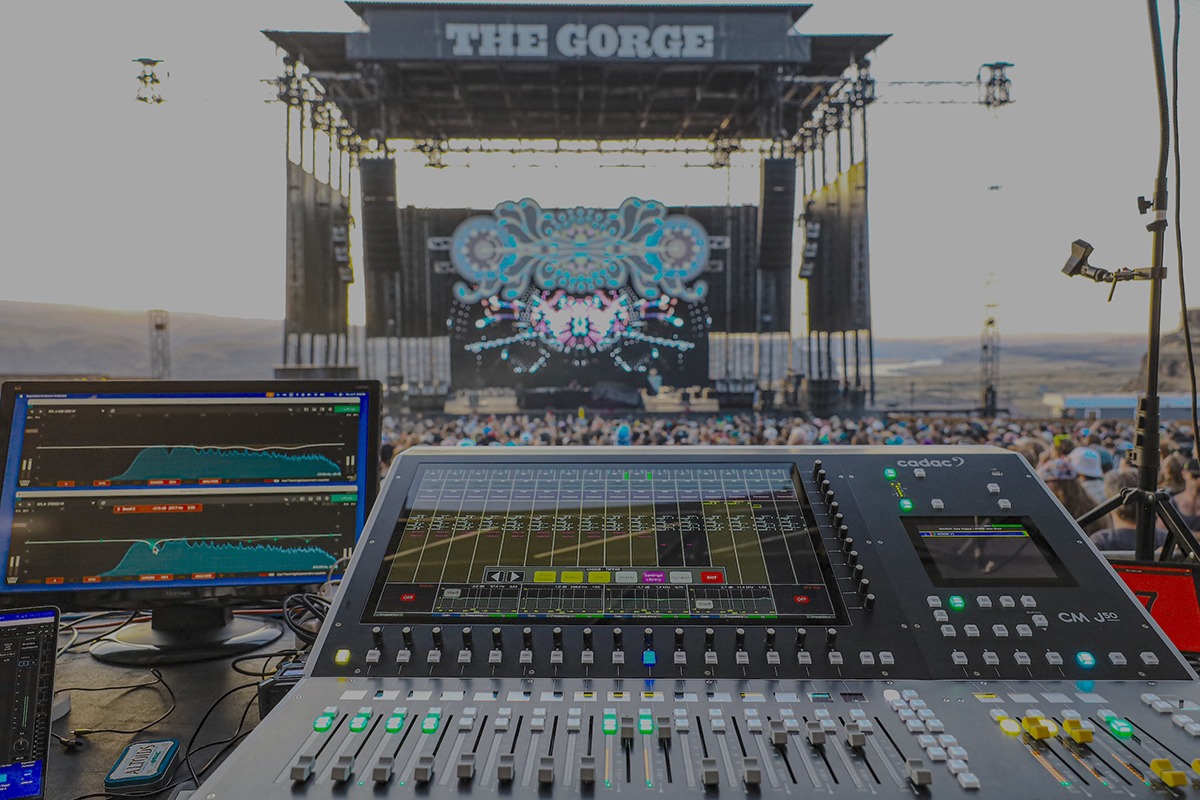
What challenges did you face bringing the CM-Series to the market?
“The biggest challenge was ensuring that scalability and flexibility never compromised what matters most to Cadac: sound quality and latency performance. The decision to standardise on fibre was central to solving that. Coaxial infrastructure starts presenting real problems at around 150m, and that is a limitation for the distributed deployments modern productions demand. Fibre gives us the headroom to run MegaCOMMS up to 2km while keeping the signal path clean and the system behaviour consistent. The goal was never simply to move audio over longer distances. It was to make the system behave identically from analogue input to analogue output. Latency was where a huge amount of the development work went. We are technically at around 0.37ms, but we standardised on 0.4ms to ensure that figure holds true even when the CM-RT12 router and extended fibre infrastructure are in the chain. Maintaining deterministic behaviour across the network, routing stability, and zero impact on operational responsiveness as the system scales was as important as the headline number.”
How does this routing infrastructure change how audio networks can be deployed?
“It’s not just distance, the CM-RT12 connects to 12 MegaCOMMS devices simultaneously with 3,072 channels of routing capacity, which means consoles, stage racks and I/O can be placed wherever they are operationally most useful rather than wherever the cabling allows. The whole CM ecosystem becomes one connected system you can design around the production, not around the infrastructure. Dynamic routing at the scene level changes how networks are managed during a show too. Inputs and outputs can be reassigned scene by scene from a large pool of physical connections, and gain compensation between multiple consoles sharing the same network is handled automatically within the system. The CM-RT12 also has its own local control interface, and the headphone output on the front panel lets engineers monitor and verify the network directly at the rack, independently of the console. When you are setting up a distributed system across a large venue, being able to verify the network locally at the router is a practical advantage.”
How did users influence the remote capability of the CM ecosystem?
“Engineers are central to how this was developed. What we now have is a coherent suite of three applications covering the full system: CM-Remote for iPad control of the console; CM-Rack for wireless control of the SR-Series stage racks; and CM-Monitor to enable performers manage their own in-ear mixes in real time. The CM-Rack App provides engineers with wireless control of the rack: mic preamp gain, 48V phantom power, AES3 configuration, mutes, and signal presence monitoring. It also opens up a different way of deploying the system. Pair an SR-Series rack with either a MegaCOMMS to Dante or MADI bridge, add the CM-Rack App, and you have a compact, standalone recording front end with no console required. For any application where the priority is getting exceptional mic preamp quality directly into a DAW with minimal infrastructure, it’s a compelling and cost-effective solution.”
Why is it important to ensure the CM-Series remains intuitive and accessible?
“Live environments leave little time for overthinking or second guessing. Engineers with just 20 minutes available were able to get to grips with an unfamiliar console and leave the gig loving the experience. That kind of validation matters more to us than any spec sheet comparison. The CM-Series was designed around the idea that you should not need extensive training to achieve results quickly. The workflow remains analogue in philosophy. We wanted to offer significant depth when engineers want to go further. The challenge was ensuring that the additional networking, feature sets, and integration capabilities never became intimidating or slowed people down. There is no point creating advanced technology if it becomes difficult to access under pressure. The engineer should remain focussed on the mix and the production rather than the infrastructure.”
What advantages does the CM-Series network offer inventory owners?
“The biggest advantage is adaptability. The CM-Series architecture allows inventory owners to scale, distribute resources and support a wider range of deployment scenarios from the same core ecosystem. Standardising MegaCOMMS on fibre is a long-term infrastructure commitment that underpins that. It is light, reliable over distance, and the CM-RT12 allows the ecosystem to scale from a compact touring system to a large-format multi-console installation without any loss in performance. The SR-Series stage racks can also be deployed as standalone premium front ends within Dante or MADI networks, entirely independent of a CM console. From a practical inventory management perspective, the CM-Series has been designed with serviceability in mind. I/O cards and PSUs are shared across both the consoles and stage racks, which significantly simplifies spares holding. The hardware has been designed for quick and straightforward servicing, and software updates have been made as painless as possible. When you are managing equipment across multiple productions, that kind of operational simplicity reduces inventory, training, time and costs. Software-driven expansion is increasingly important. The ability to add functionality, routing capability and control options, without replacing core hardware, helps protect long-term investment. With our production now in the UK, close to our engineering team, we have control over the supply chain and can respond quickly to user requirements; something that is worth factoring in alongside the performance.”
Words: James Godbehear and Emily Watson
Photo: Cadac

