
When Oasis announced their long-awaited return on 27 August 2024, the news instantly struck an emotional chord with live music fans worldwide. As tickets vanished swiftly and speculation swirled around support acts and production details, a dedicated team of touring professionals, creatives, and rental specialists were quietly assembling behind the scenes. Their mission: to deliver a production that not only exceeds expectations but is, above all, ‘biblical’.
In response to overwhelming demand, Oasis added extra dates across the UK and Ireland before heading to North America, Australia, South America, and Asia. Support acts included Cast, Richard Ashcroft, Cage the Elephant, and Ball Park Music, with experienced Production Manager, Tony Gittins orchestrating the complex logistics.
He brought together some of the touring industry’s best; Paul Normandale (show design), Star Live (staging), Lite Alternative (lighting), Urban Audio (audio control and monitors), Britannia Row Productions (PA), Universal Pixels (video), TAIT (set design), I’m Your Boss and Shop (video content), Production Park – The Mill (band rehearsals), Popcorn Catering, Vanguardia (noise management), and others.
As one of the unlucky thousands who missed out on tickets – and having last heard Oasis echo through the bedroom walls of my childhood home during their 2009 Heaton Park show – finally stepping onto that field some 16 years later, not as a punter but a roving reporter, felt like a moment of poetic justice. Sentimentality aside, it quickly became apparent, speaking to the crew, that not only was this a gig of cultural significance – with the eyes of the world watching on eagerly – but one which required steady hands, cross-departmental collaboration and innovation.
To set the stage, Star Live Account Director Pete Holdich coordinated closely with promoters and the production team during the advance stage of the production, liaising with site leads to manage the Ultra Stage System’s delivery in Manchester, Edinburgh, and Dublin.
Star Live enlisted its in-house design team, including Technical Director Roger Barrett, Design Director Andy Grantham, and Structural Engineer Pierre Gendreau. They worked in close collaboration with on-site Project Managers Ryan Robinson and Fraser Muir, alongside the touring production team.
“A full-scale test build ahead of the first show prompted several detailed changes that hugely improved the final result,” Holdich explained, speaking to TPi following the success of the opening shows. “From the outset, the overarching requirement was that the show had to look and sound exceptional.”
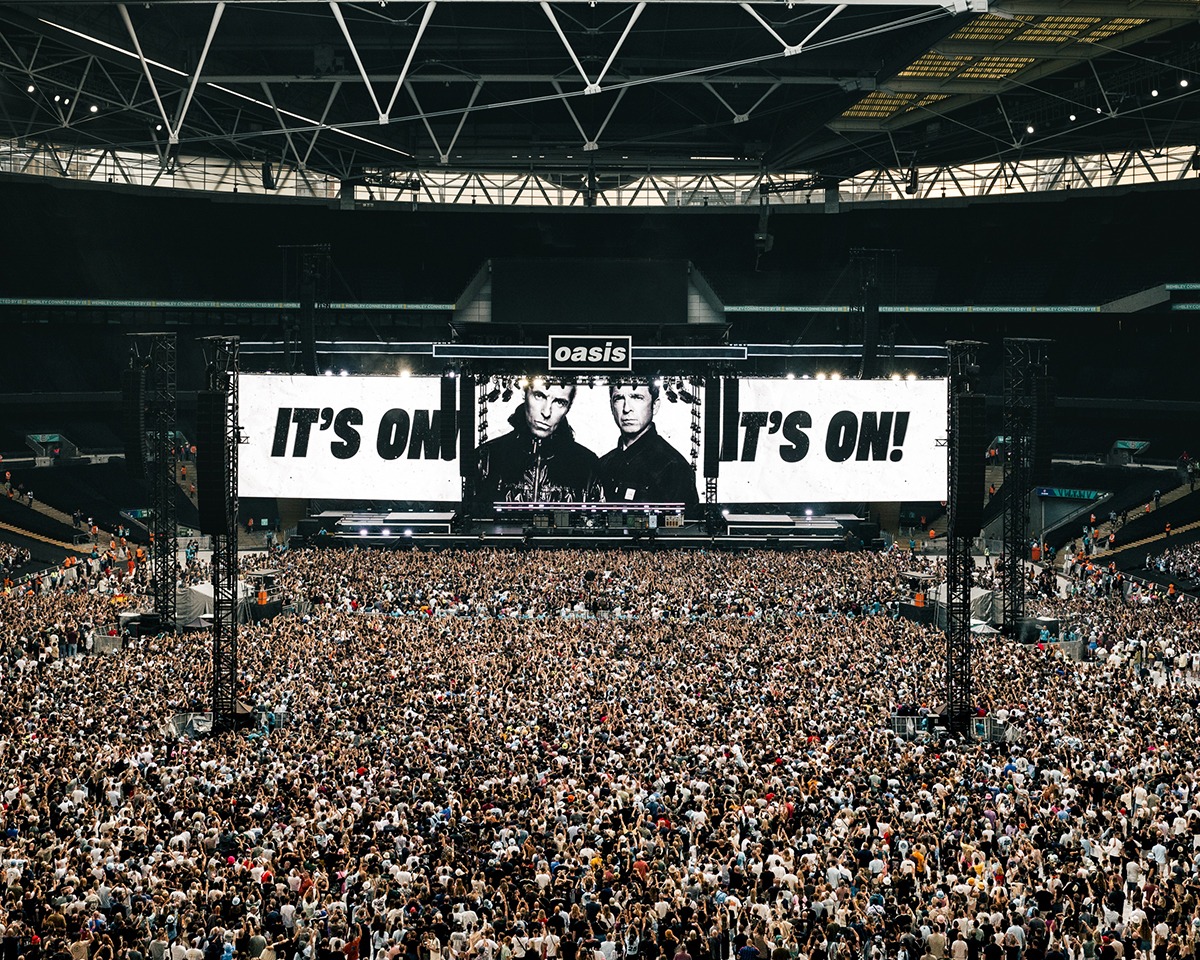
Show Designer Paul Normandale came up with the concept. The PA system came first, quickly revealing that the planned video screen wasn’t wide enough for the intended visual content. “Expanding the screen’s width seemed impossible without blocking vehicle access and audience egress routes – especially at Wembley and Murrayfield – where tickets were already sold out. This challenge led directly to the development of a wing cantilever system, extending the screens by 9m on either side of the supporting towers,” Holdich explained.
The audio system also needed to be positioned as far downstage as possible, with flown subs and main hangs arranged side by side. Combined with lighting requirements and the eventual addition of a ‘vanish’ horizontal screen above the stage, this drove the design of an 11m cantilevered roof structure. “This solution not only supported more than 27 tonnes of hardware but also incorporated a canopy for weather protection,” Holdich stated.
Further innovations included an all-new active back wall system, which Holdich points out is “faster and safer” to rig, and in-floor tech areas – also known as the ‘bunkers’ – featuring wide-open clear space and rolling roofs. Tour Rigger James Heath, who began his career with Star, helped bring the complex design together with expert precision.
Working alongside the wider Star Live team, a meticulous on-site approach helped realise the combination of triple cantilevered solutions and swept-back wings created optimal sightlines, allowing promoters to release seats across a 200° viewing angle. Holdich elaborated: “With the main audio hangs positioned 11m downstage of the first roof support and intermediate audio hangs rigged at 28m to clear the video screens, audiences experienced impeccable sound and exceptional views from every location.”
With the system proven and the early shows complete, focus turned to the logistics of taking it on the road. “Given the need for two identical stage systems but only six installs across 19 shows, Star Live made an early decision to assign one team, led by Ryan Robinson, to handle every installation, while another team, led by Fraser Muir, managed all show standbys and load-outs. In addition to the two-stage systems, Star Live transported six trucks of equipment to every show.”
Working closely with WS Transport, we developed a logistics plan that kept the production moving seamlessly across multiple cities,” Holdich explained. “But the real story is how the project drove innovation – from the structural design to the modular efficiency of our Ultra Stage System. Oasis gave us the opportunity to push the boundaries of what a touring stage can achieve: faster, stronger, and more adaptable than anything we’ve delivered before.”
The set pieces dressing the stage were supplied by TAIT’s Wakefield office. TAIT provided the main set elements, including the iconic Oasis sign, band risers, and printed masking drapes covering the top truss and masking the main stage and bunkers. Marley flooring was used on the main stage, with custom-printed marley added atop the bunkers and pedal board covers for extra waterproofing.
From concept to delivery, the set design was a true team effort across multiple departments at TAIT. Initial inquiries typically land on Adam ‘Bullet’ Bettley’s desk for evaluation before being handed to Project Manager Holly Saul. “It all started in design with our team – Mark, Richard and Andrew – working alongside Emily and Chris in procurement; Leroy, Joel, and Sean leading machining and fabrication; Julian and our paint team; Jonny in integration; and not forgetting Olivia, our seamstress. This is only a small portion of the larger team – in total, over 30 people across the business contributed to making this a reality,” Bullet explained.
“It’s been an honour to work on this project with the entire team,” he added. “We really appreciated being part of such a momentous occasion in the lead-up to opening night. It was exciting from start to finish, and now our work has been seen by audiences all over the world!”
Read the full story below…
Words: Jacob Waite
Photos: Harriet T K Bols, Star Live, Joshua Halling, Big Brother Recordings, TPi and Celestial

