
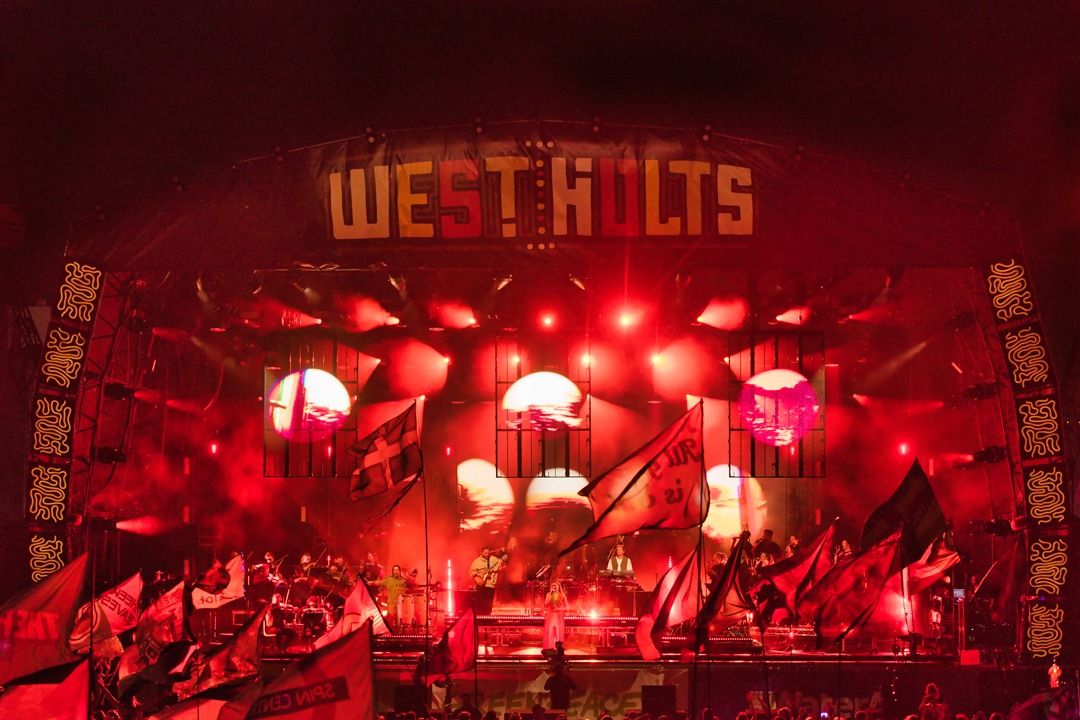
A familiar name to readers, Lighting Designer Elliot Baines of Spiral is no stranger to Glastonbury Festival. Aged just 10, he was already busking shows at Worthy Farm. Fast forward to 2025, and the creative speaks to TPi’s Jacob Waite to reflect on his latest Glasto milestone – designing the lighting for electronic music duo, Maribou State’s headline set on the festival’s third-largest stage. This project was realised in collaboration with creative directors Unlimited Dream Company (UDC), lighting supplier Liteup, video vendor iMAG, and West Holts stage supplier DPL Production Lighting.
What was your role on this project?
“For shows we design, we often work with Lite Up due to our excellent relationship with them and the fantastic support they provide. They’d recently started working with Maribou State and creative directors and content creators UDC, who we also have a great relationship with. I was initially contracted to operate the show around Europe using house rigs. Once I came on board, the band and the creative team asked if I’d like to design the Glastonbury set, which I immediately accepted. Funnily enough, we all share the same business advisor, Martin Lockett – it felt like he was the ringleader of this circus, which was cool. Our first show ahead of Glastonbury was a warm-up in Cardiff with the full ensemble – orchestra, choir, brass and woodwind section, and guest vocalists.”
How was the creative vision for the show developed?
“Working with the band and the wider creative team was brilliant – it’s such a collaborative, creative process. The visuals provided a timeline and colour scheme across the show. It begins with the track Turnmills – a high-energy opener in a dirty white palette, teasing the ground lighting package. Nervous Ticks follows with a slower tempo and an orange-peach warmth. Glasshouses is relaxed and darker, before transitioning into Vale, which then evolves into a dance section featuring teal, CTB, and brighter CTO hues. We revert to peach during Dance on the World. The final dance track is a montage, where the band performs in near-total darkness with backlighting and sweeping audience beams. It’s a visual journey told through colour, light, and movement.”
Which software and tools did you rely on for previsualisation?
“I use Vectorworks for drafting, then export into Syncronorm Depence for renders and previsualisation. They work seamlessly together – particularly when designing with house rigs in mind. We imported the DWG of the West Holts Stage into Vectorworks to ensure our design worked around the trim heights, as we included lighting towers and automated screens.”
Walk us through the rig…
“The ground package featured GLP X4 Bar 20s along the risers and downstage edge to create a soft outline and connect visually to the lighting towers. We also had Martin Professional MAC Viper XIPs – an incredible, punchy fixture I’ve wanted to use for a while – providing side and backlight. On the towers and floor, we had SGM Q8s – extremely bright, great for TV balance and eye candy. We used Robe TetraXs on the towers, aligned to the X4s, to maintain the show’s curved, cyclone-style aesthetic instead of straight lines. For Terminals, we created a vintage camera reel-inspired intro using the TetraX’s flower chip as a surprise effect. In the air, we used Claypaky Mini Xtylos HPEs. The video screens measured 2m by 3m, with three on automation, plus back and front walls. Lighting towers stood at 6m. Everything was programmed and operated on a grandMA3 console – the software makes transferring pre-existing files seamless.”
How did the lighting and video elements interplay?
“The album cover for Hallucinate in Love features two people embracing with cars rushing by. For the track Bloom, video content depicted cars swooping past, and we matched this using Robe TetraXs and GLP X4s to give the impression the lighting was extending the visuals. For Turnmills, UDC created a spinning wheel animation, with floods sweeping side to side in sync. That said, we didn’t always match visuals and lighting – to keep it dynamic. On Veil, we had teal lighting and Mini Xtylos HPE beams shooting down above the band, contrasting the blue CTB visual content. It made for some striking combinations.”
What was it like collaborating with the Glastonbury crew?
“DPL Production Lighting were incredibly supportive. The production was ambitious – we had a 45-minute changeover to install six 3m lighting towers, three automated video screens, and a large lighting package. DPL were great, letting us pre-rig components overnight. Their house rig was solid too – the vertically oriented ACME PIXEL LINE IPs on the IMAG screens complemented our lighting towers perfectly. It’s genuinely been a dream of mine to operate a show on one of the festival’s main stages. I started on small stages as a kid, playing with older rigs – and now I’ve designed a headline set on one of Glastonbury’s biggest stages!”
Why is Lite Up such a good fit for Spiral?
“Lite Up have always supported our projects – our relationship is fantastic. Alongside sharing a financial advisor, they even store some of our lighting consoles. The crew are brilliant – totally on it. They always go above and beyond to deliver our creative vision, whether it’s account handlers or on-site technicians. They help bring our ideas to life or find clever workarounds.”
Do you have any favourite looks?
“There are a few. The downward beams above the band during Veil, and the sweeping lights during Rituals, were standout moments. As a company, we ensure every song has a distinct look and colour to avoid repetition. We aimed for a theatrical journey – warm and cool moments, dynamic brightness shifts in line with the music and orchestration. We used MAC Viper XIPs to backlight Maribou State’s Chris Davids and Liam Ivory and Guest Vocalist, Talulah Ruby and the choir during key passages. At the end of Glasshouses, they were subtly backlit with just 10% key light – a slow fade left Talula and Liam at the keys with a dim glow, while the choir remained faintly visible. It was a powerful moment that told a story through restraint.”
What’s next for you?
“We’ve just completed a Canadian tour, including some special installation projects. We’re also developing creative concepts for several corporate and experiential projects, plus new artist collaborations for the remainder of the year and into the next.”
View this post on Instagram
CREDITS
Maribou State // Chris Davids and Liam Ivory
Guest Vocalist // Talulah Ruby
Lighting Design // Elliot Baines, Spiral
Tour Manager // Andy Bernstein
Production Manager // Russell Cobden
Creative Director & Content // Universal Dream Company
FOH Engineer // Lance Reynolds
Monitor Engineer // James Kedge
Backline // Sara Ferrero, James Sharpe
Playback // Echo Era Audio
Audio Tech // Eliot Varga
LX Vendor // Lite Up
Video Vendor // iMAG Displays
House LX Vendor // DPL Production Lighting

