
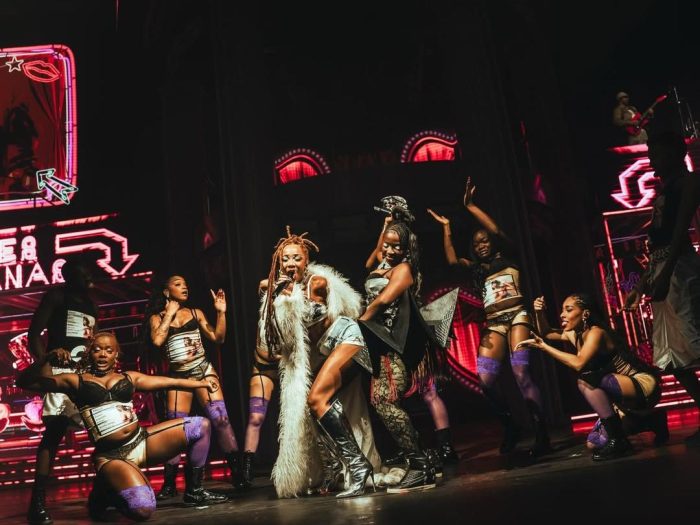
When French-Congolese singer Theodora took her Free Kitty Tour to 12 arenas across France and Belgium in spring 2026, it marked her first large-scale Zénith-level production. The tour, supporting her four Victoires de la Musique Awards with her latest album Méga BBL, sold out multiple dates and drew on a highly theatrical visual concept built around a pink house set in which video screens formed the walls, surfaces and centrepiece of every scene.
Managing the video system for the entire run was Célestin Soum, founder of Saturn Studio, who operated SMODE in a dual capacity that had him running media server output and live directing the show simultaneously.
Soum was brought into the project by Jordan Magnée, the Belgian stage, video and light designer responsible for the overall visual concept of the tour. The two had worked together on a production for French rapper Ninho. Content for the Free Kitty show was created by Mathematic Studio, with Laetitia Le Gall coordinating between Soum and the graphic artists producing the visual assets. “Managing both aspects simultaneously using SMODE was a genuinely stimulating challenge”, said Soum.
The visual rig centred on a cohesive suite of LED panels (courtesy of Alabama Média), was designed to ensure visual uniformity across the set. “Since all the elements were placed directly adjacent to one another, it was essential to minimise any variation between surfaces,” stated Soum.
At the centre of the stage, the LED tower comprised a single motorised back LED screen measuring 6.5m high x 3.5m wide, which was motorised to allow set dressing to pass through. The tower was flanked by four curved LED screens, each measuring 2.5m by 2.5m. The assembly was topped by a 10m long by 1m high half-ring LED screen. To either side of the central tower stood two further LED structures recreating shops, each made of a 5m by 2.5m front screen with two further side LED screens topped by 5m long x 1m high LED strips.
Completing the visual setup was an IMAG LED screen (5.5m by 3.5m), positioned to the rear left of the stage, visually echoing the look of an urban advertising billboard. All LED panels, together with two X-REAL media server bays running SMODE, were supplied by Alabama Média (Groupe Novelty).
SMODE handled the primary output to all LED screens and simultaneously served as a show viewer for Soum’s live direction. Two confidence feeds, which were distributed across approximately ten screens positioned around the stage and in backstage areas, gave Soum real-time information on the state of the show as it unfolded.
“This proved invaluable for keeping track of real-time information during shows that ran over two hours,” said Soum, “including the next track, the positions of the various performers, the timecode, and the return feeds from the nine cameras available in the video mixer.” A source switch built into SMODE managed what information appeared on each screen. An NDI feed was also distributed across the network to the lighting department, allowing them to pixel-map the media content into their lighting rig in real time.
Rather than importing pre-finished content, Célestin Soum assembled and edited all media within SMODE itself. “This approach offers complete flexibility, as it’s common for the music, structure and musical sequences to evolve throughout the residency and tour. As a result, I value being able to rework the media build at any point,” said Soum. On the Free Kitty Tour, that flexibility proved its worth in practice. When one song was performed accapella, Soum was able to simplify the corresponding video edit on the fly without requesting new content from Mathematic Studio.
BPM synchronisation across the show was handled using SMODE’s tempo tool, which locked the video loops to the tempo of each track. “I make frequent use of that tool to sync the various media elements, typically video loops, to the BPM of each track,” said Soum. Working to a shared methodology with Mathematic Studio, all video content was produced in durations of four, eight or sixteen seconds. At the correct BPM, each second aligned with one musical beat, allowing the visual structure to follow the arrangement of every track precisely.
“The ability to composite and edit media on a timeline is one of the software’s key strengths,” said Soum, “and the precise processing of live feeds displayed on the IMAG screen is another major advantage.” He spent significant time during the tour refining the colour treatment applied to those live camera feeds, working with a set of cinematic LUTs developed in collaboration with a cinema colourist. The aim was to present Theodora in the most flattering light possible while maintaining a subtle and consistent visual tone across the full show.
One of the most technically involved elements of the production was the creation of the house scenography visuals. To ensure the set appeared as realistically lit and spatially coherent as possible in the video content, Soum built a full 3D model of the scenography from the manufacturer’s technical drawings. After, Mathematic Studio’s graphic artists rendered the content from each of the camera positions placed in the scene, producing four separate render files per pass. Then, a dedicated SMODE project was developed to recompose those renders as 2D video via a content map and 3D mapper. The process, coordinated by Laetitia Le Gall, allowed the house to take on a distinct visual identity for each song in the show.
“Given that the set is built around video screens, video was essential to making this whole production pop,” said Soum. “Although the shape of the scenography and screens takes the form of a house, a great deal of work went into the media to translate that house into a distinct visual for each song. It was hugely important, so much so that there isn’t a single track on the show where the screens are off.” The entire rig was driven by a single SMODE instance running on a machine fitted with an NVIDIA RTX A6000 ADA graphics card with 48 GB of VRAM, backed by a spare instance, handling the full show from LED output to confidence feeds to NDI distribution.
“This is quite a different project for me, as I covered two roles, both the SMODE operator and live director,” said Soum. “SMODE genuinely allowed me to bring a degree of manageability to work that might otherwise have been simply impossible for a single person.”
With the tour dates complete, Theodora and SMODE continue to bring the production’s energy elsewhere. Theodora opened the 2026 Cannes Film Festival alongside Oklou, performing a Beatles cover with SMODE used as the media server for the ceremony.
Now, with the festival circuit just around the corner, Soum said: “I’m looking forward to hitting festivals with this project. It’ll be a great adventure to face those new challenges with the new setup.”

