
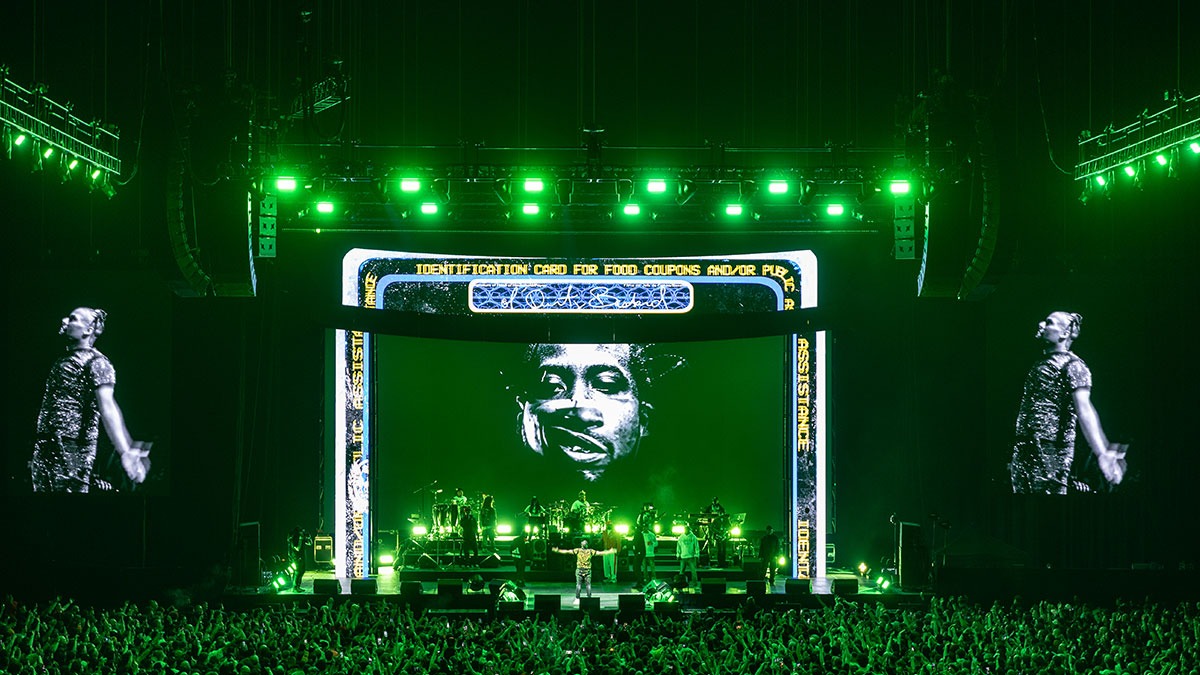
Wu-Tang Clan brought The Final Chamber European tour to arenas across the continent this year, with lighting, video and rigging supplied by PRG from its Longbridge base in Birmingham. Billed as the group’s final European run, the tour carries the weight of more than three decades of influence — a body of work built by RZA, GZA, Method Man, Raekwon, Ghostface Killah, Inspectah Deck, U-God and Masta Killa that reshaped hip hop’s sonic and cultural landscape.
Against that backdrop, Tour and Creative Director Jen Bui, lighting designer Ben Walton and Principal designer Jack Cannon faced a significant challenge: honouring a legacy of that scale while delivering a show that could hold its own in the largest arenas in Europe.
With PRG delivering integrated lighting and video, the production combined striking visual architecture with cutting-edge LED technology, ensuring The Final Chamber translated effectively across a wide range of European arena venues. Drawing on themes closely tied to Wu-Tang Clan’s identity, the video design leans into a strong samurai aesthetic, with visuals rooted in classic Japanese architecture. Rich gold tones and structured framing create a striking, almost ceremonial look on stage.
At the centre of this is a gate-style video structure designed to frame the performers in a way reminiscent of traditional Japanese forms. A large header with fascia and two L-shaped Titan columns surround the upstage screen, giving the stage a defined architectural presence that reinforces the visual world of the show.
The tour also marked the first outing for PRG’s ROE Vanish V4ST LED screen — a product whose practical advantages proved just as significant as its visual ones. In a touring environment where load-in time is currency, the speed and flexibility of a new system can make or break a production schedule.
Video HOD Steve Jones, who has worked extensively with PRG across major touring and live event projects, explained that the new technology made a material difference to how the set could be constructed. “The mechanics of it have been excellent,” Jones said. “It goes together quickly, and the angle options are really good, which meant we could build the curved upstage wall without needing to hang it from truss.”
That upstage wall is a key visual canvas, measuring approximately 18m wide by 9m high and curved to add depth and dimension to the stage. Two IMAG screens sit either side, each measuring approximately 5m wide by 7m high, delivering camera-led content throughout the show.
“The IMAG is all live camera footage, with D3 effects layered in to keep it from feeling flat — it gives the screens a texture and energy that straight IMAG wouldn’t have,” Jones noted. “The real Notch work created by Dark Matter, though, is on the upstage curved wall — that’s where the Wu Tang world really comes to life.”
The header spans 14 full frames wide, incorporating a mix of vertical and horizontal half tiles to achieve the required shape while maintaining the clean architectural lines of the design. Behind the scenes, the system is driven by Brompton processing, with six Tessera SX40 processors — five active and one spare — distributing data across 12 SD boxes.
“It’s a data-heavy system,” Jones added. “The pixel pitch means you need a higher level of port allocation, and with full redundancy built in, the data load is significant. But we’ve had no drops at all — it’s been rock solid throughout.”
Jones credited that consistency to both the quality of the technology and the discipline of the team maintaining it. “Everything’s been built cleanly and kept as neat as possible. When a system is this complex, attention to detail day to day makes a real difference to reliability on the road.”
The lighting design was created by Ben Walton, co-founder of LA-based creative production company GT PRO and one of the most versatile designers working at the intersection of hip hop and large-format live production.
With more than 17 years in the live event industry, Walton has managed arena tours for artists including A$AP Rocky, Pharrell and Anderson .Paak. Wu-Tang Clan’s Final Chamber was among his most ambitious shows to date, requiring a design flexible enough to support a setlist that shifted nightly across some of Europe’s largest venues.
Delivering that design on the road is Jack Cannon, a Los Angeles-based lighting director and programmer whose background spans concert touring, broadcast and corporate entertainment. Cannon’s approach to live performance is built on emotional pacing as much as visual impact— a sensibility he has brought to tours including Reneé Rapp’s Australian run, where his work drew particular attention for its instinctive, reactive quality. On The Final Chamber, that instinct was essential from the first show.
“We’re a fully busked show,” Cannon explained. “Everything is run live with no timecode, apart from two songs and the intro. We needed something that could adapt instantly.”
Across the first run, the show pulled from around 70 songs over 30 dates, with changes often happening at short notice. The rig had to be ready to respond to tracks the team hadn’t prepared for, an environment that suits Cannon’s reputation for fast, instinctive programming.
Built around 130 fixtures, the system combines GLP X5 Bars, JDC Burst 1s, Vari-Lite VL3600s and Robe iForte fixtures for followspot duties. The design extends beyond the stage: two truss bars flown above the audience push light deep into the arena and into upper seating levels, drawing the crowd into the visual world of the show.
On stage, two upright trusses sit either side of the video wall, giving Cannon the ability to shift between tighter, more selective looks and full walls of light that box performers in. Additional trusses above and behind the LED wall house hidden fixtures that allow light to flood the stage without revealing its source.
Followspotting is one of the most critical elements of the design. Twelve Robe iForte fixtures are controlled via Follow-Me, with six active targets at any one time.
“The big challenge is the number of performers,” Cannon explained. “We can have 11 or 12 people on stage, but only six follow targets, so it really comes down to the operators being able to pay attention and lock in.”
Control for the show is handled via grandMA3 full-size consoles, giving Cannon the speed and flexibility to react in real time across a set that never stands still. The rig’s consistent performance has been a standout — no fixture failures during a show throughout the run, with any issues resolved well before doors.
Despite many of the team having not worked together previously, the on-site dynamic has been a highlight of the run for Cannon. “Tom’s been great as Crew Chief — the rig goes up quickly every day,” he said. “The crew has been phenomenal, probably the best I’ve had in my touring career.”
With significant design changes taking place just a week and a half before the tour began, PRG’s music department also proved essential in keeping everything on track. “There were constant changes, but they handled it really well and made the whole process seamless.”
Delivering The Final Chamber across multiple European territories required close collaboration between departments, from initial prep through to arena load-ins.
At the heart of that effort were Tour and Creative Director Jen Bui and Technical Director Matt Brewer, whose coordination across the touring party kept the production running smoothly night after night.
Bui is a well-connected figure in contemporary hip hop touring and across genres, having previously worked with The Kid Laroi and Lil Baby before bringing her network and experience to Wu-Tang Clan’s final run.
Her ability to draw together the right team — from creative collaborators to technical crew — proved central to the cohesion of a production that required constant adaptation across a demanding European schedule.
Supporting Bui, PRG supplied fully integrated lighting and video solutions, ensuring consistency and impact at every stop on the tour. The scale of the production reflects the significance of the run — a show designed to honour a defining legacy while meeting the demands of modern arena touring.
PRG Director of Concert Touring, Yvonne Donnelly Smith, summed up the brief: “This run needed to feel significant. It celebrates an incredible legacy, but it also had to land with real impact in large-scale European arenas,” she added. “It’s been a pleasure to support Jen and the team to bring the design to life. The collaboration across departments and having PRG Account Manager Ian Jones supporting on the video side, allowed us to deliver technology that honoured the group’s history while presenting it in a bold, modern way.”

