
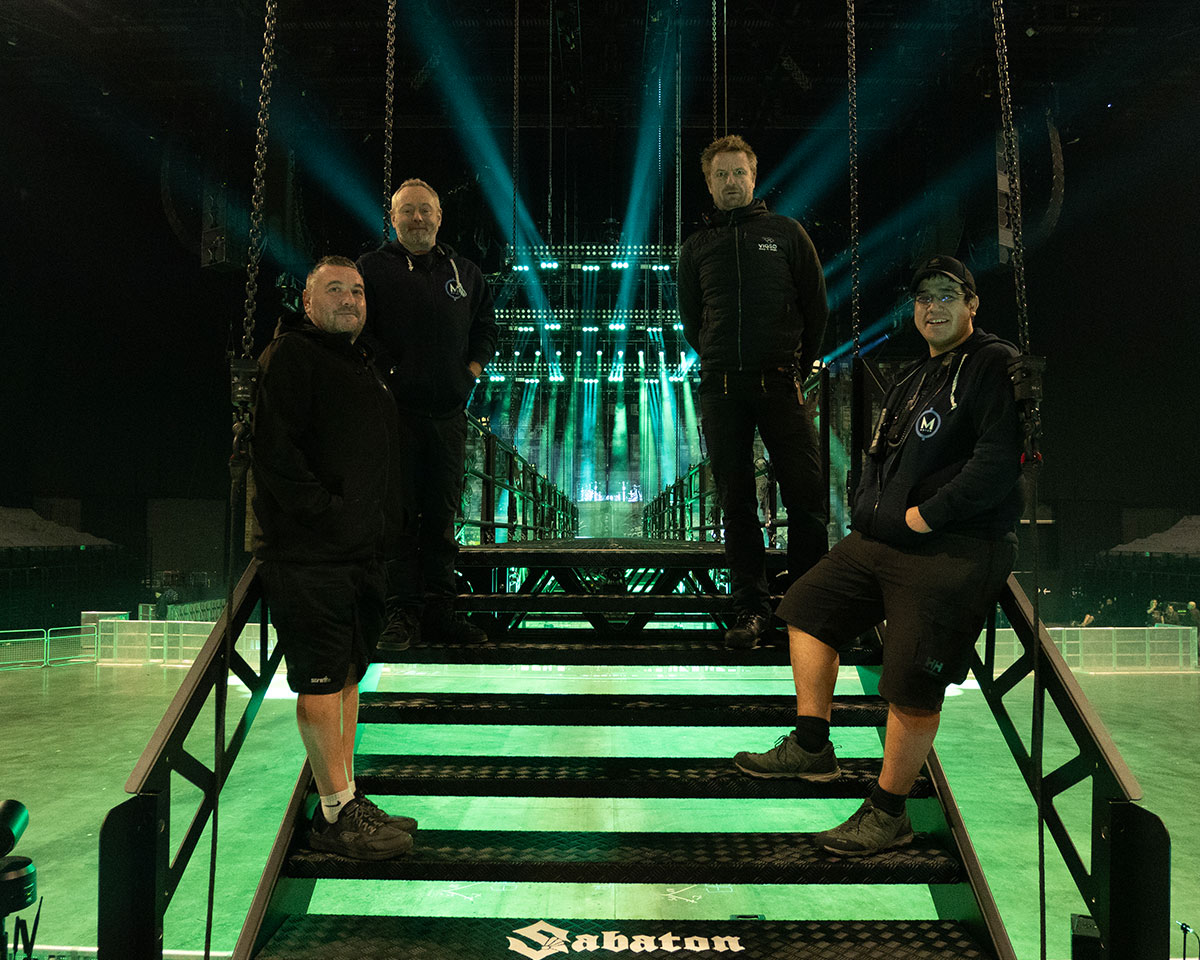
Sabaton and their 200-strong touring crew have announced themselves on the European arena circuit with a production that matches the Swedish power metal band’s reputation for theatrical, history-infused live performances. Their latest touring design features a towering castle, a support orchestra, an automated drawbridge with integrated lighting and smoke, a rising and descending drum riser encased by inflatable hands, and fire-breathing dragons – an ambitious brief which required equally ambitious engineering.
MOTOR Stage Automation, based in Denmark, began its relationship with Sabaton a year ago, flying a tank set piece during the band’s set at Sweden Rock Festival in front of 60,000 fans. Drummer Hannes Van Dahl performed inside the tank itself. “A strange request, but one we certainly rose to,” recalled Jimmy Johnson, Automation Project Manager for The Legendary Tour and Technical Sales at MOTOR Stage Automation.
Production Manager, Johan Bengs wanted a system that was quick, safe and efficient – not only to meet tight show-call demands, but to give the crew adequate rest on an intense touring schedule. The band, known for spending time among their fans, also required a stage architecture that let them physically connect with the audience. “The best way to do that was to utilise our automation solutions and integrate them fully into the show,” said Jimmy.
Central to this was MOTOR Stage’s M:CAT automated catwalk, which would become a defining element of the tour. Early conceptual meetings saw MOTOR Stage sharing Vectorworks drawings and product catalogues with the band and creative team, among them bassist, band manager and co-designer, Pär Sundström and Lighting Designer, Bertil Mark.
“The aim was to achieve their vision – the castle, the inflatable hands, the drawbridge, while guaranteeing the level of safety essential for any automated system,” Jimmy explained.
After initial prep at MOTOR Stage HQ in Horsens, Denmark, production rehearsals continued for two weeks at BBM Clair in Berlin. The design was informed by available inventory – including a 70m cable limit for floor-based drive racks, which set strict parameters for positioning the B-stage and the connection to the main stage. “This is one of the band’s largest shows to date, and their fanbase has grown accordingly. Everything needed to scale up safely,” Jimmy added.
Safety was overseen by Blumano Associates, brought in as specialist consultants. “There are a lot of ‘what if’ questions, from engineering to working at height,” Jimmy said. “If we can remove doubt for the artists, that’s when they can truly perform.”
For the drum riser, Hannes was secured in a restraint harness, with eight RCF Light Locks, some double-stacked, sub-hired from Neg Earth Lights to prevent platform drift. A deadlock system ensured the riser could not move unless Hannes was fully strapped in. Integrated lighting within the MLT4 system was installed via MOTOR Stage’s sister company Vigsø, with wiring by PRG as part of their master rig. The truss and catwalk were fully pre-rigged, supported by collaboration with HOF, who helped further develop the M:CAT system. Their dollies allowed the MLT4 elements to be sent quickly into the rig “much like you would approach with lighting,” said Jimmy.
The smooth integration of automation, rigging and lighting impressed him most: “Head Rigger Yose Lawson worked closely with UK Rigging to ensure clear paths and safe working zones. Service hoists meant we could fix issues without climbing.”
IN MOTION
As Automation Programmer and Operator, Kentaro ‘Ken’ Johnson ensured the full automation package operated seamlessly on site, as part a team of four overseeing 14 hoists on the catwalk leading to the B-stage, plus four 1250kg units on the drum riser – each hung on two separate mother grids built from MLT4 truss. One grid sat above the lighting, the other extended above the audience to the B-stage.
MOTOR Stage Automation deployed a full MOVEKET system with dual Expert desks (primary and backup) and an automation barge housing all drives and low-voltage motor control in the grid. “Load-in and load-out is straightforward,” Ken explained. “Two caddies of cables come straight out and into the roof – we’re live within half an hour of powering on. It’s a very efficient system.”
MOVEKET was chosen for its suitability over audiences and its compliance with EN 17206. “Each hoist has its own configured drive. Once set in prep, it stays consistent throughout the tour,” Ken said.
With over a decade’s rigging experience, he stressed the value of load understanding: “We’re moving a lot of weight – the drum platform is just over two tonnes with pyro and lighting; the bridge is just over five tonnes; and around eight tonnes including hoists and catwalk suspended from the mother grid.”
MOVEKET’s SIL3 rating was a key factor. “All the technology talks to each other – load monitoring, fault reporting, global E-stops, deadman switches on everything. The data feedback gives the operator real confidence,” Ken added.
Additional safety layers were built in, including an isolation switch for the drum riser. “If a spotter or drum tech isn’t happy, they can isolate the riser instantly. It cannot be controlled until it’s safe.”
Two mechanical constructs defined the show’s automation: the drum platform and the main drawbridge leading to the B-stage. The riser moved between load-in height and balcony level – Hannes mounts at the mid-position before ascending to full height, performed twice during the set. The drawbridge is the show’s signature moment, used for band entrances and audience interaction.
“It’s a very theatrical show, so actors distract the crowd during movements,” Ken said. During Attack of the Dead Men, smoke machines under the catwalk activate as the bridge lowers over the audience. “Automation becomes part of the storytelling, not just a transport mechanism.”
The 24m catwalk and 30m bridge (28m with stairs deployed) run on a combination of 1250kg and 500kg hoists.“MOVEKET treats the whole thing as one object, providing synchronised movement. If any error is detected, the entire construct stops – ideal from a safety perspective,” Ken noted.
Touring with 42 stagehands – trained during rehearsals – brought consistency to daily workflows. With 26 trucks, including three dedicated to automation (one for the catwalk alone), the tour required tight scheduling. Advanced rigging meant hoists were hung before the touring crew arrived. “We start unloading at 9am and are fully assembled by midday. Automation rolls in ahead of lighting – the catwalk has integrated wheels, so it glides straight out,” Ken added.
“MOTOR Stage is brilliant,” he continued. “With a four-person automation crew, we can rotate and rest which makes an enormous difference.” The wider automation team featured MOTOR Stage Automation Project Manager, Jimmy Johnson; Operations Manager, Daniel Klausen; Special Projects Engineer, Valdemar Enemark; Automation Crew Chief, Martin Kirch; Automation Programmers and Operators, Samuel ‘Sam’ Colclough and Kentaro ‘Ken’ Johnson as well as Automation and Performer Safety Technician, Gareth Sumnall.
Having wrapped projects with Dua Lipa in South America, Lewis Capaldi and now Sabaton, 2025 marked a landmark year for MOTOR Stage Automation. “Production managers and designers value a personal touch,” Jimmy concluded. “We’re a family-orientated company – from the office to the road. We’re excited to see the HOF MLT4 pushed to its limits. It’s fast, efficient, and made for this kind of show.”
Speaking to TPi backstage, Sabaton drummer, Hannes Van Dahl concluded: “This tour has been in the works for two years, and it takes a great deal of time to prepare and decide what we want to do. It’s been a long journey to get here but it’s been a blast – 200 people all working their asses off to deliver a truly great show. It’s a dream come true and we’re incredibly grateful for that.”
Words: Jacob Waite
Photos: TPi, Jens De Vos and Nathan Dobbelaere

