
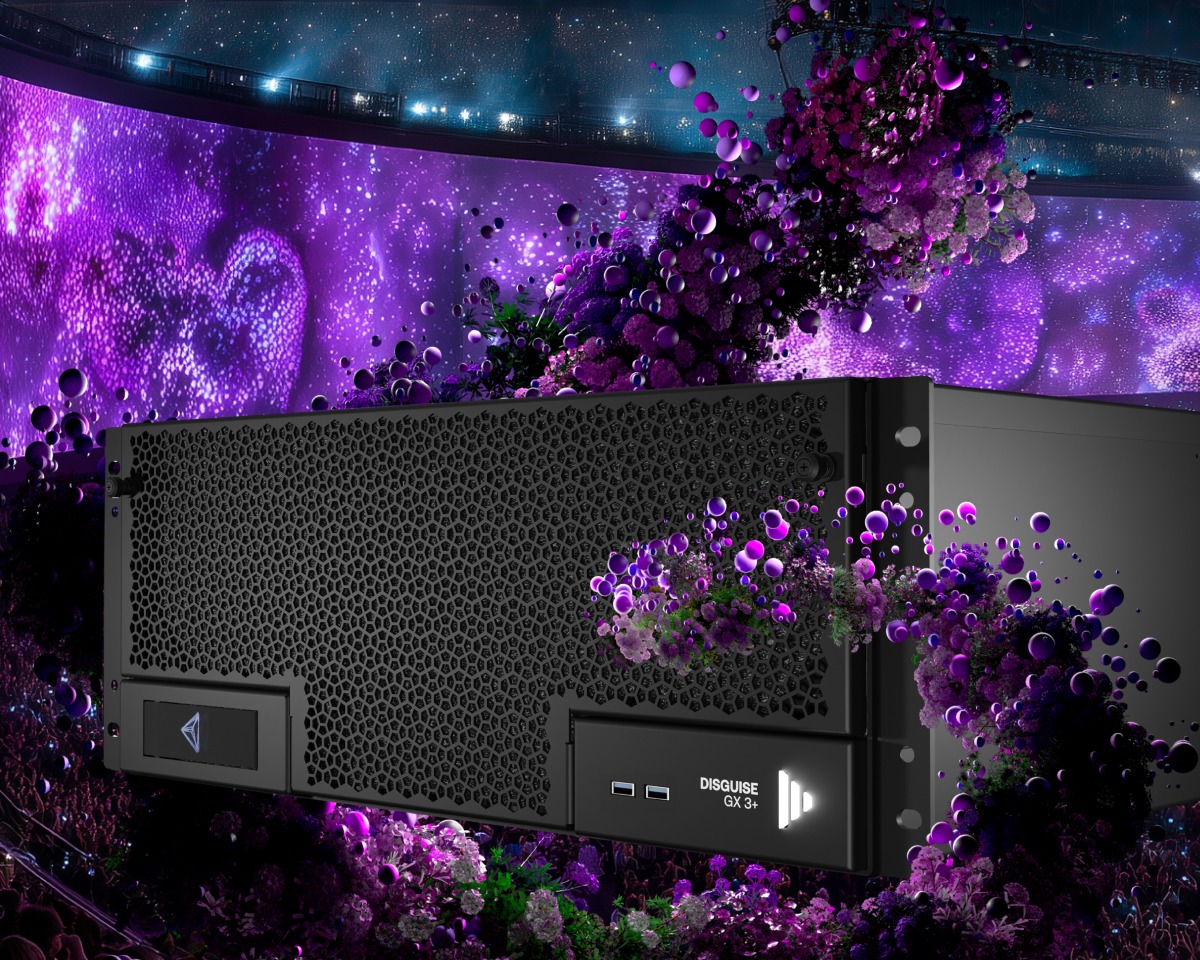
What challenges did you face bringing GX 3+ to the market?
“A challenge faced during development was working to ensure that we can guarantee the increase in power requirements for the NVIDIA Blackwell GPU architecture, which has a maximum power consumption of 600W. This has meant that we have had to validate a new power supply unit (PSU), as well as managing the increased cooling requirements. Beyond that, development has been smooth, incorporating extensive validation across GPU, CPU and motherboard types, together with rigorous environmental testing for heat, shock and drops. This level of testing goes beyond standard server requirements and ensures the GX 3+ is prepared for the demands of touring.”
From a live touring and production standpoint, what improvements does the GX 3+ deliver over its predecessors when it comes to deployment speed, system reliability, and day-to-day operational efficiency?
“The GX 3+ delivers a 175% increase in Notchmarks – a benchmarking metric in Notch that assesses key rendering techniques such as shading, procedural operations and texture sampling, and at least, 40% more video layers, enabling far more intricate projects.”
How do you see the GX 3+ elevating the creative possibilities for visual performances?
“The GX 3+ provides creators with more headroom to focus on intricate design and experimentation, without altering familiar workflows. By building on the full Disguise ecosystem of tools and features, it sets a new standard for large-scale productions, empowering set and content designers to push creative boundaries while working with the reliability they know and trust.”
What refinements or new features are included in the Designer platform?
“We’ve introduced a few new features in Designer to help teams get the most out of the GX 3+. RenderStream is our bidirectional protocol for transporting rendering information. It supports engines like Unreal Engine, Notch, TouchDesigner and Unity. One of the key advantages to RenderStream is its remote mode, which allows us to distribute the real-time rendering capabilities to a cluster of dedicated render nodes via a 25Gb or 100Gb network. The video frames are then returned from the render node cluster back to the VX or GX range media server(s) for composition and output. We have since extended its functionality with RenderStream Local, which allows rendering to run directly on the media server itself. That reduces latency by removing the need to send frames over the network, something that’s especially important for IMAG, and the GX 3+ provides the graphics headroom to take full advantage of it. We are also working on enabling full support for SMPTE ST 2110 video input into the GX 3+, as well as the other VX and GX range media servers, via their high-speed network ports. This enables video teams to increase the number of available video inputs into a Disguise media server and enables more creative possibilities for IMAG.”
How do you envision the GX 3+ influencing the next evolution of live shows?
“Audiences today expect much more from live events. They’re looking for unique experiences, the kind of moments that feel immersive, engaging and worth sharing online. For concerts and festivals, that expectation for high-quality, responsive environments is only going to increase. Younger generations have grown up surrounded by technology and experiences that already feel highly interactive and immersive. As this continues to evolve, it’s very likely their expectations will only rise. That makes it important for venues and event producers to be equipped with technology that meets today’s demands and positions them to deliver the kinds of standout experiences audiences will want in the future. The GX 3+ gives designers the power to do exactly that. Its performance means you can run complex real-time visuals, trigger effects on the fly, or synchronise content with audience and environmental inputs. That opens the door to shows that react in the moment.”
Read the full story below…

