
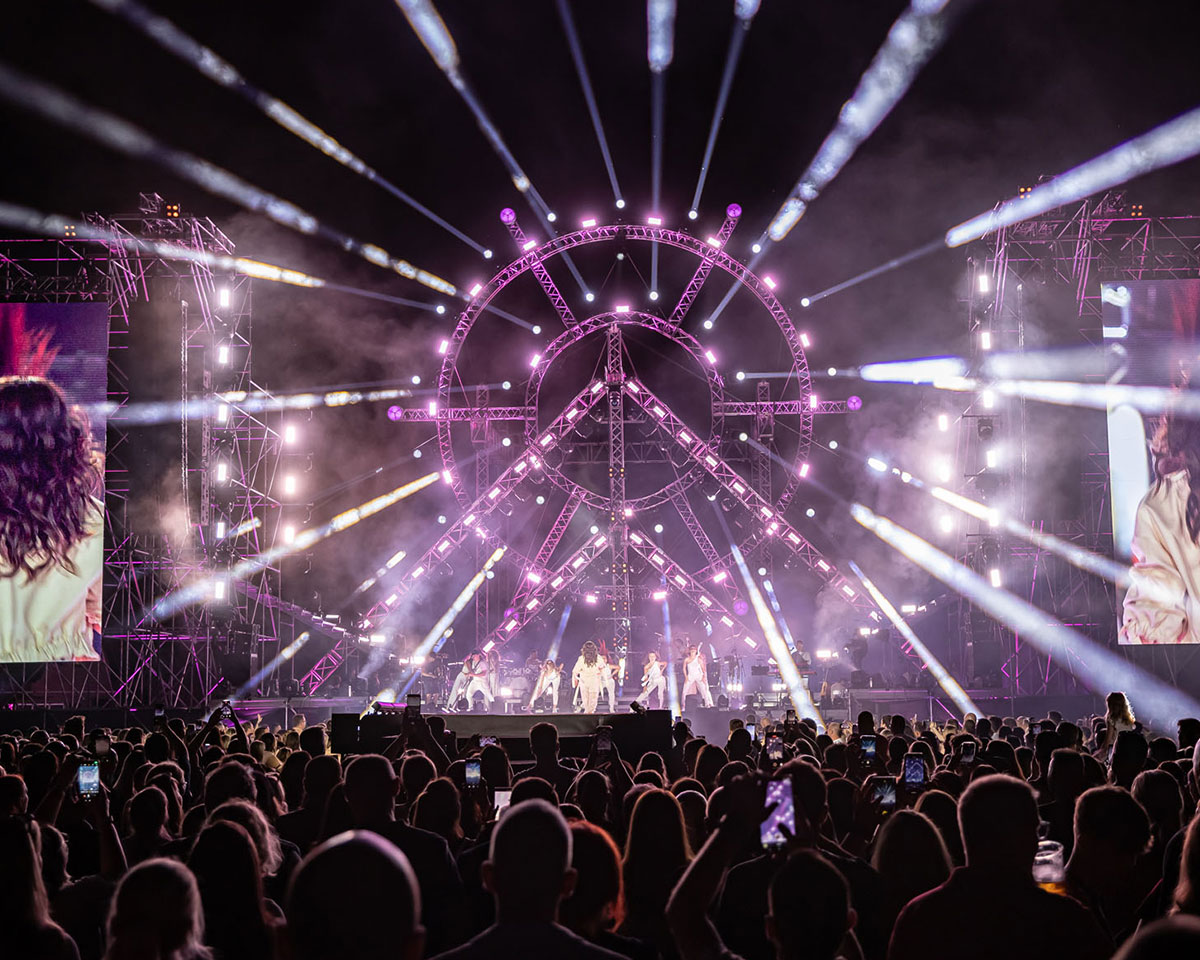
Slovenian singer Nina Pušlar rocked her picturesque hometown of Ivančna Gorica, 40 kilometres out of Ljubljana, for a homecoming concert at the football stadium, celebrating 20 years of success in the music industry.
Lighting designer Crt Birsa of design studio Blackout produced a carefully sculpted lightshow crafted for the scale and importance of the occasion, stoked with so much anticipation. He utilised nearly 200 Robe moving lights among his 500-plus fixtures to impress Nina’s friendly, loyal, and enthusiastic fanbase, which included Slovenia’s President, Nataša Pirc Musar, who sat unobtrusively in one of the VIP areas.
Birsa and his team at design studio Blackout have been working with the artist for around 15 years, looking after the lighting and visuals since her early career, which has skyrocketed in that time and given them a unique perspective and window into her professional achievements.
A major starting point for lighting this show was the venue – which had never staged anything this huge or complex before. In fact, productions of this magnitude are rarely seen in Slovenia at all! Birsa also had plenty of input from Nina herself, who wanted to create something truly spectacular!
He worked with regular collaborators set designer Greta Godnič and production manager Rok Lozar. An early suggestion was having a Ferris wheel behind the stage which could also help facilitate lighting positions.
After much discussion, with unpredictable weather in mind, this morphed into inspiring Birsa and Godnič to create the circular trussing architecture that defined the performance space, which was based around a large 12 metre diameter trussing circle giving a max height of 22 metres, with spikes connecting it to a smaller 6 metre diameter inner circle.
Two angled truss pieces either side formed triangles descending from the central point in the middle of the circle.
Two side IMAG screens were rigged to two front Layher towers flanking the stage, together with the main PA hangs, with another two single span truss towers either side of the FOH position providing positions for front lighting fixtures and follow spots.
Robe is a brand that is constantly appearing on Birsa’s designs, so it was a go-to for this one, especially as rental company Intralite, which supplied the full technical production, has a large inventory, supplied over the years by Robe’s Slovenian distributor, MK Light Sound.
A critical element of the design was that there was no upstage centre video screen – just the two portrait left and right IMAGs – so a lot of visual emphasis was on the lighting design. It had to provide a cool backdrop as well as effects and practical lighting.
“I needed all the moving lights to be as multi-functional as possible, so Robe was the way to go,” he commented.
The first fixtures on the plot were 58 MegaPointes, positioned all over the four towers and triangular trusses. MegaPointe is one of Birsa’s all-time favourites, “It’s a great fixture, has everything I need and is simple to operate,” he stated.
32 Pointes outlined both sides of the thrust stage / runway, which were used in conjunction with the MegaPointes for primary and augmenting beams. The structural form of the trussing naturally lent itself to producing numerous big and dramatic beamy looks.
14 FORTES were positioned on the upstage edge of the stage and used for strong backlight.
Birsa chose 32 Spiider LED wash beams for the main onstage wash coverage, dotted all over the Layher scaffolding of the side towers – another of his regular picks. Eight iFORTE LTXs rigged on the delay towers were used for front and key lighting.
For this show, Birsa was running three RoboSpot systems each controlling two lights at a time. Two of these key light RoboSpot base stations were positioned at the bottom of the delay towers, and the third was backstage.
The backstage one controlled an iFORTE LTX rigged right at the top of the large circle and a FORTE at the apex of the larger triangle, both used for highly effective backlight when the artist was working along and at the end of the thrust.
Two fixtures a side of the eight iFORTE LTXs on the front towers were also RoboSpot controlled for key lighting and specials on the band, and for guests – of which there were several – including the Stična Quartet, who have accompanied Nina since the start. The Stična Elementary School children’s choir, under the direction of her first singing teacher,who also made an appearance.
Birsa used 32 Robe ParFect 100s as the truss toners for both circles and their connecting trusses.
Sixteen LEDBeam 150s were deployed along the front of the stage, providing low-angle key light for the band, helping eliminate shadows which was important as the show was recordedlive by Digital 3 Production.
“This rig was a great combination of both classic and contemporary Robe fixtures,” noted Birsa, adding that “while it’s a brand that moves with the times, it’s still good that products like MegaPointe and Pointe are so robustly built that they are readily available!”
Overall production challenges for creating a colourful and vibey show that riffed with the energy of the evening included the fact that – with no stage roof (which was another aesthetic decision) – all the lighting had to be ground supported. On top of that were considerations in case of bad weather, which luckily weren’t needed.
Starting in daylight and the show being a one-off, it was also vital to make an impression in the first few numbers, so Birsa did not hold back on revealing a series of stunning lighting looks, each time drawing audience reactions!
The design also had to look cool in differing natural lighting states – daylight through dusk and into darkness – staged a day before the midsummer solstice, there was more daylight than darkness in the equation! On top of all these requirements, it had to look great on camera as well as live!
As Birsa also works on many television productions, these factors were seamlessly integrated into the design from the outset, together with the architectural look and feel, which apart from being one of Birsa’s aesthetic trademarks, looked fantastic for all the back-of-shot looks and cable-cam swoop ins.
Haze management was galvanising and is always an unknown in an outdoor environment. Despite copious expertise and 15 haze machines at his disposal with strategically calculated fanning devices all over the stage he thinks there could have been more.
Programming time on site was very limited. For some of the songs, Birsa developed an extended update to the existing programming from his Blackout colleague Amadej Superger– who looked after lighting on Nina’s last arena show, and for the new material presented inIvančna Gorica he programmed from scratch, consuming around 18 days of pre-viz followed by two half nights on site with the full rig. Blackout’s Klemen Krajnc took care of key lighting programming throughout this process, leaving Birsa free to focus on developing the big picture looks, effects and overall aesthetic.

