
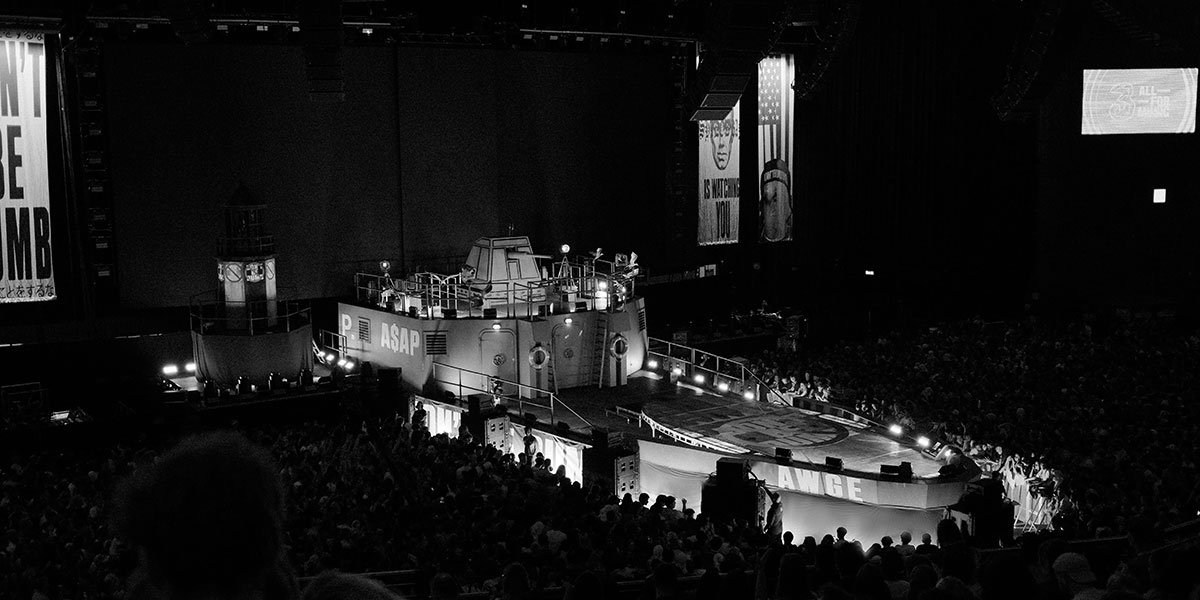
‘Bold, boundary-pushing, and on brand’ are all words that 1826 CEO, Joe Sanchez used to describe A$AP Rocky’s Don’t Be Dumb Tour, and it’s hard to disagree with him. The show featured a 104ft warship, a lighthouse, and an automated helicopter, with the creative team striving to keep a cinematic and musical focus for the show amid the bells and whistles of the production design.
Sanchez and the extended 1826 team worked on an accelerated timeline, with the group brought in midway through the tour’s US leg by Roc Nation’s Jay Brown.
“1826 Group came in and undertook a complete production overhaul: transitioning the majority of the vendor and touring teams, while partnering with 1826 Studio to redesign the show from the ground up,” Sanchez explained. “This resulted in a production distinct in look, feel and execution from what US audiences experienced.”
For the reconfigured show, the team brought in PRG (automation, lighting and rigging), Ox Event House (scenic), Major Tom (audio), Stagetruck (trucking), Beat The Street (bussing), Pyrotecnico and BPM SFX (special effects) and The Event Safety Shop – TESS (safety consultancy).
A$AP Rocky was hands-on in the creative process, with Production Designer, Darren Mullis, dubbing the rapper a “multi-medium creative director” in his own right. “He was involved at every stage and didn’t want to just sign it off at the end, and that’s what makes a tour like Don’t Be Dumb work with so many elements,” Mullis said.
The rapper wanted the stage to be built around a battleship; from there, the team developed a “bellicose, post-Orwellian” environment, Mullis explained: “Some of these scenic elements were inherited from the North American leg, and we built on these to give Rocky a cinematic world he wanted the audience to feel and to mosh. That feeling resembled a turbulent ocean to me, so when Rocky asked for a battleship to be placed protruding through the crowd the audience then became the sea,” Mullis added. “Rocky performs from the boat and lighthouse, so he is always addressing the ‘sea’ directly, rather than a room watching from outside it.”
According to Mullis, putting the audience inside the ‘ocean’ makes them part of the world, watching from the inside. “The show starts with Rocky inside the mosh pit. He is then attached to a helicopter and raised above it. It’s a striking way to open a show, the audience watching him ascend out of the crowd below,” Mullis said. “From there the ultra-wide upstage screen assists in the storytelling work moment to moment: cinematic IMAG shots layered over ‘oceanscapes’ move the boat through storms, razed cities, sunsets, so the audience feels the shift rather than being told about it.”
Ox Event House, led by Ben and Fiona Levitt, created the 104ft warship, a lighthouse, and a show-starting helicopter. “Working with Joe Sanchez and the team he gets in around a production was really pleasant,” Ben commented. “He puts the utmost trust in his suppliers and lets us get the job done.”
The bespoke staging company took a test helicopter, as well as a prop helicopter and refurbished them and added all the rigging points to be suitable for the tour. The warship was hailed by Navy veteran crew members on the road as completely lifelike.
“The ship stood at 18ft tall, and despite it being 104ft long, we were able to treat it as similar to a rolling stage as possible,” Ben said. “We added different changes and edges to our standard decking to build out the design – and then, to make it quicker for the touring team, we introduced a new deck system, which features a coffin lock that latches together.”
In collaboration with PRG and BPM SFX, the staging and scenic specialist integrated lighting and pyro elements into curved grill decks. “We worked with Thirsk, which made a custom 18mm, three-quarters-of-an-inch-thick grill that matched the top of a normal stage deck so that the lighting and the special effects can come through it,” Ben explained. “We also created rolling carts that allowed the tech structure to remain, which made load-ins and -outs much simpler.”
The duo praised the Hull-based team and around 40 scenic freelancers involved in the project.“We had all hands on deck,” Fiona shared. “We are all really proud of the outcome. It looks epic!”
LIGHTING
Lighting Designer, Luke Rolls cited GLP JDC Burst 1 as the workhorse fixture on the tour. “They are used as footlights on top of the ship, washlighting for its fascia, and then effects within the rig to add atmosphere and to accent the music,” he said. “With the JDC Burst, the touring LD has a fader that can adjust the tilt of the footlights to track exactly where Rocky is.”
Other fixtures included ACME Lighting PIXEL Line IP, GLP impression X4, Solaris Flare, Ayrton Veloce, and GLP Fusion X-PAR 12Z.
“For lighting the show, we wanted it to feel cinematic so that meant lots of atmospherics, washy light that doesn’t define the space, which in turn looked better on IMAG,” Rolls added. “I wanted the lighting to look as minimal as possible and we endeavoured to hide as many lights as possible on stage. We were able to hide most of our flown rig behind the PA, or by following the geometry of the video screens so it would blend.”
The video panels of choice, as provided by PRG, were ROE Visual V4ST with Brompton processing, while Panasonic PTZ AW-UE160KEJ and Sony HDC 3500 cameras were utilised with Blackmagic Design processing.
The software utilised for previsualisation by the production was Vectorworks, and when the lighting rig and its contents had been approved, the team moved over to Syncronorm Depence R4 for renders.
“We spent two weeks in previs programming and then a further four days in rehearsal to clean up and make any tweaks. Even once the show is up and running, small changes are carried out by the touring LD as song arrangements are changed, or if there are any setlist changes, it’s a never-ending process,” Rolls commented.
Rolls enjoyed working with PRG on the project, he said: “Kelly and Richard are lovely to work with, and both were supportive and helpful in meeting the lighting requirements I envisioned for the show. The on-the-ground team during load-in and rehearsal led by Tim and Aiden were driven and adaptable as we progressed through the build and development of the look of the show in rehearsals.” This long-existing relationship with Rolls is a testament to what the team pulled together in a short turnaround time.
“This project leaned on our relationship in a real way; there was not much time to second-guess each other, we were moving on instinct and trust built over years,” Mullis said. “It was a hard one but the shows you do under real pressure tend to be the ones that end up meaning the most. If it doesn’t stretch you, you probably haven’t pushed far enough.”
Mullis reflected on watching the concept grow beyond what any of the team quite expected: “Seeing the battleship and lighthouse come together and land better than I had hoped was incredibly enriching. That’s part of the strength of 1826 being able to cross pollinate between design teams and our full production teams that produce the ideas we and our clients imagine.”
Words: Alicia Pollitt
Photos: Robert Maguire

