
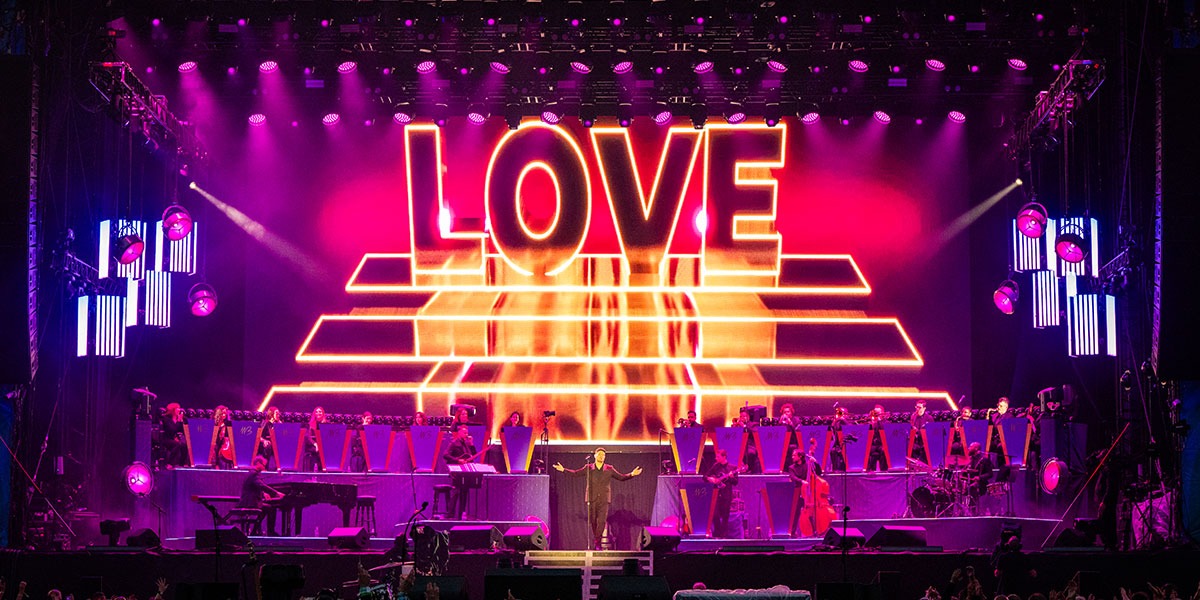
The Canadian singer-songwriter proved he isn’t just for Christmas with a stint of summer shows across the UK and Ireland, and what else to complement his hits than a 27-piece band and a focus on art deco, as well as drawing upon big-band and swing traditions.
Describing himself as a visual storyteller, Design Lead and Creative Director, Jamie Davis wanted the production design of Michael Bublé’s summer shows to demonstrate the creative brief, as well as to illustrate the music.
Working closely with the singer since 2018, their collaboration over time has become streamlined: “I have developed a strong understanding of his tastes and can anticipate many of the things to which he will respond,” Davis began. “However, for everything that cannot be predicted, we build enough flexibility into the design process to create and adapt quickly once he is in space.”
The influence and ornamentation of the 1920s all the way to the 40s ran throughout the design for the shows, from a suspended chandelier and architectural railing details to the riser masking and custom music stand fronts. “The intention was to build a visual world that felt glamorous and timeless, but still had the scale, energy, and technology expected of a contemporary Michael Bublé show,” Davis said. “The band is not simply an accompaniment in Michael’s show; it is central to the identity of the performance. With 27 musicians onstage, we wanted to celebrate them and frame them as a major part of the visual composition. The scenery therefore needed to create a strong sense of period and occasion without making the production feel like a historical reproduction.”
Davis entrusted TAIT and Christie Lites with helping to pull off the ambitious vision. “By working closely with our suppliers, we were able to combine that Art Deco and big-band vocabulary with modern scenic construction, lighting, and control. The resulting stage felt rooted in the golden age of that music while remaining unmistakably Michael’s show,” Davis added. “Christie Lites has been the lighting supplier throughout my time working with Michael’s camp, so this is a long-standing and trusted relationship. Ian Gordon is a good friend and has always been extremely supportive of both the camp and the design process. That continuity is valuable because the Christie Lites team understands the production, the expectations, and the pace at which decisions sometimes need to be made.”
Conrad Drew, who works closely with Gordon, and has acted as Crew Chief for the Bublé tour in the past, returned to the road for the 2026 run, though Davis added that the team were in excellent hands with Sean Hardcastle who stepped up as Crew Chief and was accompanied by Luke Rudge and Gary Rees. “The package performed very well, but just as importantly, the support behind it was exceptional. On a run involving festival infrastructure, varying venue systems, late sunsets, and morning-of-show load-ins, having a supplier and crew who are both flexible and deeply familiar with the production is invaluable,” Davis said.
The Design Lead and Creative Director went on to mention Production Manager, Craig ‘Fin’ Finley, and his support of the design process. “He understands the value it brings to the show and works hard to provide the resources and flexibility that is needed for ideas that might only arise once the production is in rehearsals.”
Touring through venues and festival systems, the touring rig, as described by Davis, was a substantial floor package, with “carefully selected” flown additions.
The fixtures included ACME Lighting Lyra, Ultra Blinders, Tornados, Pixel Line 1000, Martin Professional MAC Aura Raven XIP, Sceptron XB, GLP JDC1 Strobes and Robe PATT 2017, all controlled by a MA Lighting grandMA3.
“The Sceptron XBs did much of the visual heavy lifting. We toured close to 200 units, with 120 hung as a series of chandeliers immediately offstage of the band. They created sparkle and visual depth in an area that can otherwise become negative space, particularly in wide camera shots,” Davis said. “The remaining Sceptron XBs were integrated into our scenic elements, including uplighting the custom music-stand fronts printed with the MB logo. The additional output of the XB compared with the original Sceptron was particularly noticeable. Many of the shows took place in northern parts of the UK and Ireland, where the sun did not set until approximately halfway through Michael’s set. That added punch made an enormous difference while we were competing with daylight.”
Davis also shouted out the ACME Lighting Tornados, naming them an “important component” that introduced colour and beam behind the band to create an immersive environment around the musicians on stage. The ACME PIXEL LINE 1000s are a mainstay for the Bublé camp, with the camp utilising the fixtures for many of the singer’s live iterations. “Michael enjoys a good sparkle during the more pop-driven songs, and the PIXEL LINES provide exactly that while also adding visual interest along the downstage edge,” Davis said.
Initial design conversations for the summer shows began in January, with a focus on ensuring that every angle of audience view had a fuller look, which is why the designer added in the PATT 2017 and Sceptron XB fixtures to add depth, texture and points of interest into the emptier space on stage.
“Before we hit the road we spent one week previsualising the show in Depence R4. We then had two rehearsal days before loading into the first festival. That was followed by a night of overnight programming, after which the remainder of the run operated on a same-day schedule, loading in on the morning of each performance,” Davis said.
The first creative direction that Bublé gave Davis at the start of their working relationship, was “make it look cool”, Davis elaborated: “For Michael, that means the show needs to feel visually large, polished, and captivating. But the scale only works if it is balanced by smaller moments. Some of the most important looks strip everything back and focus solely on Michael, allowing the audience to reconnect directly with him before the production expands again,” he said. “Lighting is what allows us to control that perspective. It can make 27 musicians and a large festival stage feel enormous, then narrow the entire world down to one performer and one lyric.”
Words: Alicia Pollitt
Photos: Cal Halliwell

