
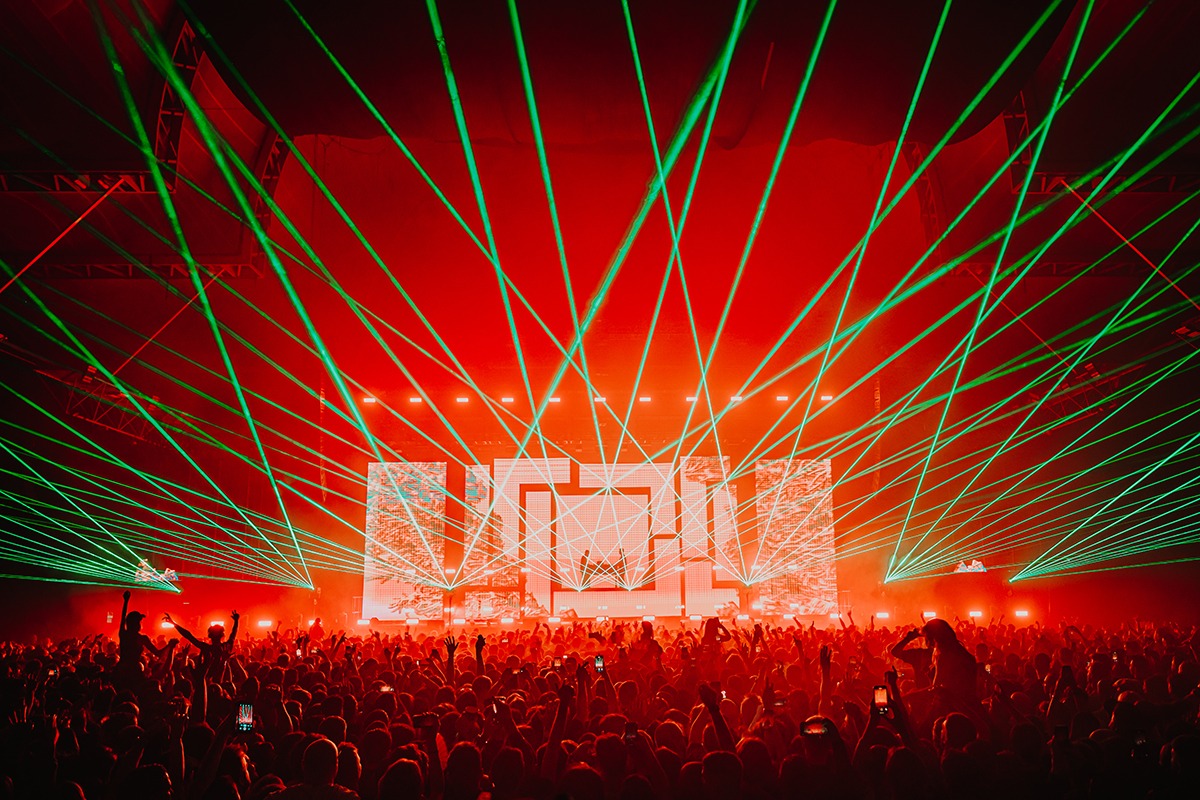
No matter the industry, innovation often comes from an outsider’s perspective on established frameworks. Given the increasingly complex nature of live touring, many companies are looking to break the long-held convention of ‘how things should be done’ and offer an alternative. One such company that seems keen to explore new methods of production design and workflows is Zeal.
In the relatively short time since it was founded, the company has been heavily involved in designing shows for the likes of Tom Grennan, Barry Can’t Swim, and Bicep, to name but a few. Rather than simply being a rental house or a design agency, Zeal’s USP is that it handles everything from design through to equipment provision, offering a more holistic service to clients. With the company celebrating its move to a new warehouse, TPi sat down with Zeal’s Steve Hough, to learn about the company’s unique offering and how it is preparing for a busy summer season.
FROM BACKFLIPS TO BACKLIGHTING
Hough has a less-than-conventional live events origin story, having been a gymnastics coach. “Alongside teaching gymnastics, I began running an agency that would supply acrobats to live events, which led me to work in the production for the London 2012 Olympic Games Opening Ceremony.”
After getting a behind-the-scenes look at one of the biggest productions in the world, he was very much bitten by the live events bug and looked to transition into the industry. “I started Zeal that same year and initially started looking at becoming a traditional lighting rental house,” Hough explained. “I just knew I wanted to be involved in the industry. Fast-forward a few years, and I got some experience in design and operating shows and even did a few stints in both tour and production management.”
With this wider experience in other aspects of the industry, Hough and his colleague Jon Trincas ventured to start another branch of the business called Colab to provide design services. “We listened to the advice that both disciplines could never be provided under the same company.”
However, after a few years, Hough and the team opted to ignore this advice and instead bring everything under a single umbrella, Zeal.
FULL-SERVICE SOLUTION
Although Zeal still operates as a traditional rental house for some tours, over half of the work the company engages in sees it providing a full-service product where it will work on the creative, design for a tour, all the way to supplying and prepping the gear before sending it out on the road.
As one might imagine, Hough has faced naysayers poking holes in the business model. “People sometimes presumed that, for instance, when it comes to designs, our team will only use the fixtures we stock,” stated Hough, with the implication being that designs and creativity might be limited.
“I might wish that to be the case,” chuckled Hough, who exemplified that often when he received a design from his team, there would be plenty of fixtures that Zeal did not own and therefore must be sub-rented in.
He further commented that some industry peers suggested that LDs outside the organisation would not want to use Zeal as a rental house because they would “feel threatened”. “But it turns out that is not true, and we work with loads of other LDs,” stated the Managing Director. “It all comes down to relationships and trust.”
In fact, Hough thinks Zeal’s approach leads to more creative shows that align with what is possible, especially given the available budgets. “What we do, I call ‘strategic imagination’,” explained Hough.
In his mind, the usual way a show is created is a “linear process” – creatives come up with ideas, then suppliers get involved, and naturally, creativity is shaved off out of necessity.
“I speak to so many LDs who are having to compromise their shows – they might want 10 fixtures but can only afford six – and everything becomes squashed. Whereas in our model, albeit sometimes messy, we’re more than happy, and often have thrown out an entire design if it’s not working early on the creative and financial side.”
Zeal also values the ‘team approach’ over the individual creative voice in show creation. “There is a psychological safety of creating when working in a group,” he explained. “The entire team is never focussed on who takes credit for a design.”
He continued to talk about the inspiration he and the team have drawn from Pixar, which has a method called Braintrust, a feedback system in which directors, writers, and senior storytellers openly critique works in progress to help improve the story. “Everyone at Zeal is happy to muck in, and everyone wants their team to succeed, rather than having a level of resentment of one individual having loads of credit.”
As a working example, he commented that when a show is being prepared in the warehouse, teams often offer a better build solution that dramatically alters the design and, according to Hough, creates a far more cohesive show. “We’ve received a lot of positive feedback from our recent work with Barry Can’t Swim,” stated Hough. “The show is not overly complex, but it’s executed very well and seamlessly.”
With a real focus on every element of the production as part of a whole, each aspect has a greater impact. “My view is that everyone should care just as much about another department as they do their own specific area. We care a lot about lighting and visuals, but we don’t discount the importance of audio. We know that if lighting and audio don’t match up, people leave thinking it sounded worse. But when they work together, they both elevate each other.” He added that Zeal’s passion to be involved in all aspects of the production goes beyond the triad of audio, video and lighting.
“On the programming side and for our clients in the dance market, such as Barry Can’t Swim or Bicep, we try to keep laser design in-house, with several team members LSO [Laser Safety Officer] certified,” he stated. “From several shows, we have brought in an SFX supplier just to provide and set up equipment, but then we’ll be in control of the lasers during the show – again feeding into the concept of one team overseeing and working toward a seamless visual goal.”
ADD TO CART
The MD believes that having a finger on the pulse of design has had a huge benefit for stock investment. “We can make a decision very early on if we are going to buy a product, as we can ask our designers when they generate ideas for a show whether they’d get multiple uses out of a fixture or whether they think it will be used for just one project.”
In essence, Zeal doesn’t need to guess if a fixture would become a reliable workhorse in the industry and invest in technology the team collectively enjoys. The extensive investment has led to a need for more space, with the company moving to its new building in Basingstoke this year.
“In our previous space, it became a bit of a joke how often we needed to spill out into the car park and play a complex version of Tetris to get everything back in again at the end of the day,” he laughed, noting that in recent days, as the team were simultaneously loading out shows for The XX and Kneecap, even the new space was starting to feel tight.
Currently, Zeal employs 20 full-time staff who cover everything – from the design team to the warehouse crew, not counting a dedicated pool of freelancers brought in during busy periods. On the topic of a growing team, another core principle Zeal believes in is educating the next generation of industry specialists, particularly those seeking to make their mark in the design realm. “We are in a unique position for young people wanting to get into design and visuals. We can offer internships for three months where they get to see everything from creative direction, design, planning and delivery all in one house.”
Over the past year, Hough and the team have developed a project for each of their interns to complete during their three-month period of work called Project X. “It’s a hypothetical project where we ask them to put together a show from initial creations to how they would deliver,” stated Hough, who commented that some entries have been so strong that they have led to the company employing the intern full-time.
The company has been housing apprentices for some time. In fact, a previous apprentice, Holly Jackson, won Apprentice of the Year at the Breakthrough Talent Awards at the 2024 Production Futures event. With an ever-increasing stock list, the MD explained that the company knew the level of production it wanted to work in. “It’s nice that a lot of people are supporting independent companies like us,” he explained. “People say they keep coming back to us due to our personal attention to detail.”
He made the point that although they are working at the academy-to-arena market, this level of detail is arguably more important than the large stadium show space. “If there is one hazer half broken and leaking at a show in Alexandra Palace, people are going to notice, but in a large stadium show, most people are likely to miss those small details.”
A NEW PARADIGM
There is no question that the Zeal business model is intriguing. Hough himself stated, when you look at other industries – namely that of TV and Film – the role of a Producer is commonplace, but then doesn’t seem to exist in the same way in live touring. “In my opinion, for live tours you need that person who is able to walk into a room with the artist and managers, also converse with the creative as well as the crew on the ground and understand the implications of a creative decision,” concluded the MD.
Throughout the events industry many traditional rules are being questioned. For example, TAIT’s latest acquisition of Silent House, bringing in a creative designer team into a manufacturing house, not to mention the number of shows that are no longer designed by a solitary show designer but by a creative house. We seem to be in a more collaborative environment and what this will mean for future results is yet to be seen. But having seen some of Zeal’s work, there’s no doubt that the results from this different workflow are commendable.
Words: Stew Hume
Photos: Zeal and Luke Dyson

