
As live entertainment continues evolving into increasingly immersive and hybrid visual environments, LED display technology has become one of the most critical foundations behind today’s large-scale productions, writes LEDMAN.
From international music festivals and touring concerts to luxury event venues and broadcast productions, audiences now expect seamless integration between physical staging, digital content, and real-time visual effects. What once relied purely on lighting and scenic design has expanded into a layered ecosystem combining LED visualization, AR integration, motion tracking, and real-time rendering technologies.
This shift was clearly visible during this year’s Coachella Valley Music and Arts Festival, where several performances created “hologram-like” visual experiences that quickly drew global attention online.
Giant digital figures appeared to move naturally within the stage environment, while virtual effects blended seamlessly with performers and physical structures. However, these experiences were not driven by holographic technology, but by the precise coordination of high-performance LED systems, synchronised content playback, real-time rendering, and broadcast AR workflows.
Although virtual production and AR effects often attract the spotlight, the core infrastructure enabling these experiences remains the LED display system itself. For large-scale stages to deliver convincing hybrid visuals, LED displays must meet increasingly demanding technical requirements. High refresh rates are essential for flicker-free camera capture during live broadcasts, while accurate module alignment ensures seamless large-format visuals across extended stage surfaces.
Equally important are contrast performance and black-level control. In immersive stage environments, the objective is not simply maximum brightness, but the ability for the display surface itself to visually disappear. When contrast and light control are properly optimised, digital content appears integrated into physical space rather than confined to a screen.
In outdoor productions and touring environments, these requirements become even more complex. Ambient lighting conditions constantly change, setup schedules are compressed between performances, and systems must withstand repeated transportation, installation, and dismantling cycles without compromising visual consistency.
Under these conditions, practical engineering becomes just as important as visual performance.
For rental providers and live production teams, successful staging depends not only on creative execution, but also on operational efficiency and reliability. Small engineering details can significantly affect deployment speed, maintenance workflows, and long-term operating costs. Protection-oriented cabinet structures help reduce handling damage during transport and repeated assembly. Stable locking systems improve installation precision and structural consistency across large-scale builds, while service-friendly module architectures simplify on-site maintenance during time-sensitive productions.
Optimised internal layouts and simplified cabling further reduce troubleshooting complexity, while universalized component systems help streamline inventory management for rental companies operating across multiple projects and touring schedules. These practical considerations are becoming increasingly important as live productions grow larger, more technically demanding, and more dependent on fast deployment timelines.
This growing industry demand is driving manufacturers to rethink how modern rental LED systems are designed.
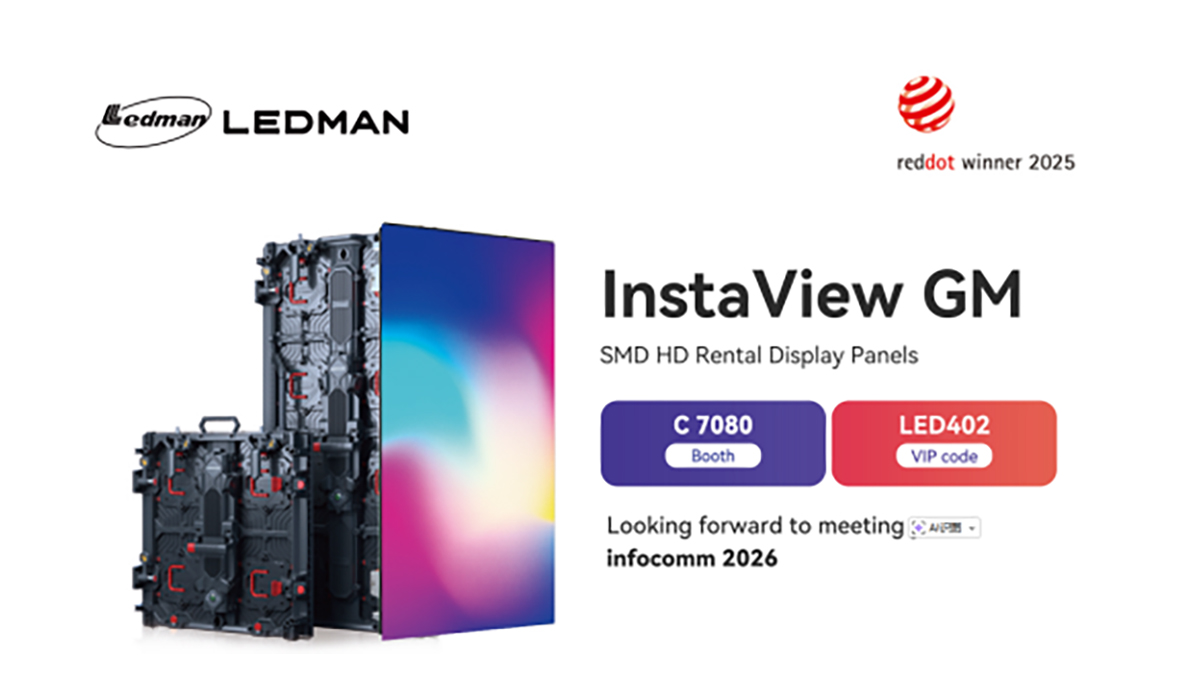
Solutions such as the GM Series rental LED display from LEDMAN reflect the industry’s shift toward combining high-performance visual capabilities with practical engineering optimised for real-world live event environments.
Designed for both indoor and outdoor rental applications, the GM Series integrates high refresh-rate performance for broadcast workflows, optimised brightness and contrast for immersive stage environments, and structural features developed specifically for touring and high-frequency installation scenarios.
Its engineering design also prioritises operational efficiency. Patented protection mechanisms help reduce damage risks during transportation and assembly, while service-oriented structures — including one-handed removable power modules — support faster on-site maintenance and reduced downtime during productions.
A universalised component architecture further simplifies spare-part management and operational workflows for rental providers handling multiple projects simultaneously.
Because in today’s live event industry, the success of a production rarely depends on creative vision alone. More often, it depends on whether the underlying technology is engineered to perform reliably under the realities of large-scale deployment.
As immersive entertainment, virtual production, and live event technologies continue converging, rental-oriented LED engineering is expected to remain a major focus across the professional AV industry. At InfoComm 2026, manufacturers and production professionals will continue exploring how faster deployment systems, hybrid stage workflows, and advanced display technologies are reshaping the future of live experiences. LEDMAN will showcase its latest GM Series rental LED solutions during the exhibition at Las Vegas Convention Center, Central Hall between 17 to 19 June 2026 on Booth C7080.

