
Matthias ‘Matze’ Christner, Head of R&D Systems & Technologies at d&b audiotechnik, plays a pivotal role in shaping the company’s long-term technology strategy and advancing next-generation professional audio solutions. With a background spanning physical acoustics, system engineering and networked audio architectures, he combines scientific rigour with practical product innovation.
Over the course of his career, Matze has contributed to some of d&b audiotechnik’s most significant technological developments. He has been instrumental in advancing broadband directivity control and cardioid system design, innovations that have redefined clarity, control and consistency for touring applications worldwide.
Speaking to TPi, the Stuttgart native reflects on an unconventional route into the company: “It’s a funny story,” he began. “My plan was to leave the industry after a summer of touring and move into laser optics. But while travelling between festivals, I promised a d&b employee who was with us that I’d give the company a call, and the rest, as they say, is history…”
Matze credits his time in the field, alongside the experience of his colleagues, as a key influence on d&b audiotechnik’s direction. Insights gathered from real-world applications continue to inform product development and help align innovation with the needs of engineers on the ground.
Over three decades, he has moved from loudspeaker electroacoustic engineering to a broader systems perspective, working across signal processing, software development and overall system design. This evolution is reflected in d&b audiotechnik’s Systems & Technologies department, a specialist team of around 12 focussed on long-term innovation.
“One of the most significant developments has been our processing architecture,” he explained. “From the early days of the D12 amplifier through to the D80 platform, there has been continuous evolution. Understanding the interaction between loudspeakers and amplification, what each requires from the other, has enabled more efficient, competitive and energy-conscious system designs, including partially passive solutions.”
While tradeshows typically serve as launch platforms for new products, d&b’s presence at Integrated Systems Europe (ISE) 2026 balanced innovation with heritage. Alongside previews of the U-Series multipurpose point source loudspeakers and the 42S ultra-compact model, the company also showcased the enduring F1220, among other solutions.
“These products still influence us today,” Matze noted. “It was a milestone at the time. I experienced it first-hand as an engineer working with one of the early d&b audiotechnik customers… It was a clear step up from anything I had used before.”
He later identified directivity as the defining factor behind that impression. “It delivered a superior direct-to-reverberant ratio compared to other systems available at the time,” he said. “Experiences like that stay with you, directivity remains a core driver of our development.”
That continuity is reinforced by d&b audiotechnik’s culture. “There’s a long-standing joke that once you join d&b, you never really leave,” he laughed. “Long-serving employees provide continuity, shared knowledge and valuable first-hand insight.”
At the same time, newer members of the product management team bring fresh perspectives. Close collaboration between R&D and product management ensures a balance between technical excellence and market relevance. “It’s a dynamic that has to be built and renewed every day,” Matze added. “That’s what makes it strong.”
Central to d&b audiotechnik’s philosophy is a pragmatic approach to technology. “We don’t adopt technology for its own sake,” he emphasised, earnestly. “There has to be a clear technical requirement, using the right tool for the job.”
This thinking extends to networking. Matze has been a strong advocate for open, future-proof architectures, including the adoption of Milan-AVB.
“If you require precise timing at the processing endpoint to drive a line array, AVB-Milan currently offers the necessary performance. In other scenarios, other protocols may be perfectly viable. There’s no need to engage in ‘format wars’ – it’s about usability and reliability for the end user.”
He cited the transition from analogue outboard processing to integrated controller systems, which enabled more users to achieve consistent results. “A similar shift is happening in networking. The most reliable and efficient solutions will ultimately prevail. System configuration should be prepared in advance, not built from scratch on site,” he underlined.
This user-centric approach is also evident in tools such as d&b’s proprietary ArrayProcessing software, which transformed system design and optimisation workflows. “It was a game changer,” he reflected. “We didn’t invent the underlying concept, but we made it accessible and practical.”
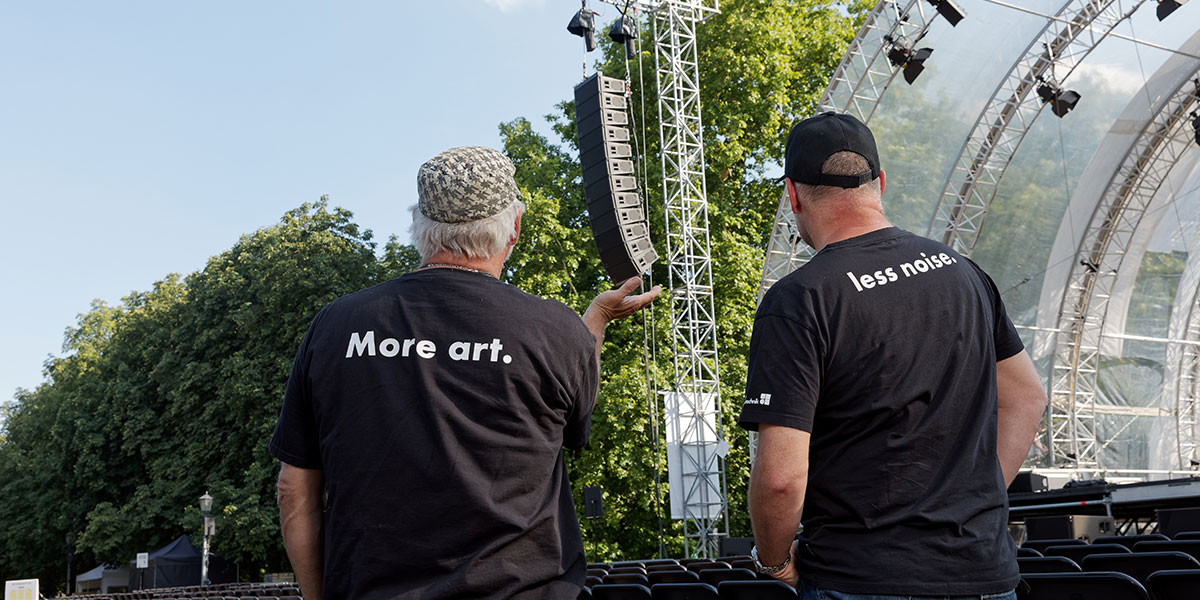
The same holistic thinking informed the SL Series, from electroacoustic design through to rigging and system planning. Initially driven by the need to address environmental noise in outdoor applications, its cardioid behaviour also delivered unexpected benefits indoors. “The level of improvement exceeded our expectations,” Matze recalled.
Looking to the future, he sees automation and emerging technologies, including AI, as ‘enablers’ for the sector. He elaborated: “Their greatest value lies in supporting system planning and setup, reducing trial and error, and getting engineers to a ready-to-go system faster,” he concluded. “If it helps you be the first person in catering, it’s worth it.”
Words: Jacob Waite
Photos: d&b audiotechnik

