
When pioneering electronic artist Four Tet returned to Alexandra Palace’s Great Hall, the brief was as deceptively simple as it was ambitious: create a vast, communal dancefloor experience anchored not by a performer, but by light, geometry and feeling. For award-winning Production and Lighting Designer Ed Warren, the challenge was irresistible, as TPi discovers.
A long-time collaborator, Warren has worked with Four Tet’s Kieran Hebden for 17 years, and that history shapes every iteration of the project. He designed the entire room concept and layout, programmed the artist’s latest show’s, and operated the lighting live, busking.
“The core principle has always been that the dancefloor is the focal point, not Kieran on-stage,” he explained. “The aim is for everyone, wherever they stand, to feel fully immersed in the experience.”
Scaling up to Ally Pally, and to arena-size rooms beyond, required a fresh architectural gesture. Warren found it in what would become the show’s defining feature: a single, uninterrupted axis of light. “When we learned we were scaling up, I knew I wanted a continuous line of light running down the centre of the room,” he recalled. “The first question was: ‘How long can we physically make this?’ Once that was established, the geometry of the entire show grew from that single decision.”
The result was a 58m line of CHAUVET Professional COLORado PXL Curve 12s, suspended on Kinesys and capable of descending to just above the audience’s heads or tilting into angled formations. “It shrinks an enormous arena into something that feels intimate, like the small clubs where Kieran first started DJing,” Warren noted.
Each PXL Curve houses 12 individually tilting pixels, giving nearly 700 controllable points in a perfectly straight line. “I spent a long time experimenting with effects across that array,” he said. “During the previsualisation stage, the results looked almost impossible, and they were even better. At times, it became this slow, ominous sheet of bending light; at others, a room-filling rainbow broken into hundreds of moving pieces. It suited my love of symmetry and geometry perfectly.”
Some of the show’s most striking moments came from just two fixtures. “We drop two Ayrton Kyalami into the centre of the room, just above head height,” Warren noted. “With a single rotating beam each, they create a rotor-blade effect overhead that slowly accelerates with the music. For nearly ten minutes the room runs on just those two fixtures. In a 10,000-capacity production, that kind of restraint is incredibly powerful.”
Supporting the central truss are four straight runs loaded with Ayrton Rivales and GLP JDC1s, simple tools deployed with precision. “Often the simplest looks were the most effective. A single bounce-dimmer chase running the length of the JDC1s could transform the space. Simplicity is always the guiding principle, especially as we deliberately avoid video content.”
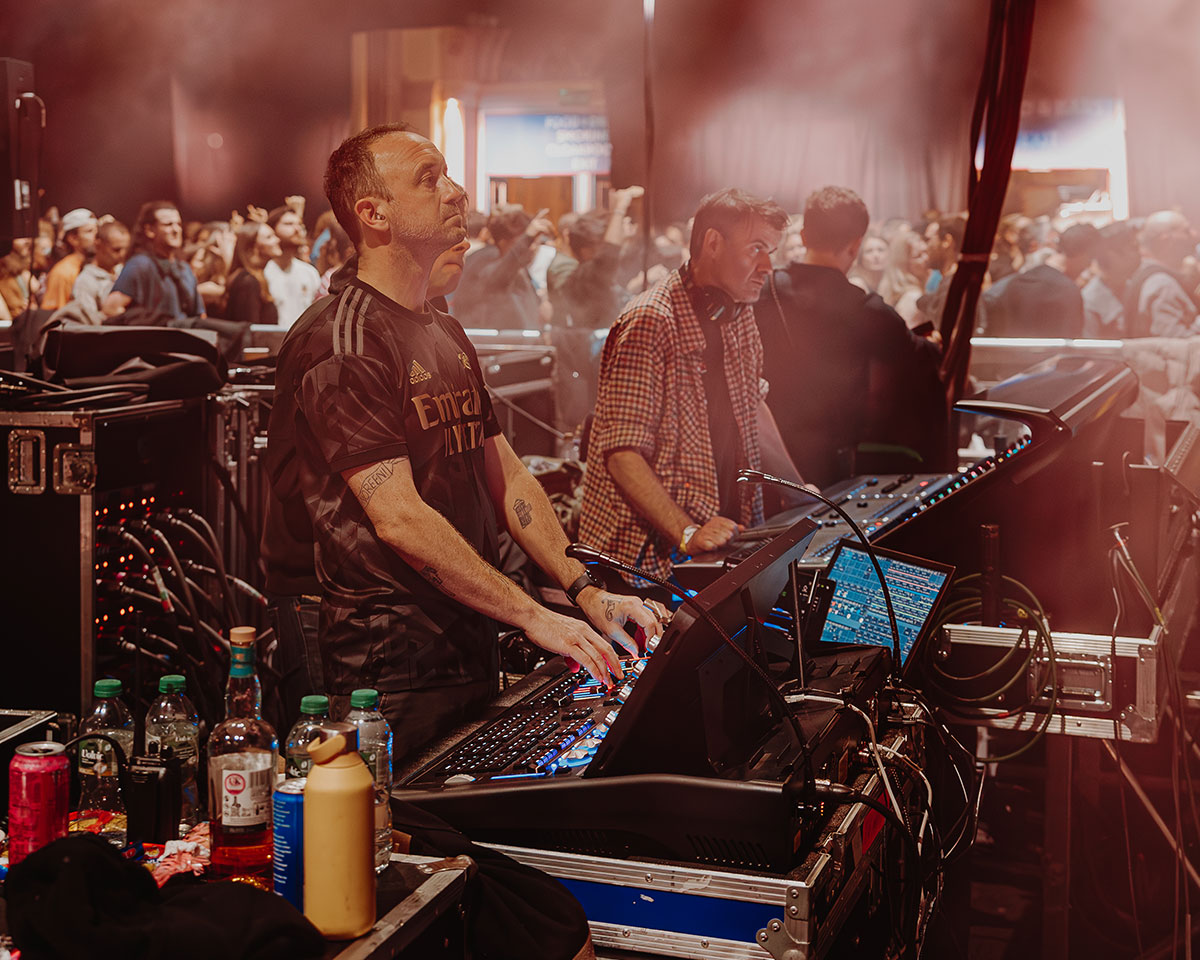
Control for all of this comes from Warren’s own ChamSys MQ500M Stadium Console, the same surfaces he uses in his studio. “They are perfect for a busked show of this scale,” Warren said. “They let me build and manipulate multiple effect types across whichever fixtures I select, quickly and flexibly. I busked a four-hour show with almost 200 fixtures from a single page of faders and buttons.”
Lights Control Rigging (LCR) supplied all lighting and handled the rigging advances, including coordination with audio. “I work directly with LCR Senior Account Manager, Rob Watson, who brings a huge amount of care, detail, and consistency to every project. From prep to plots to onsite support, the whole team is solid – reliable gear, meticulous work, and a genuinely collaborative attitude,” Warren said.
Having first worked with Production Manager Matt Barker and the Four Tet team at Glastonbury Festival, Watson, alongside LCR Project Manager Sam Dilworth, LCR Crew Chief Gaz Horridge, Lighting Technicians Richard Griffin, Ashley Tutt, Ben Webster, Rich Hoxley, Jon Barlow and Dan Turner, Kinesys Operator Tom Darby and Production Rigger Zack Wade, oversaw the deployment of five static trusses and one Kinesys truss, each measuring 60m, as well as 48 rigging points for the audio infrastructure and cable management.
KB Event supplied four 45ft Megacube trucks, steered by long-time drivers Ian Botham, Marcus Baugh, Steve Parks, Alister Stone and Mike McCord. “We evaluated fixture types to make the logistics feasible. It all loaded in on the same day as the first show, four and a half trucks’ worth of LCR gear, on what was essentially an in-show day with no production rehearsals,” Watson recalled, speaking to TPi following a record-breaking 2025.
The project’s primary challenges, as ever, were time and the sheer volume of infrastructure required: five, 60m of lighting truss alone, 10 cable bridges for lighting and four for audio. Three trucks’ worth of truss were stacked and transported ready to be rolled out. On site, the team ensured perfect symmetry among the lighting fixtures using laser measurements.
“It was a challenging feat, but the result made it all worthwhile. We love working with Ed Warren, he is a lovely human being, flexible yet someone who knows exactly what he wants,” Watson said, emphasising that collaboration was fundamental to the project’s success. Every department had to liaise and work together to deliver this show.”
With no support act, Warren used GLP JDC1s to create a warm white palette that could easily be mistaken for house lights. Dynamic lighting looks were introduced slowly, and at 8.30pm the first Kinesys move took place. All the data in the dimmer areas were driven by Luminex. The wider rig incorporated 1,250kg and 500kg hoists as part of a Kinesys Apex automation system.
“Seeing the audience realise that a truss was moving above their heads out of nowhere was a special moment,” Watson said. “It is a great-looking show, nothing is overdone. There is a moment where a small truss in the middle of the room, with two Ayrton Kyalami on it, drops in for one song, does a clockwork spin, then rises again. There was a surprisingly diverse range of looks, despite it being a busked show.”
The main challenge for Warren was rigging above a densely packed dancefloor. “Every cable bridge and drop had to be extremely discreet and clean. Beyond that, the rig itself is deceptively simple: five straight trusses. The real challenge was using that minimal geometry to create a show that stayed varied, coherent and uncluttered over four hours.”
Among his favourite moments is one that happened almost by accident. “I was splitting the PXL Curve pixels into symmetrical, morphing shapes while running a full-length rainbow chase across them,” he said. “It was entirely busked, but it created a moment of pure visual magic.”
And, of course, the rotor-blade sequence remains a personal highlight. “The slow build, the restraint, and then the release when the full show comes back in… it hits hard every time,” he added. “For a production of this scale to rely on two small fixtures for that long, that contrast is exactly what makes it so powerful.”
Reflecting on nearly two decades with Hebden, Warren is clear about why this partnership continues to evolve. “Working with Kieran for so many years says everything,” he said. “He trusts my instincts completely and gives me the freedom to experiment, while also pushing me to challenge expectations of what a show should look like. There is no ego, no compromise, just a shared commitment to making the experience better every time.”
According to the production and lighting designer, the shows journey is far from over. “The show will continue to develop; every iteration teaches us something new,” Warren revealed. “We are only just getting started…”
Words: Jacob Waite
Photos: Luke Dyson

