
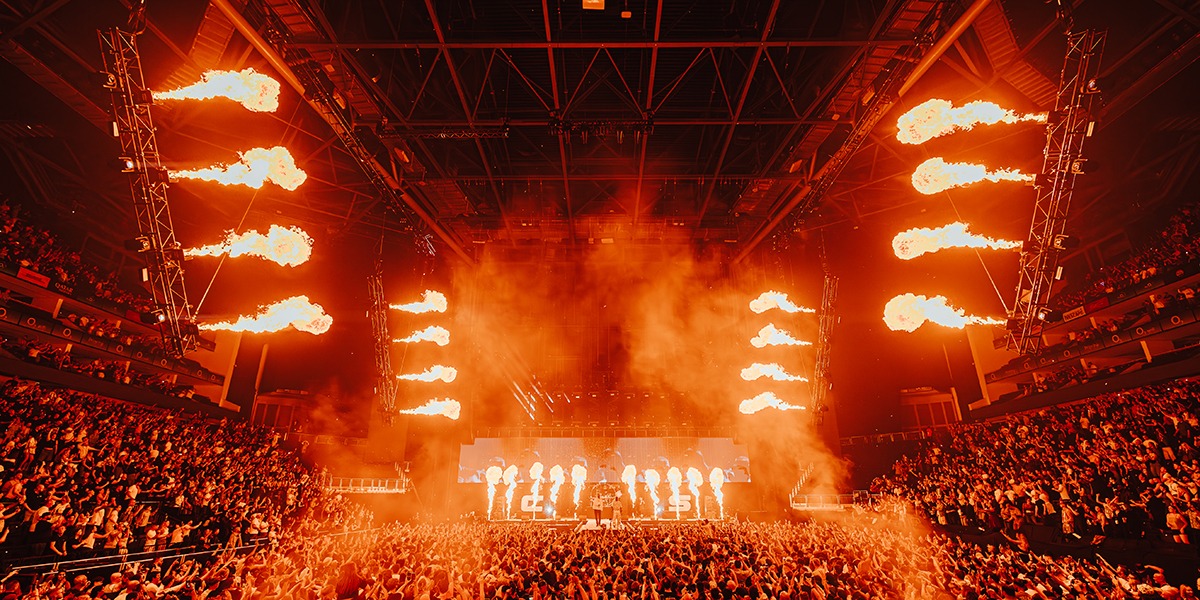
Trading digitally rendered content for real life footage, Chase & Status’ latest arena run is a homage to ’90s rave culture – part warehouse rave, part post-apocalyptic theatre. Behind the controlled chaos is a roster of TPi Award-winning live event professionals and technical partners, who collectively brought the electronic music duo’s vision to life. From blowing up cars in central London to integrating live camera feeds through a custom ‘letterbox’ LED screen, this production pushed the boundaries of what live electronic music can look and feel like, as TPi discovers.
Chase & Status’ latest arena tour began in April, with dates scheduled across several UK cities. The tour’s vendors included PRG (video and rigging), Lights Control Rigging (lighting), BPM SFX (lasers, pyrotechnics, and special effects), Ox Event House (set), Protect and Tour (tour management), Only Helix (agent), and Production Park (production rehearsals).
The visual team consisted of Show Director and Production Designer, Sam Tozer of Vision Factory; Production Manager, Mike Clegg; Lighting Director and Co-Lighting Designer, Olly Walker; Media Server Programmer, Charlie Rushton and Artist Manager, Sophie Kennard.FRAY Studio began working with Chase & Status in 2024. “They had previously used and reused a lot of similar content, and last year, they were exploring other options for visuals in the dance and electronic music world but didn’t want to replicate anything else being done prior,” FRAY Studio’s Adam Young told TPi.
This project marked FRAY Studio’s first foray into the genre. “We had no preconceived notions,” Young stated, pitching the idea that the show shouldn’t feature any animation – every piece of content should be filmed and feel authentic.
The first round of content was captured last year, then revisited and reworked ahead of the tour. The main piece revolved around a 1991 BMW with the engine stripped out. In one sequence, cast members Clare Hough, Chay Ballard, and Etienne Lutanki smashed the car to pieces – filmed at 600 frames per second – before setting it on fire and blowing it up. “The band believe that dance music has become too polished and pretty, so we wanted to bring some rage and punk back into the scene,” Young explained.
Another clip involved two experienced television and film dog handlers whose dogs were trained to appear incredibly aggressive on demand – a nod to the duo’s No More Idols album artwork. Producer, David Dunnage discovered a warehouse in London Bridge where all filming took place. “The owners were remarkably chill about everything we wanted to do – including graffitiing the inside of the building, smashing up a room, and setting fire to a stunt performer,” Young recalled, laughing.
Planning took six weeks, followed by two days of filming. The shoot’s suppliers included Two & Eight (production company), MJ Knights Military Effects (special effects), Sunbelt Rentals UK (camera equipment), and Gav’s Kitchen (catering). “Every time we need to film something for a show, we partner with Two & Eight because they don’t shy away from our ridiculous ideas. The car, specifically, required a lot of paperwork. Everything had to be stripped out. MJ Knights Military Effects were brought in to sign it off – they spent an entire day in south London equipping it with explosives and setting up cordons,” said Young.
In addition to FRAY Studio team of Designers, Editors, and Graders, Adam Young, Norvydas Genys, Kira O’Brien, Letty Fox, and Grace Arnott-Hayes, as well as Studio Producer, Georgia Young – the wider creative team included Director and DOP Bobby Goulding; Producer David Dunnage; PM Nathan M. Legger; PA Luke Clifton; Runner Jack Dunnage; First AD Samuel Fullerton; 1st AC Lewis Watts; Second AC Roisin Byrne; Camera Trainee Beth Lamyman; Gaffer Samuel Hilaire; Spark Chay McGill; Production Designer Delphine Fyrst; Props Master Henry Minden; Props Assistant Stuart Manning; Dog Handlers Liam McArthur, Melissa Isidoro, and Dale Fastnedge; Medic Michelle Franey; BTS Photographer Dave New; and BTS Videographer Tyler Palmer.
Given the location, blowing up a car in London Bridge was understandably not simple to organise. Emergency services and the local council had to approve the plan, with Pinewood Fire Department present on-site. A production assistant leafletted neighbouring addresses to inform them that an exploding BMW wasn’t a cause for alarm. “It’s one of those ideas you never really expect to become a reality,” Young smirked. “Six weeks later, there you are, watching a car being blown to smithereens. That’s the thing with Chase & Status – they don’t shy away from big ideas and concepts.”
The content drew inspiration from the band’s back catalogue – album artwork, stage iconography, and music videos – revisiting earlier material when their image was less polished, with subtle references to archival material. Footage was captured using anamorphic lenses in an anamorphic ratio on a RE-35 digital camera, allowing it to be enlarged without distortion.
Additional cameras captured footage at 700 frames per second. Adobe Premiere Pro was used to edit and assemble 18 terabytes of footage in Adobe After Effects. Seven songs on the setlist featured live camera visuals with Notch real-time generated effects used to create new live looks. Contrast and grain were added to roughen the visuals, complemented by footage captured using vintage ’90s camcorders.
“Everything about this project pushed back against the overuse of fancy, new technology. There were plenty of conversations about how it would be easier to blow up a car in Unreal Engine and put it on a filmed backplate, but the band wanted authenticity. There’s something about those two days of filming with 25 people, dressing a physical space, all working towards the same vision. It’s a different feeling to being sat in an office behind a screen,” Young reflected proudly. “We’re used to collaborating digitally via Microsoft Teams and Notch, so assembling a team of Adobe After Effects compositors and editors, who understand the fast-paced world of live music, was quite a unique challenge.”
The centrepiece of the stage was the unusual “letterbox” LED upstage screen, mounted on MoveKet automation to reveal the band as the show began. ROE Vanish V8T LED panels were used to construct the 27m-wide, 4m-deep structure. The V8Ts were chosen for their vibrant colour depth and 50% transparency, which enabled lighting integration as the screen moved, adding dynamism to proceedings.
Flanking the stage were two 3m by 5m IMAG screens, supported by a camera package, consisting of a Grass Valley Karrera system with four Sony system cameras: two with Fuji long lenses at FOH and two wide-angle pit cameras. Six floating trusses hovered above the audience, powered by the MoveKet automation system. During the show, they rose to form a dramatic V shape before then lowering it right above the crowd’s heads.
The PRG crew comprised Video Crew Chief, Steve Jones alongside Max Timpson, Paul Borthwick, Chris Hobson, Nick Edwards, Chris Keating, John Carr, Izzy Everatt, Will Gallegos, Jack Dixon, and James Andrews.

‘EXECUTING WITH PRECISION’
Having supplied a range of special effects and laser packages across several of Chase & Status’ live shows since 2013, BPM SFX delivered a bespoke package that replicated the overhead flame effects featured in the duo’s headline set at Creamfields 2024.
The stage design incorporated a dynamic combination of lasers, flames, and confetti to heighten the live experience. Twelve Atom58 laser fixtures were rigged on truss ladders positioned behind the band and used throughout the show to accentuate key moments with precision and impact. Fourteen MagicFX STADIUMSHOT III units provided spectacular confetti hits, showering the crowd amid the track, Blind Faith.
A total of 34 Galaxis G Flames were deployed to fill both the stage and arena with immersive flame effects. Of these, 24 were mounted on Kinesys-tracked trusses suspended above the audience, delivering dramatic overhead bursts. The entire effects package was programmed and controlled via a grandMA3 Light console to ensure seamless synchronisation throughout the show. “The flame effects were a standout moment of the show, energising the entire arena and drawing an incredible reaction from the crowd,” commented BPM SFX’s Liam Haswell. “We continually strive to push the boundaries of what’s possible in live shows, bringing innovative ideas and concepts to the table – and then executing them with technical precision.”
The flame effects for this show presented unique challenges. Owing to the requirement for timecode, the team were unable to rely on standard wireless functionality. Additionally, integrating the system with Kinesys automation demanded a custom solution. To address this, BPM SFX designed and fabricated bespoke external canister enclosures to ensure the cartridges remained in a vertical orientation, guaranteeing reliable ignition.
A host of guest vocalists appeared throughout the show, including NADIAH, IRAH, Ethan Holt, and a special appearance by ArrDee during Liquor and Cigarettes, prompting further roars from the Manchester crowd. Reflecting on the project Young concluded: “The beauty of this project was freedom – we weren’t restricted or held back by what’s considered standard.”
Words: Jacob Waite
Photos: Dave New (BTS) and Luke Dyson (show)

