
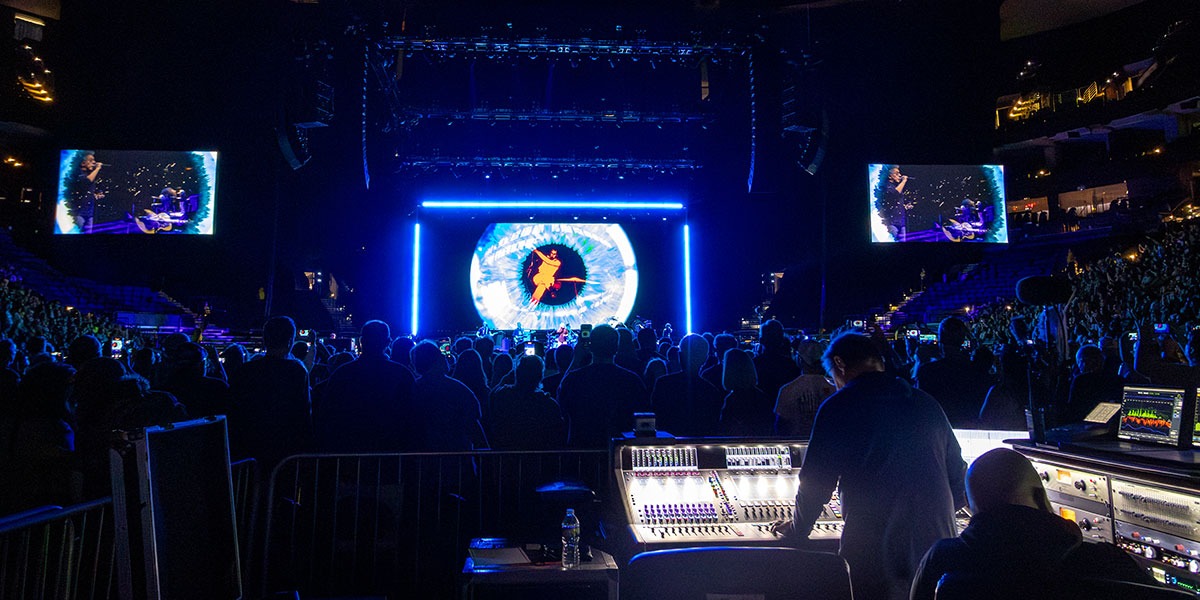
The Who’s The Song Is Over finale tour in North America featured original members Roger Daltrey and Pete Townshend as they wowed fans one more time across the US and Canada. Cohesion was the chosen PA for all dates on the band’s farewell trek.
Prior to The Who’s closing Philadelphia performance at Xfinity Mobile Arena, FOH Engineer, Robert Collins and System Engineer, Chris ‘Chopper’ Morrison, who have performed their respective roles for both The Who and Eric Clapton for more than a decade, discussed their working relationship, their philosophies mixing and designing the Cohesion audio system, and their perspective on the ultimate tour for one of the world’s most famous bands.
“We’ve worked together for, what, twenty years, and I remember that first show: it was such a laugh!” said Collins. “We’re a duo, and Chopper’s a master, the brains behind it. We’ve been on the road on this [PA] for ten, twelve years. We had some great results on Clapton, both of us together, and we liked it. It doesn’t come at you like a bulldozer. It has space in it. I want everybody to hear everything that’s being played, at all times, everywhere in the building. It’s a good PA and responsive to what you want to do.”
Eighth Day Sound, a Clair Global brand, deployed the audio system. Eighteen Cohesion CO12 left-right composed the main hangs, and another fourteen CO12 were featured on the side hangs. A dozen Cohesion CO10 were flown on the 270° hangs. Morrison noted that the show at venerable Fenway Park in Boston did not use the rear hangs and added two more CO12 on the sides.
Four forward-facing Cohesion CP218 II+ are flown per side. “It’s more of a natural bass sound; they sound rounder,” said Morrison. “Roger doesn’t want a lot of bass, and we don’t need a lot. It’s not an EDM show. It’s a proper rock and roll gig.” Another four stacks of two subwoofers on the ground in cardioid configuration to keep the energy off the stage.
Four CP118+ were placed on the ground in front of the stage. “We put these here for the super fans, the ‘Wholigans,’ who are always sitting up front, and they love it,” said Collins. “It’s all for the fans. They requested the bass,” added Morrison, pointing at the four subwoofers centred on the floor. “They [the CP118+] are tiny, and they’re out of the way.”
A stack of three CO10 sat atop each ground subwoofer on either side, one pointed as outfill and the other as infill. “Robert and I figured this design out ages ago with The Who… It shouldn’t sound like a roof system. It should sound like a gig!” said Morrison.
“It drops the sound down,” explained Collins. “We did the same for Eric Clapton. All the sound should come out of Roger Daltrey’s mouth.”
Morrison pointed to six Cohesion CF28 fill speakers spread across the front of the stage as crucial to providing “great” sound for those ‘Wholigans’ packed to the rail. “The [CF28] have so much on the bottom end,” Collins added. The only venue on the tour to use a delay rig was Madison Square Garden, which featured three hangs of eight CO10, which Morrison described as a solution to ensure all seats received coverage given the low PA trim height due to MSG’s scoreboard.
The Song Is Over was one of the first tours to utilise new amplification technology from Cohesion’s new P Series. The full PA was powered by only two racks of seventeen amplifiers per side. “They’re a good upgrade, very quick, and performing well,” said Collins of the amplifiers. “I don’t think you realise it until you’ve got your hand on the fader, and you think, ‘Ooh, wow, was that me? ’ They’ve got a good response.”
Morrison agreed: “The transient response is noticeable, a lot quicker, when you’re tuning and mixing… The power is better, and you can hear that it’s a cleaner amp. The mid-range is tighter, the vocals stand out more, and there’s a lot more top end. The footprint is smaller too. We don’t have to fight with the lighting guys for room!”
The Who have been awarded the Kennedy Center Honors for contributions to American culture, beginning with their first American show in New York in 1967. The extremely influential band — Daltrey, Townshend, and the late John Entwistle and Keith Moon — was inducted into the Rock and Roll Hall of Fame in 1990.
The band’s catalog is stuffed with memorable hits, including the Billboard-charting tracks See Me, Feel Me, Who Are You, and Won’t Get Fooled Again, all of which were played on The Song Is Over. With twelve studio albums, four EPs, and 58 singles over sixty years of music to their name, The Who gave their fans plenty to cheer for at one last show.
“People want to come and hear The Who,” started Morrison. “And it’s got to be rock and roll,” said Collins, finishing the thought. “This is back to the roots. Cohesion, you know, it’s a rock and roll PA.”

