
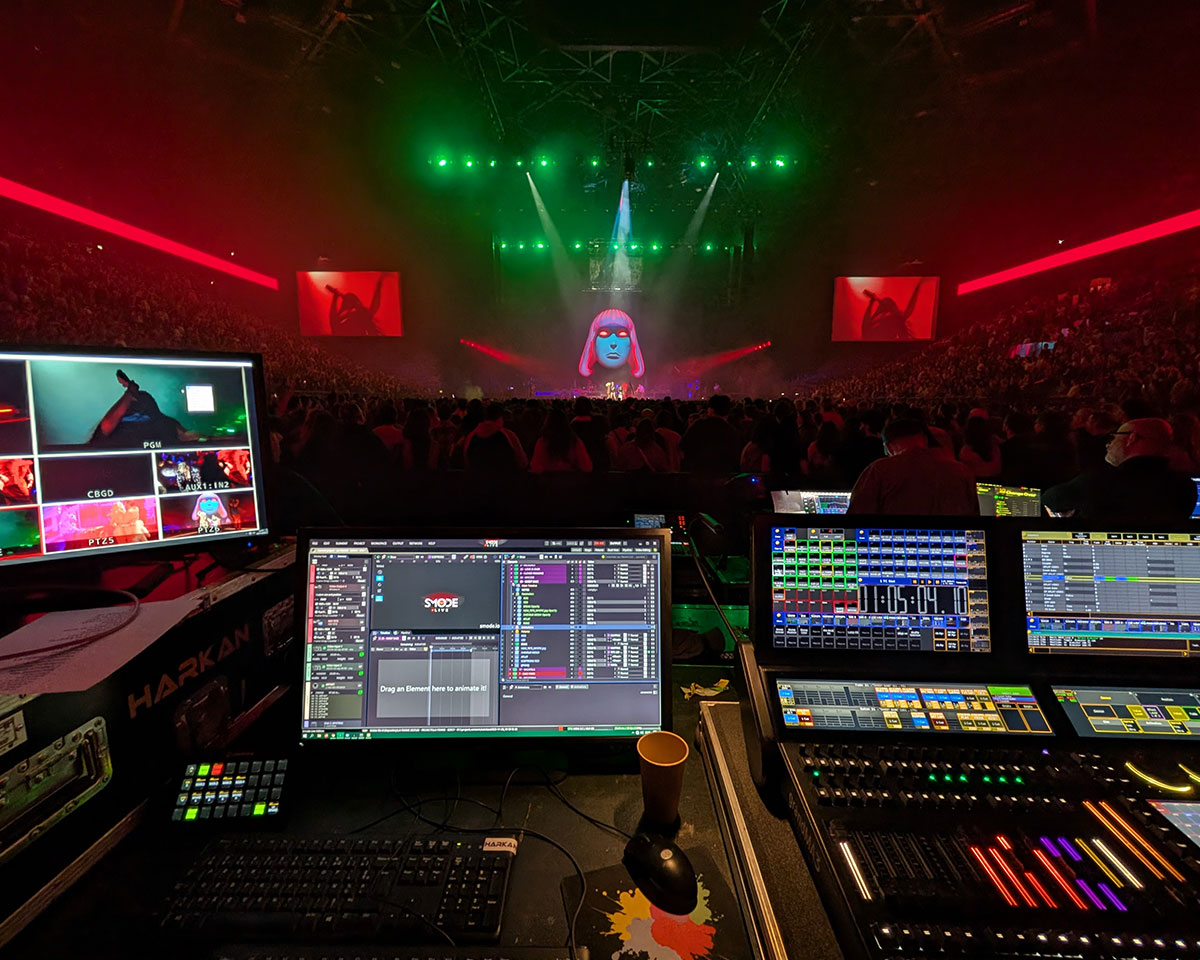
SMODE played a central role in delivering the striking visual universe for French rock band La Femme’s very first concert in France’s largest indoor venue: the Accor Arena in Paris. After starting in small Parisian clubs and performing at venues around the world, the band recently conquered one of the biggest stages in France to present its latest album and celebrate more than ten years of career with their fans.
Working alongside long-time collaborator and lighting designer Rémi Deschamps, Quentin Brard, the SMODE operator on this tour, helped shape the show’s artistic direction using real-time video workflow that underpinned the ambitious scenography.
Brard was invited onto the project by Deschamps and quickly became a key creative and technical contributor. The visuals behind the show were crafted collaboratively by Deschamps, film director Ilan Zerrouki – who made a lot of the videos and album covers for La Femme – and Brard himself. “My role as SMODE operator extended to an active participation in the artistic development of the show. There was no creative studio or director, as the whole visual aspect of the show was created by Remi, Ilan and myself,” he explained. “There was a great deal of creative freedom, which made the project both exciting and demanding.”
At the heart of stage design stood a dramatic eight-metre inflatable head fitted with LED strips embedded in its hair, eyes and shape. This facial centrepiece was brought to life through projection mapping using two Barco projectors, with a 24m x 12m semi-transparent 40mm pixel pitch mesh LED screen on the back of the stage. Additional video elements included a 24m x 3m semi-transparent LED banner above the stage, a left-right IMAG projection, two 11-metre runs of Martin Sceptron linear battens along the proscenium, as well as the fixed LED ring that runs around the entire venue.
To power all the content to this wide range of video elements, the team relied on two SMODE servers, delivering four 1920/1200 outputs and a 1024/1024 NDI feed dedicated to the head’s LED strips. SMODE’s flexibility allowed Brard to manage and encode the entire system with precision. “SMODE enabled us to send content to all the different surfaces, while making it easy to encode the LED strips on the head shape and the battens that ran along each side of the proscenium,” he said. “We could also enhance camera feeds with stylised effects that extended the scenography and creative camera motions.”
SMODE’s compositing engine proved particularly powerful in the creative process. All content for the LED strips on the head was generated directly within the software using its extensive toolbox (Uniform, Masks, Noise, 2D transform and Modifier). The same applied to all camera effects, where Brard used tools such as People Mask as well as a multitude of modifiers including Feedback, Sobel, Frame Delay, Blur or Kaleidoscope to craft unique content. Several visual “paintings” and the entire LED ring were also created and adapted within SMODE, which simplified the integration workflow.
A significant portion of the video content was created by Ilan Zerrouki, known for his work with the band, with the team further reworking existing materials inside SMODE. The video element played a core role in the show, often driving lighting fixtures as well as the inflatable head. With everything integrated into a grandMA2 session, lighting and video interacted fluidly: “Sometimes the light led the show, sometimes it was the video, and sometimes both worked together to produce combined effects,” said Brard.
Brard praised the creative possibilities unlocked by SMODE. “It’s always a pleasure to work with SMODE and its compositing power,” he said. “On a show with this level of creative freedom and such a substantial video kit, it really made the impossible achievable.”

