
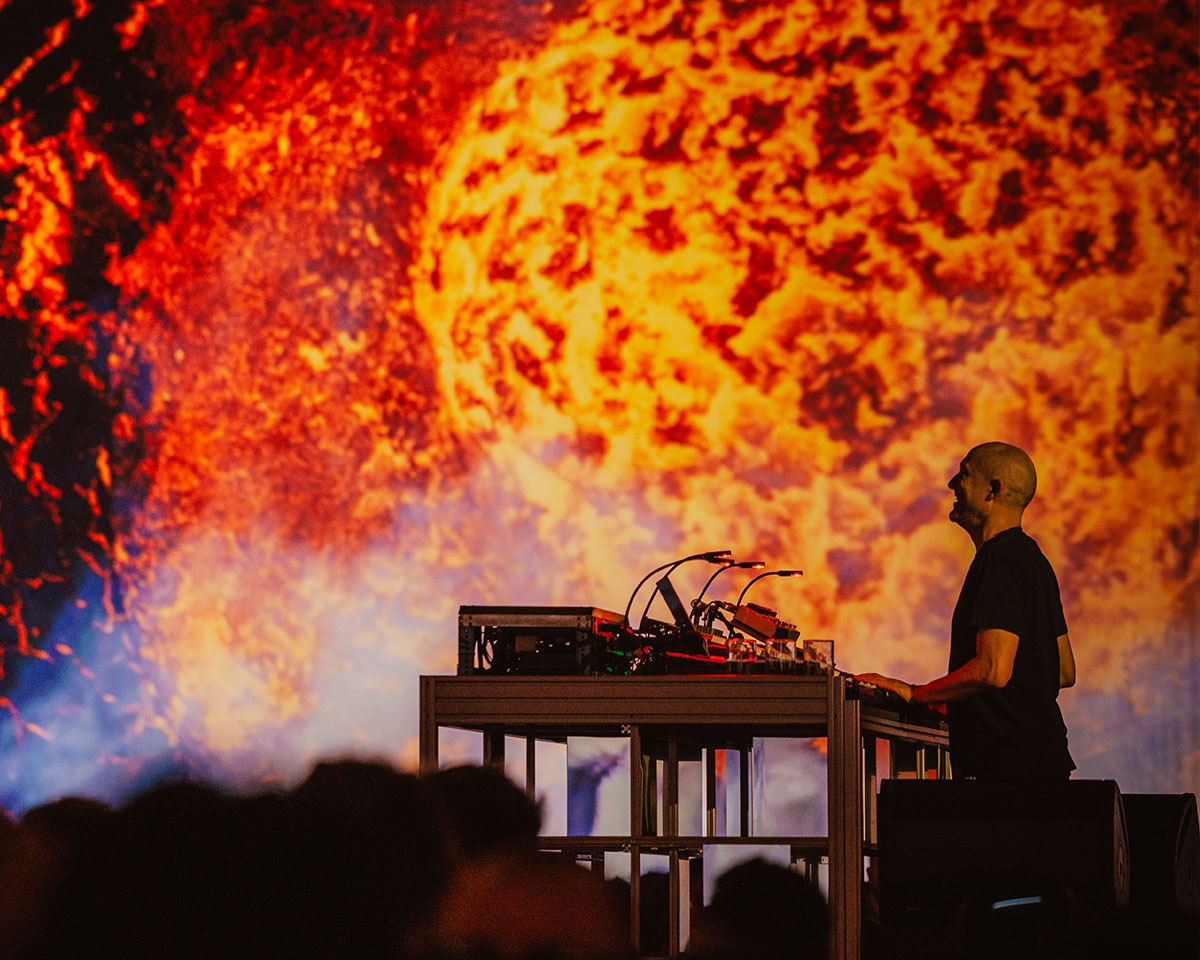
Spanning Mexico City, Los Angeles and Paris, and creating 30 individually unique concerts, Cercle Odysseymarked a turning point in live AV production. Combining live music with real-time visuals, spatial audio, synchronicity and rich narrative, the project demanded an unprecedented level of integration between performance, technology and environment. At the heart of this live, multisensory experience was SMODE – powering generative visuals, compositing and playback in real-time across a massive projection surface.
The brainchild of French music platform Cercle, Odyssey was conceived as a new type of ‘nomadic’ concert – monumental in scale yet intimate in execution. Audience members entered a 2,300m² structure surrounded by 50-metre-wide and 12-metre-high screens on all sides with the artist placed at the centre. Every aspect of the show was designed to immerse the audience in a cohesive journey, from multi-layered audio and cinematographic visuals to the diffusion of specific scents.
“This is a new type of immersive and nomadic concert experience,” said Cercle Odyssey’s visual creator, Mathieu Glissant. “We travelled the world with a monumental installation – a mobile immersion space with giant screens, a central stage, spatialised sound, synchronised scents: everything is designed to offer a completely new multisensory experience. The aim was to reinvent the way people experience music at concerts.
SMODE was chosen as the media server and real-time visual engine for the project, provided by Alabama Média, part of Groupe Novelty, using its proprietary X-REAL media server bays. A total of eight servers (including four spares) handling 12x4K feeds, each equipped with SMODE licences, powered the demanding multi-screen projection setup. The video signals were transmitted via HDMI over optical fibre, with Lightware distribution systems ensuring low-latency delivery to the projectors.
Visual content was not pre-rendered – it was created, adapted and synchronised live, making each concert a unique, once-in-a-lifetime event, not to be replicated again. SMODE enabled operators to control and modify media directly during the show, making it possible to respond to each artist’s unique needs and performance style. Original content was supervised by Cercle and created in collaboration with Paris-based creative studio Motion Palace’s director Neels Castillon and his team.
Every Cercle Odyssey show was a singular, site-specific creation where artists such as Ben Böhmer, Rawayana, Max Richter, Monolink and Moby, amongst others, brought their own individual musical style, with the help of SMODE to tailor unique content for each performance. While shared media libraries were often used as a starting point, they were continually reinterpreted and rearranged according to artistic direction thanks to SMODE’s versatile real-time compositing workflow.
The software offered two essential playback modes: timecode-synchronised for precision-triggered sequences, and interactive live mode for improvisational control. This duality gave the team the freedom to respond to the performance dynamically, controlling parameters like colour, speed, intensity and orientation on the fly. The visuals themselves were often fully generative, with no external media files. SMODE calculated effects in real-time, allowing content such as particle clouds, 3D sprites or nebulae to evolve continuously in sync with the music.
SMODE visual operator Morgan Davodet controlled the show live using SMODE as the central tool. Depending on the artist, content could be triggered with a console or even manipulated through gesture-based tools like a theremin, all within a setup that maintained fluid performance even at ultra-high 8K resolution across five synchronised projection surfaces.
SMODE’s 3D preview functionality was instrumental throughout the preproduction and planning phases. It enabled the team to visualise each concert environment before the physical stage was even built. This made it possible to test camera angles, sequence transitions, and spatial layouts in advance, increasing creative efficiency and minimising on-site setup time.
“Each concert is different, and each artist has their own specific needs. SMODE allows us to adapt visual content to each performance without having to start from scratch. It allows us to reconfigure, reinterpret and reorganise media libraries according to the artistic requirements,” he said.
For instance, Davodet continued, “We have developed generative content using SMODE to create visual bridges between reality and digital elements. These elements are entirely modifiable in real-time – colour, speed, density, orientation – and we can control them through various interfaces, such as a console or even a theremin for gesture-based interactions.”
Indeed, all the parameters can be adjusted on the fly. “We can trigger, modify, and improvise during the show,” added Davodet. “For example, we can rotate a virtual camera around a particle cloud, adjust intensity live, add effects like ‘glowing mosquitoes’ and so on. And everything remains smooth, even at high resolution.”
Technical and creative teams also took advantage of SMODE’s capabilities in controlled studio environments. Preproduction was carried out at Groupe Novelty’s immersive studios. These spaces enabled teams to build immersive content workflows around SMODE and preview the results with spatial audio and full projection simulation.
Groupe Novelty’s project manager, Julien Pagnier, led the event’s immersive audio design department (technical direction, sound design, pre-production support, and object-based mixing for the bands). Pagnier spoke with each artist team before and during their performance to add 3D sound positioning in the space and enhance each session with additional layers of immersive audio, also based on the visual content presented during the show.
“The real challenge was to deliver an immersive mix that was both fast and efficient, while preserving the codes of a traditional concert setup. The immersive concert concept truly shifted the live experience into another dimension.”
The scale and complexity of Odyssey required absolute stability and performance under pressure. SMODE provided the reliability needed for daily immersive shows, with each day’s programme comprising a new immersive mix created from scratch.
Its real-time architecture enabled last-minute creative changes or operational corrections to be made during live performance, without compromising visual fidelity. For instance, the team could rotate a virtual camera around a generative particle effect, apply visual treatments (such as glowing mosquitoes mentioned by Davodet), or modify parameters in real-time to match the evolving tone of the performance. With this level of control, each audience witnessed a truly unique, singular experience – a one-off interplay of music, visuals and space.
In addition to providing the video infrastructure and SMODE-powered servers, Alabama Média, played a wider role in the production, overseeing logistics, technical coordination, setup and management of all video content. As the industry’s only technical service provider with a dedicated immersive sound department, Groupe Novelty also played a significant role in the project’s audio system, with Alabama providing audio services as well.
The video and audio systems were deployed by Dushow (a Groupe Novelty company) in Paris, with immersive front-of-house setups and a powerful L-Acoustics system tailored for object-based spatial audio mixing. The integration of the SMODE visuals with Odyssey’s sound design, managed using Spat Revolution and MiRA (FLUX::), created a tightly coordinated AV environment that allowed the audience to feel visually and sonically immersed.

