
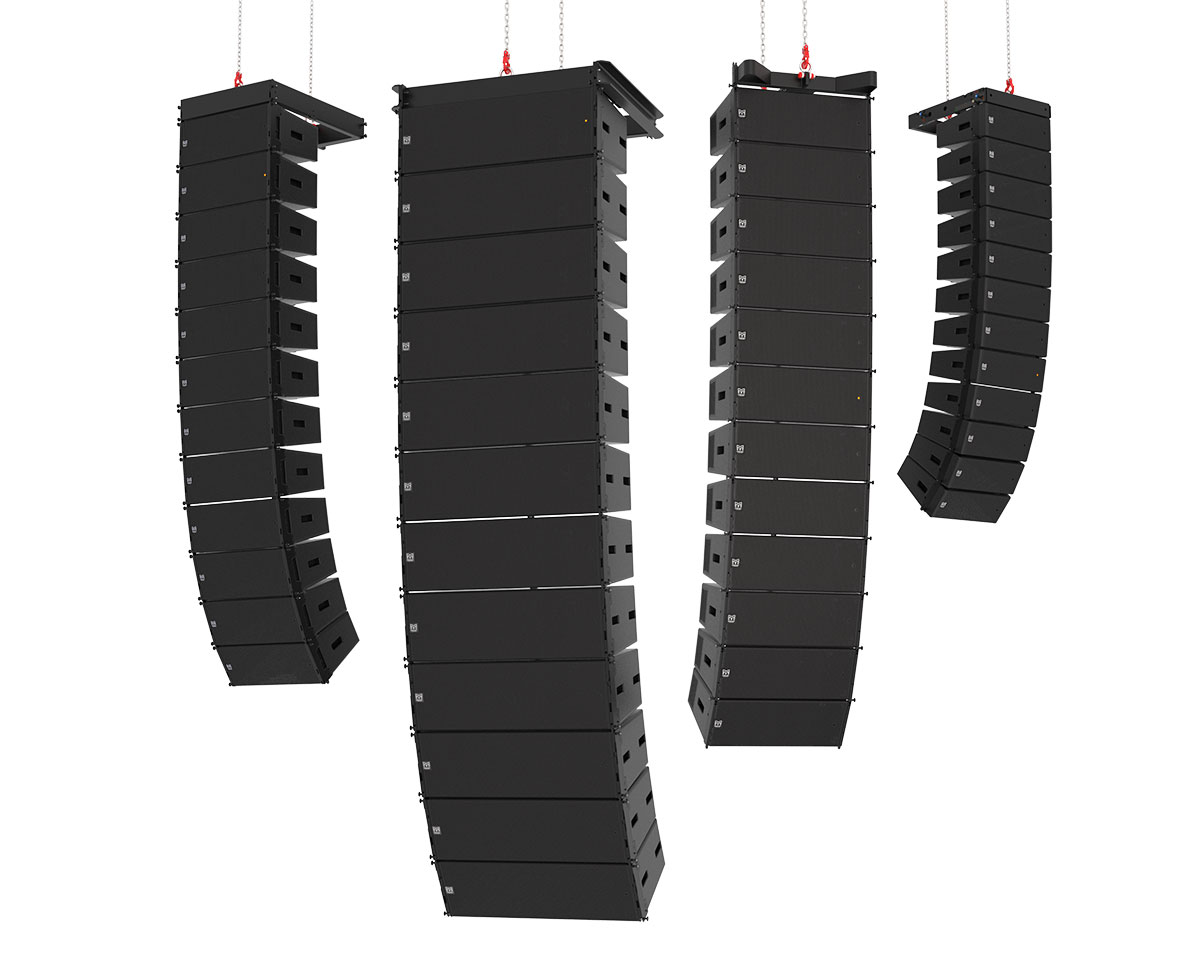
How long has the Wavefront Precision been a part of the Martin Audio line-up?
“Wavefront Precision has been part of the Martin Audio family since 2017, when the WPC and WPM were introduced as the first two models in the series. Two further formats followed in 2019 – WPS and WPL – completing a four-model family that scales from compact corporate work all the way up to arena-scale touring. That breadth of coverage is a deliberate part of the design philosophy: the same core optimisation principles, applied across different throw distances and SPL requirements. It’s now the best-selling line array family in Martin Audio’s history, with a proven track record across global festival sites, major tours, theatres, houses of worship, and permanent installations.”
Could you describe the hardware updates to the line array and the SXH218 subwoofer?
“From Q2 2026, every Wavefront Precision enclosure ships with a significantly more robust construction. They are stronger, smarter, faster, and higher precision. The enclosures carry an IP54 rating, with corrosion resistance, heat, cold and humidity protection, and UV stability all addressed through improved materials and manufacturing methods. With upgraded paint finish and stronger metalwork, Wavefront Precision is built to handle the daily realities of touring without degradation over time.
“For rental companies, that translates directly into longer asset life and stronger return on investment. The grille now incorporates an LED indicator, controllable via VU-NET software. That means a technician can identify any individual cabinet in a hung array from the ground or FOH and confirm it’s correctly patched and wired, without climbing or guesswork. On the SXH218+, the same LED appears on the rear panel as well, so whether the sub is deployed in standard or cardioid configuration, positive identification is immediate. It’s a small addition that removes a real-world headache.”
Could you also describe some of the updated features in DISPLAY 3 software?
“The processing engine in DISPLAY 3 runs 27,000 times faster than DISPLAY 2. In practical terms, a complete system optimisation on a high-spec laptop takes under ten seconds; a single hang adjustment is resolved in under a second. That speed fundamentally changes how much design iteration is possible during the hours before doors open.
“Rather than committing to a prediction and hoping it holds, engineers can model multiple configurations and refine the detail. This is particularly useful across complex festival sites where every stage has a different geometry and audience area.
“Snapshot storage is another step forward. Up to 20 optimisation snapshots can be stored per array, so when site conditions change, for example, when crowd density builds, wind shifts, or weather rolls in, switching to a pre-calculated solution is immediate rather than requiring full re-optimisation from scratch. Low frequency control has also been improved.
“The new goal-setting tools include a ‘Don’t Care’ zone function, which instructs the algorithm to not waste DSP on non-critical areas, and focus where it is absolutely required. Hence, if there was a zone that was less critical, this could be the designated ‘Don’t Care’ zone, whereas utilising the DSP with Hard Avoid functionality provides up to 30dB of reduction in designated areas.”
How can these updates be incorporated into rental houses’ existing stock?
“Retro-compatibility has been central to how this update has been structured. All existing Wavefront Precision inventory is forward-compatible with the new systems, so a rental house running existing inventory doesn’t face a forced replacement cycle. For those who want the physical hardware improvements, upgrade kits are available and these add the enhanced weatherisation treatment and the LED indicator to grille components. The same applies to SXH218 owners. Critically, the DISPLAY 3 software benefits of faster optimisation, improved LF control and enhanced voicing are available to all existing Wavefront Precision owners regardless of whether they take the hardware upgrades.”
What will these updates mean for end users?
“The updates span hardware durability, field workflow, and software capability so the intent is that both existing and future partners feel the benefit from a system that is stronger, smarter, faster, and have higher precision. Stronger systems that withstand tougher conditions stay earning longer. Faster optimisation means better-designed deployments, not just quicker ones. The low frequency control improvements open up flexibility in how engineers approach line length and coverage – particularly relevant in the increasingly complex noise management environment that festival and live touring operators work within.
“The aim is that Wavefront Precision continues to be what sound system engineers reach for when the deployment demands a smarter approach with higher precision, not just raw output.”
Words: Dom Harter
Photo: Martin Audio

