
At today’s live music and entertainment events, the quality and level of immersion delivered by production teams have never been more important. Driven by truly spectacular visual and audio experiences, audience expectations are at an all-time high, and artists need to ensure that the impact of every show is optimised for each venue, regardless of location.
A huge amount of creative effort goes into the production process, with set, lighting, video and sound design integrating to create a seamless visual identity that can be re-imagined for each performance.
Less well-known is the role that logistics plays in channelling the efforts of designers and technicians who depend on precise planning and movement to bring their concepts to life. Indeed, freight logistics is an integral part of the picture, even at the earliest stage of live event planning. For instance, logistics specialists are often consulted before shows are even announced, with decisions about how much equipment can be transported and how quickly, having a direct impact on production design and the various systems used to create the live experience.
These practical boundaries act as creative parameters, with issues such as what can fit on a 737 or 747 becoming part of the design brief. As a result, freight planning can determine the scale, configuration and visual ambition of a production. For large tours, logistics input can even shape the concept itself, with some productions designing multiple versions of a show (for example, a main arena format and a smaller fly-away version).
CREATIVE PLANNING MEETS REAL WORLD APPLICATION
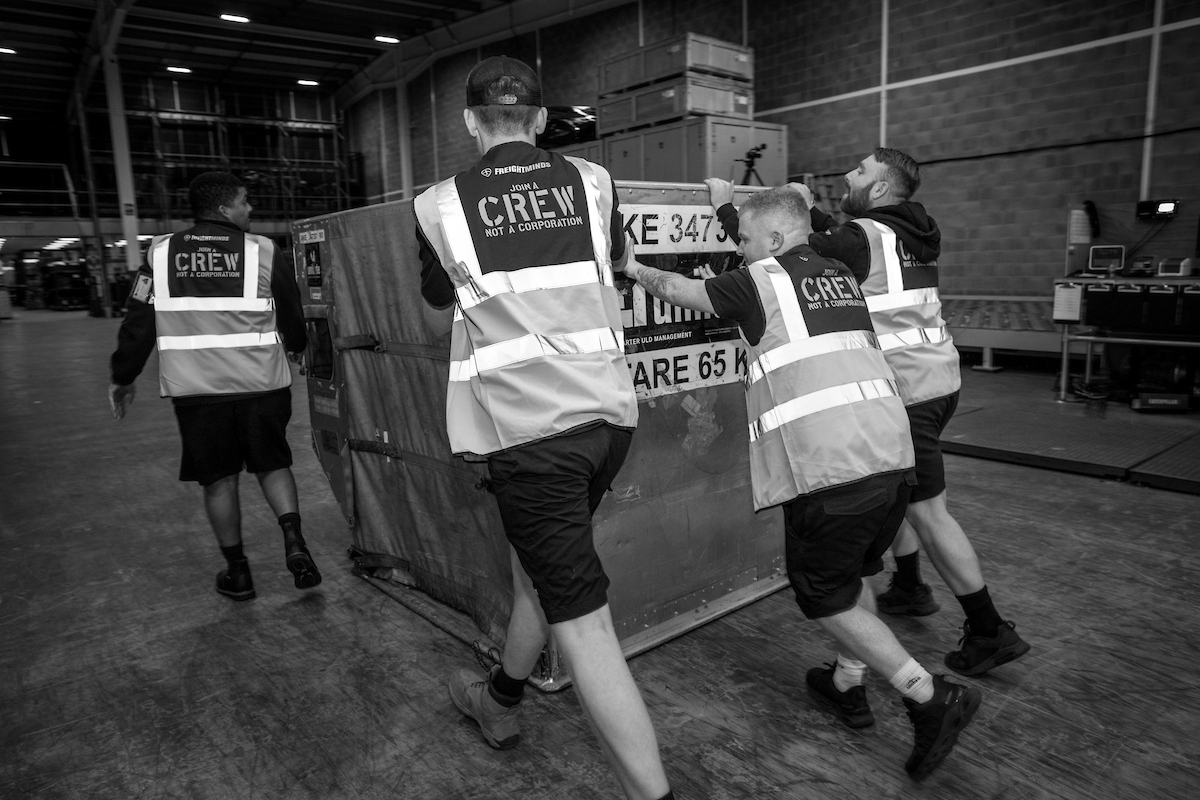
Take the challenges associated with turning around a large production, from one venue to another, in just 24 hours. This is a common requirement and, in practice, requires production and logistics staff to complete a full deconstruction and rebuild – including lighting, video walls, sound systems, instruments and stage structures with little room for manoeuvre.
Typically, the process works like this: once the performance finishes and the audience leaves, crews load trucks in a defined sequence and head to the airport. On arrival, the trucks are offloaded, and the equipment clears customs before the cargo is screened, palletised, and secured for flight, sometimes using sniffer dogs or x-ray equipment. Airline pallets are then built so the items required first at the next venue are placed for priority unloading. After flying to the next destination, the shipment clears customs again, the pallets are broken down, and the equipment is loaded onto trucks in the correct order for transport.
Rigging and lighting are typically delivered to the venue first, with backline equipment following last, helping each department follow a strict build sequence.
Every stage is subject to potential disruptors, such as delayed flights, customs bottlenecks, technical faults, bad weather, or other challenges, and all of these activities are frequently coordinated across multiple time zones to ensure that the next show can begin as scheduled.
Clearly, these timelines are extremely tight, so teams plan multiple contingencies and must be ready to get creative, with resourcefulness and improvisation playing major roles in finding new solutions when plans unravel.
This problem-solving mindset keeps the process running, as modern logistics requires teams to apply experience and intuition, not just procedure.
Bring all these elements together, however, and touring productions can deliver a win-win of events that deliver the experiences artists require in each venue and audiences expect from world-class live entertainment.
Words: Matt Wright
Photos: Freight Minds

