
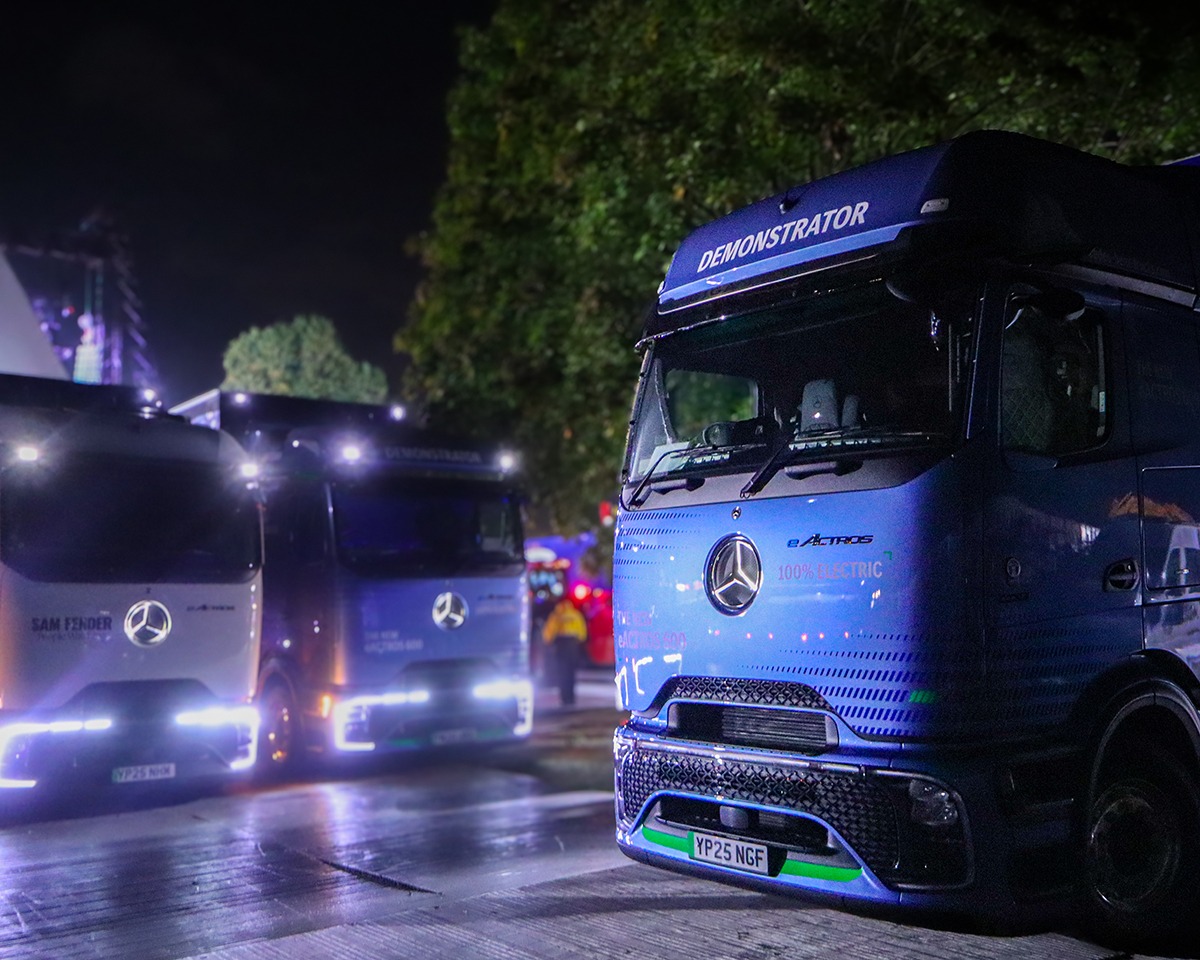
In a world of social media finger-pointing, it is hard not to feel sympathy for transport companies in the live touring industry. Anytime the topic of sustainability comes up, too often naysayers in the comment sections state how terrible the vehicles are for the environment. But often, these are the very companies that are thinking outside the box to create more sustainable solutions for their customers. It was for this reason that we opted to put together an article to highlight this hard work. Then, serendipitously, the topic made headline news when it broke that Sam Fender’s latest summer run of shows had utilised electric HGVs.
With this news ringing in our ears, we set course (via train) to dig past the mainstream headlines and learn how the production industry is pushing the limits of sustainable travel. Our first stop was an industrial estate just outside Nottingham – the home of logistics specialist KB Event who provided four Mercedes-Benz eActros 600s for Fender’s latest run. “Our history of using electric trucks started during the first ACT 1.5,” commented KB Event Managing Director, Richard Burnett, discussing the company’s involvement with Massive Attack’s project that aimed to reduce carbon emissions created by a live show.
“The band’s Tour Manager, Jamal Chalabi, came to us explaining that they were looking to power the show by batteries and therefore required the creation of an electric tank,” stated Burnett, who then explained how this required weeks of planning and collaboration with e-trucks from Volta [a company that has sadly since gone out of business] and using specially ADR-trained drivers.
Following the successful solution, KB was asked to aid in Massive Attack’s LIDO performance, which led Burnett to reach out to all the major trucking manufacturers to see if there might be another solution out there. “The biggest issue with all the trucks on the market was the range, which was only around 120 to 160 miles,” stated Burnett, noting how this is impractical in the world of live events.
However, the launch of the new Mercedes-Benz eActros changed this reality. “It has a range of 500km [310 miles],” Burnett revealed. “It’s a real game-changer.”
With the right tools in place, KB Event began working with the Massive Attack team to create a plan for LIDO Festival, which not only involved the load-in and load-out to the festival site but also a run into Co-op Live to pick up the production. During the planning, Burnett was approached by Sam Fender’s Manager, who asked if the same package might be used for a multi-date tour for the Geordie superstar.This use of eHGVs is a giant step forward when it comes to sustainable travel, but Burnett highlighted the logistical challenge of moving an entire tour onto electric.
“We couldn’t fail,” chuckled Burnett, while explaining the pressure of delivering a show to thousands of people waiting in the next city. The entire team agreed they had to commit to the idea and not simply have several diesel trucks on standby if anything went wrong. He was complimentary of the KB drivers who threw themselves into the project. “They were sceptical initially, thinking it would be like driving a milk float, but after some driving, they were very impressed and keen to push the limits of the range.”
JOINING THE E-REVOLUTION
One of the biggest issues facing a full move to electric vehicles – which Burnett and the KB team admitted – is the logistical challenge of where to charge. For the Sam Fender project, the company had to rely on publicly available charging points. “None of the major arenas in the UK have the ability to charge the vehicles, so our only option currently with this solution is to drop the trailers and take the trucks to a car charger,” explained Burnett, adding that this solution, if taken on, would require an even greater level of planning than a standard tour.
Another company that has invested in the electric vehicle market is Stagetruck, who last month took delivery of two new MAN electric trucks at its HQ in the Netherlands, with the company also installing charging facilities for them at its base. “They are at such an early stage of adoption that the infrastructure required is a huge obstacle,” stated Director Sarah Tobias, describing the strain charging vehicles has on the local power supply as well as their lack of range. “It’s crucial that we make these strides,” she continued. “The Netherlands is such a small country that the range limitation isn’t a problem, and we’ll continue to scale our fleet there at pace. However, in other parts of Europe, electric vehicle infrastructure is years away.”
She continued to suggest that hydrogen options might effectively leapfrog electric vehicles as a solution for the touring market. “The evidence is clear that the range limitation of eHGVs, the lack of charging infrastructure, and enormous power requirements for charging are huge barriers to the adoption of electric trucks at scale. We feel there is an education job to be done with the wider public and touring community, who naturally look to this as the answer as awareness about EVs has grown exponentially.”
Pieter Smit, in recent years, has made major investments in the EV market – with vehicles and by building a dedicated charging hub for its truck fleet. “In the coming years, we will expand our electric fleet,” stated CEO Louise Smit, explaining how it is one pillar of the company’s green initiatives. “This autumn, Pieter Smit Group is running three tours fully electric, and we are now entering into formal agreements with productions to tour fully electric going forward. This demonstrates our proactive approach in sustainable touring.”
Smit highlighted how recent European Regulatory Support has meant that electric touring across Europe is becoming increasingly feasible thanks to the AFIR regulation. “This requires EU member states to install truck charging stations every 120km,” she explained. “Combined with the development of megawatt chargers, this infrastructure will significantly accelerate the adoption of electric heavy vehicles for touring.”
HVO
Although these latest developments in electric power are important to pay attention to, logistics companies are making great strides in finding alternative fuels – namely HVO. “The emission reductions with HVO are staggering and the technology is here now and in use,” said Tobias. “The only limitation is knowing where trucks can refuel and covering the additional costs of its usage.”
Stagetruck recently concluded tours with Coldplay and Ed Sheeran, providing trucks that all ran on HVO, along with a full summer of shows with Billie Eilish also using this fuel source. “HVO reduces emissions by a staggering 88%,” stated Tobias. “There is some resistance to the additional costs due to the lack of awareness, but more awareness through publicity and peer-to-peer education will be a huge step forward.”
It is this goal that led Stagetruck to partake in the Coldplay-led study currently being carried out by MIT. “They [MIT] usually specialise in urban metabolism but have applied their expertise to carbon emission reductions in live touring. We’ve loved being part of the advisory committee and the work they have done is brilliant from what we’ve seen so far,” she reflected.
KB Events CEO Stuart McPherson started on the HVO journey back in 2018. “We started to offer it to some of our corporate clients, although some were still sceptical of this solution,” he recalled, revealing that he once spoke to Google’s Sustainability team, who were unsure of the solution, but then after seeing the research, invested in the solution for a project. “Sustainable diesel – or what we call HVO – in the journey to Net Zero is the only way to get there while we bring in other solutions,” added Burnett. “That, paired with Euro 6 engines and ensuring that the HVO is palm oil free,” continued McPherson, who explained that when KB offered an HVO solution to customers, they always stipulate that their fuel is palm oil free. “Since 2019, while travelling through Europe, it is so much easier to offer an HVO solution to our customers.”
TRUCKINGBY has made significant investment in HVO in recent years with the installation of a 50,000-litre HVO tank at its Featherstone HQ. “Most production managers now request an HVO option and while we know tour budgets are always a key factor, we work hard to provide the most competitive rates possible,” stated Melissa Ness, Live Events Office Manager at TRUCKINGBY. “Currently around 25% of tours by us are running on HVO.”
All the operators expressed that the investment in this alternative fuel requires buy-in from artists and upper management. “Our fleet has all been brought up to Euro 6 standard and we are going to implement the use of HVO by the end of the year. Demand is growing from artists, promoters and venues, but more sporadically than an outsider might perceive,” explained Tom Curtis of Fly By Nite.
“We’re seeing a clear and growing demand for sustainable solutions from the artists and productions we work with,” commented Smit on the demands that Pieter Smit had received in recent years. “In some cases, this is driven by external requirements to meet environmental standards. In others, it stems from a strong internal commitment to sustainability. We’re currently running a project involving 120 trucks powered entirely by HVO. Which shows the momentum toward greener practices continues to accelerate.”
As well as the trucking companies, the likes of Vans For Band is pushing the envelope when it comes to alternative fuels. “We’re constantly looking for new ways to reduce our environmental footprint,” began the company’s Director, Tarrant Anderson. “This has involved progressively upgrading the fleet to all Euro 6-rated vehicles, and we ran our first European bus tour fuelled by HVO last year for Australian band Lime Cordiale, who were filming a documentary for Netflix about sustainable touring.”
Anderson and the team asked for the advice of KB Events, which enabled them to offer HVO as an option for bus tours and van hires from mid-2024 onwards. Despite the success of incorporating HVO into its business, Anderson pointed out the “harsh economic realities” that are holding back its widespread adoption. “We’re by far the largest provider of passenger transportation services for grassroots and mid-level touring artists in the UK, so we get a good overview of what the pressures are,” he commented. “If artists can make a sustainable choice, they virtually always will. But there are harsh economic realities at play, and the difference between fuel with HVO for a month’s tour and normal diesel is not insignificant to them.”
OUT OF THE BOX
One trend that emerged while bringing up the conversation of sustainability with many of these transport operators was how many were thinking outside the box to find sustainable solutions for day-to-day operations. Fly By Nite, for example, at its rehearsal facility, is recycling all its cooking oil, which gets turned into biofuel, while also installing air-sourced heat pumps. Vans For Bands meanwhile has experimented with the use of solar panels on its sleeper buses. “This is to help offset the power draw from landlines when parked, enabling buses to park without shore power or engines running,” said Anderson.
Stagetruck, in the Netherlands and the UK, has installed giant water tanks to collect surface water. “This means we can keep our vehicles spotless by using grey water with minimal environmental impact,” stated Tobias.
Many of the companies also expressed their constant analysis of working practices out on the road that can significantly reduce carbon emissions. “Fuel emissions are monitored each month, and drivers’ performance is reviewed regularly,” explained Ness, outlining TRUCKINGBY’s internal procedures. “Eco-drive training is provided where needed, and our fleet managers work to minimise empty journeys.”
A similar protocol is also run at Fly By Nite, as Curtis explained: “All our trucks are GPS tracked with up-to-the-minute location information, which allows more accurate planning, less dead mileage and wasted time. Internal system changes allow more efficient route planning, reducing unnecessary mileage.”
Smit added: “I’m a strong advocate for circular thinking. The construction sector is leading the way with modular building, material reuse, and CO2 tracking throughout the entire process. These frameworks are measurable and scalable, and touring can benefit from adopting them. It’s not always about replacing everything with something new; it’s about using what we already have in smarter ways. That mindset helps reduce impact without overwhelming the system.”
Many of these beliefs are being incorporated in the fabric of Pieter Smit’s new facility, which is in the process of being built. “It’s a big project, and an opportunity to learn and apply new techniques,” remarked Smit.
THE SOLUTION?
There is a sense among logistical operators that they wish to be ahead of the curve when it comes to sustainable offerings. The fact is that in the UK, by 2035, there will be no new diesel cars or vans sold, meaning that in only 10 years there will need to be a shift in mentality when it comes to transport. However, as is characteristic of those working in the events industry, many transport companies are attempting to find solutions before problems arise and are offering options for artists wishing to do something different.
The future seems uncertain as to what the vehicles may look like – and be fuelled by – but at the heart of this journey, the same age-old dilemma of better communication between promoters and productions seems to be one way the sustainability needle can be pushed. “More sharing of best practice case studies to inspire and benchmark others,” commented Curtis, while discussing what incentives might lead to change. “If everyone was transparent about successes and failures, it would lead to greater changes, as sustainability is often about incremental improvement and trade-offs.”
Ness concurred: “From a live events perspective, one of the most effective ways to drive sustainability is through collaboration across the entire supply chain – from promoters and production managers to transport and venue teams. Incentives such as supporting venues with renewable energy sourcing or highlighting sustainable practices in marketing materials can all encourage wider adoption. Ultimately, visibility and recognition for sustainable efforts can be just as powerful as financial incentives in driving change across the industry.”
Anderson added: “Mark Davyd from the MVT [Music Venue Trust] has a vision for the future of sustainable touring, which is pretty inspiring and critically recognises that sustainability in touring will only be achieved by also tackling the economic barriers that both artists and venues currently face. It’s not just about having environmentally friendly transport solutions; it’s also about making it economically viable for artists at all levels to use them, and for venues being able to afford to invest in the technology and infrastructure to facilitate this.”
There will never be a one-size-fits-all solution, and no doubt there are still multiple chapters yet to be written in a more sustainable touring industry, but as always, we at TPi are interested in seeing what new innovative solutions the transport companies and the wider live events community bring to this ever-evolving conversation.
Words: Stew Hume
Photos: Tia Simpson, Stagetruck, Vans for Bands, TRUCKINGBY, Fly By Nite and Pieter Smit
www.brianyeardley.com
www.flybynite.co.uk
www.kbevent.com
www.pietersmit.com
www.stagetruck.com
www.vansforbands.co.uk

