
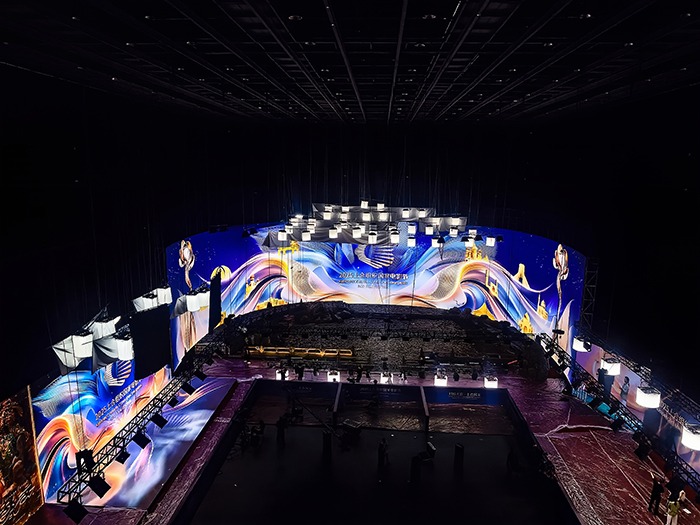
DAWA Studio’s Yongchuan Virtual Production Studio in Chongqing, China, has opened a new chapter in Western China’s technology-driven filmmaking capabilities. For Phase II, Brompton Technology’s Tessera LED video processing was selected to power the facility’s impressive LED workflows, delivered in partnership with AOTO Electronics.
Located in the urban area of Yongchuan District, adjacent to a high-speed rail station and a major transport hub, the site offers excellent connectivity, just 15 minutes by high-speed rail from Chongqing’s main city centre and 50 minutes from Chengdu. Anchored by the Yongchuan Virtual Production Studio, the project is positioned to develop a nationally leading digital film and television industry base and a Western China hub for technology-driven filmmaking.
Since the start of the project, the facility has grown rapidly in both scale and capability. Phase I, completed and commissioned in May 2023, comprises a total construction area of 20,000m², including 6,000m² of soundstage space. It includes one 3,000m² virtual production studio and one 3,000m² practical set construction studio, supported by make-up rooms, offices, meeting rooms, rehearsal spaces and other functional facilities. Phase II, completed in 2025, expanded the studio to 5 standard soundstages, including two high-tech studios, adding 32,800m² of stage space and enabling the simultaneous service of more than three mid-to-large-scale production crews. The broader Phase II project encompasses approximately seven acres (28,330m²), extending the campus with additional infrastructure including spaces for prop production, post-production, crew offices, personnel accommodation, warehousing and multipurpose facilities.
At the heart of the virtual production environment is AOTO’s RM1.9 LED display series, supported by Brompton’s Tessera platform. A flagship configuration also includes a 60m-wide by 10m-high curved main LED wall, complemented by four movable extension screens measuring 7m by 4.5m each, supporting fast scene changes and highly flexible on-set shooting.
To process and distribute content across the LED volume, Brompton has supplied 30 4K Tessera SX40 LED video processors and 60 Tessera XD 10G data distribution units. For the DAWA Studio team, Tessera’s value lies in ensuring the LED image captured by the camera is completely free of visual defects such as flicker, scan lines or artefacts, which, as Tiezheng Yang, Production Director at Dawa (Chongqing) Imaging Technology Co. notes, is “a fundamental requirement for high-end virtual production”. ShutterSync synchronises the LED refresh rate with the camera shutter to eliminate visual artefacts, while the Extended Bit Depth feature significantly enhances dynamic range in shadow areas, enabling cameras to capture far greater detail in low-light regions.
“On a stage like this, everything comes down to what the camera sees,” explained Yang. “We needed a processing platform that gives us confidence in clean on-camera capture, particularly when productions are pushing challenging shutter settings and lighting. Brompton Technology is the processor of choice for many of the world’s leading virtual production stages, both domestically and internationally. This extensive, proven global adoption provides strong confidence and assurance in our technology decisions. Software features like ShutterSync, and the ability to preserve detail in darker areas, were key reasons for choosing Tessera LED processors.”
Beyond image integrity, Tessera supports advanced colour management to meet the requirements of a wide range of productions, from commercials to feature films. The platform supports professional colour spaces including ACEScg, DCI-P3 and BT.2020, and enables real-time colour adjustment via on-set grading systems such as Pomfort Livegrade, supporting a true ‘what you see is what you get’ workflow. For multi-camera setups, Frame Remapping makes it possible for cameras operating at different frame rates to capture the correct image from a single LED volume simultaneously, expanding creative flexibility and improving shooting efficiency.
“Virtual production is at its best when it combines creative flexibility with operational reliability,” said Sebastian Kanabar, Head of Sales (APAC) at Brompton Technology. “DAWA Studio’s Yongchuan facility represents a significant investment in technology-driven filmmaking, and Tessera is designed for exactly this kind of environment, delivering clean on-camera performance, precise colour control and multi-camera efficiency, alongside the stability studios need day after day, while continuing to evolve through software updates to help protect long-term investment.”
Centred on virtual production technology, the studio deploys integrated systems including XR, VP and motion capture, alongside a second virtual production pipeline based on real-time green screen workflows. The wider facility also includes a digital human application platform and an on-site real time rendering and intelligent computing centre with 1,000 servers. The project holds over 200 patents and intellectual property rights, and to date RMB one billion (nearly 109 million GBP) has been invested in the construction of the Yongchuan Virtual Production Studio.
The studio’s virtual production system is designed to reduce the cost of filming complex scenes such as sci-fi and fantasy productions by up to 90% compared to traditional methods, while improving overall shooting efficiency by more than 55%. This supports the continued shift of virtual production from experimental use to a standardised, repeatable production tool. Since opening, the studio has hosted over 50 high-quality film and TV productions, including Project P, Resurrection, The Day I Happened to Come Back, and many more.
“Once known as a ‘natural film set’ and dubbed an ‘8D cyberpunk city’, Chongqing is now attracting productions from across the country through cutting-edge virtual production technology, turning creative imagination directly into on-screen reality,” said Chenliang, COO at Dawa (Chongqing) Imaging Technology Co. “Plans for Phase III are already under way, with commissioning expected by late 2026 or early 2027. Even more new technologies will be introduced. The future is well worth anticipating.”
“Yongchuan is a strong example of virtual production scaling at pace, and we’re excited to see how DAWA Studio supports everything from commercials through to premium film and TV work as the facility continues to evolve,” Kanabar concluded.

