
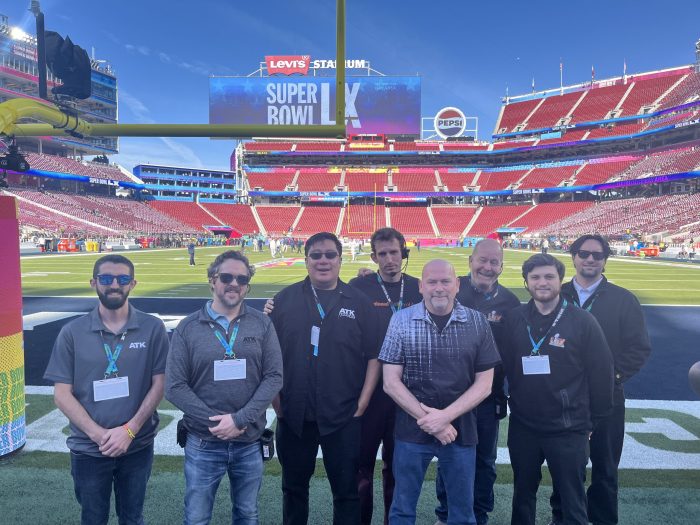
Santa Clara’s Levi’s Stadium held 70,823 fans while approximately 128 million viewers tuned into broadcast coverage which saw the Seattle Seahawks crowned 2026 champions over the New England Patriots. The event included a variety of musical performances; Bay Area punks Green Day began opening ceremony proceedings with a medley of their greatest hits, followed by Brandi Carlile’s rendition of America the Beautiful, a National Anthem performance by Charlie Puth and a version of ‘Lift Every Voice and Sing’ from rising star, Coco Jones.
However, it was one of the most talked-about halftime shows in recent memory, a 13.5-minute concert spectacular from six-time GRAMMY Award-winner, Puerto Rican megastar Bad Bunny, who made headlines as the first artist to sing entirely in Spanish throughout the Super Bowl’s 60-year history.
Game and entertainment audio was handled by veterans ATK Audiotek, overseen by Engineer in Charge, Kirk Powell, who has worked on the event for almost three decades. It’s a job that requires meticulous technical planning months before the musical acts are revealed.
Levi’s open-air construction called for total design flexibility this year; with no roof-hanging option, the audio team utilised both the stadium’s new JBL Professional house PA system – installed in 2025 by Clair Global Integration (CGI) – and a temporary L-Acoustics system. Both were crucial audio component.
Kirk commented: “The event is broken down into two parts: the game audio (commentary, sideline interviews, spoken word announcements), and the entertainment elements, including all musical performances. Essentially, we were working with two separate packages, the game audio used the house system, and the entertainment audio called for a bigger, portable, concert grade cart system that could be moved onto and removed from the field easily.”
The new in-house JBL bowl speakers are accompanied by new amplifiers, audio consoles, IEM systems and audio control room racks, as designed by technical design consultants, WJHW. This end firing system is situated at one end of the field behind the scoreboard and sits on custom rigging frames. The design consists of a mixture of VLA301Hi, VLA601Hi, and VLA901Hi models and Fulcrum CS218L-WR subs, powered by Powersoft Unica 12K and 16K amplifiers.
For the Super Bowl, these loudspeakers became extensions and delays for the entertainment sound, homing in on CGI’s ‘from construction to production’ capabilities, enabling venues to tie into high-performance event execution.
Charged with tuning both PAs and the creating the cart design, Systems Engineer Johnny Keirle returned to take up the mantle. He says: “We spent a lot of time trying to find a solution that would really work in this unique environment, but we obviously faced some design limitations due to the nature of the roofless venue. The result was impressive, sounding bigger than most people expected.”
Keirle’s design featured 18 cart positions around the field, each housing two KS28 subs, two K1SB subs, and either four or five boxes of K2, all powered by L-Acoustics’ LA12X amplified controllers running AVB Milan.
He continued: “I pushed to have extra amplified controllers so that the system could run more efficiently. One of the challenges of working with a ground-based cart system is managing the high d-ratio of the shortest distance to the longest throw distance. With a typical stadium system, throw distances are usually around 60m to the furthest seat and 30m to the shortest, but by contrast, with a ground-based system, we’re throwing as short as 6m to the closest seat and 110m to the furthest. Having those additional amps and more processing granularity was important for this year’s design.”
A plus of a ground-based cart system is how fast it can be moved and positioned with ease. In this instance, with eight ATK ‘quad leaders’ and 100-strong crew who manoeuvred the carts in groups of five. He continued: “We secured our ideal cart positions, but as football is the main event, there is a priority to protect the grass.”
Given the disparity of seats to speakers, auditory health was another priority for both ATK and the NFL, as Keirle furthered: “We have a very real responsibility to make sure people have an enjoyable audio experience at all live events: delivering impact while considering and preserving auditory health. That’s a main reason I wanted the increased processing granularity; it means I have far better control of the SPL profile across the varied throw distances.”
An additional challenge with any Super Bowl is its secrecy, a far cry from the genre-led designs engineers typically work with: “When I design a new system, I decide on targets that the system must perform to, to meet the criteria for the music. That’s always my starting point. However, I can’t define those targets for this event because like everyone else, I don’t know what the music content is for a long time beforehand.”
This level of secrecy also means the audio team gets very little time to make any noise during rehearsals, especially in an open-air environment such as Levi’s. “I design to what I think will be a good target, with a certain amount of low-end, low-end extension and contour, [dynamic changes in frequency, amplitude, and phase]. But the design still needs to work for the pre-game entertainment speeches,” he added.
Bad Bunny performed from within thoughtful architectural set pieces, including sugar canes plants, local street vendors, and atop electricity pilons, paying homage to beloved Puerto Rico. The performance also gave fans perfectly choreographed dancers who laid way for his impactful reggaeton style which would surely have blown the roof off – if there was one. As promised, Bad Bunny got the world dancing, and better still, he got the world dancing to the beauty of Latin American culture.
With special guests Lady Gaga and Ricky Martin’s vocals adding to the energetic set, the 2026 audio design truly helped to bring the party to the playing field, as Johnny confirms: “The outcome sounded great, and not just for a ground-based cart system. All the way up at the very top of the stadium, the sound was immediate; good low frequency and sub coverage for a vibrant and high energy halftime performance.”
The show was mixed by FOH engineers Alex Guessard and Dave Natale and monitor mixers Tom Pesa and Chris Daniels. The entertainment portion was mixed through a DiGiCo Quantum 338 at FOH, and Quantum 5 for monitors, with SD Racks. The in-game sound was mixed through a pair of Yamaha PM5 Rivage consoles, (one for production, another for the house band). Utilising a digital audio signal path, ATK built a powerful Dante-networked audio infrastructure, which included the Focusrite RedNet D16R MkII, A16R MkII, and D64R range of audio converters and interfaces.
Led by Matt Campisi of ATK Versacom, ATK’s dedicated comms brand, this team deployed sitewide communications entailing intercom systems for the halftime show, NFL Broadcast Executives, full stadium control and the production team. In addition, the crew also looked after the ‘tailgate’ area this year, a space located outside the stadium filled with TV network and music mixing trucks.
Campisi began: “We ran comms to the tailgate and had connecting comms to NBC’s truck for coordination lines, and the pre-show elements. We deployed a redundant network for our high profile and critical positions and worked with our in-house network team and Riedel Communications directly to devise the best result. “We didn’t experience any issues with our main network but having that back-up plan is always comforting – working on one of the most watched events across the world can be intimidating, but when we have a great team like we do, it makes all the difference.”
Riedel worked with ATK to obtain additional frequencies, creating more space for the plethora of wireless intercoms. Matt continued: “With that in place and working in an open air stadium, it made a great outing for our wireless technology which is always the most challenging part of a comms system. This year we provided over 100 matrix panels, 150 Riedel Bolero wireless intercoms, 44 Bolero antennas and 60 hardwire belt packs.”
Reflecting on the success of Super Bowl 60, he added: “It’s still the most challenging show I work on; I’ve been the Lead Comms Engineer & Project Manager for 27 years now, and as it grows, that experience really comes into play. There’s a huge amount of pre-production involved, but after all this time, this event remains the most gratifying accomplishment.”
Super Bowl LXI is scheduled for 14 February 2027 at SoFi Stadium, CA.

