
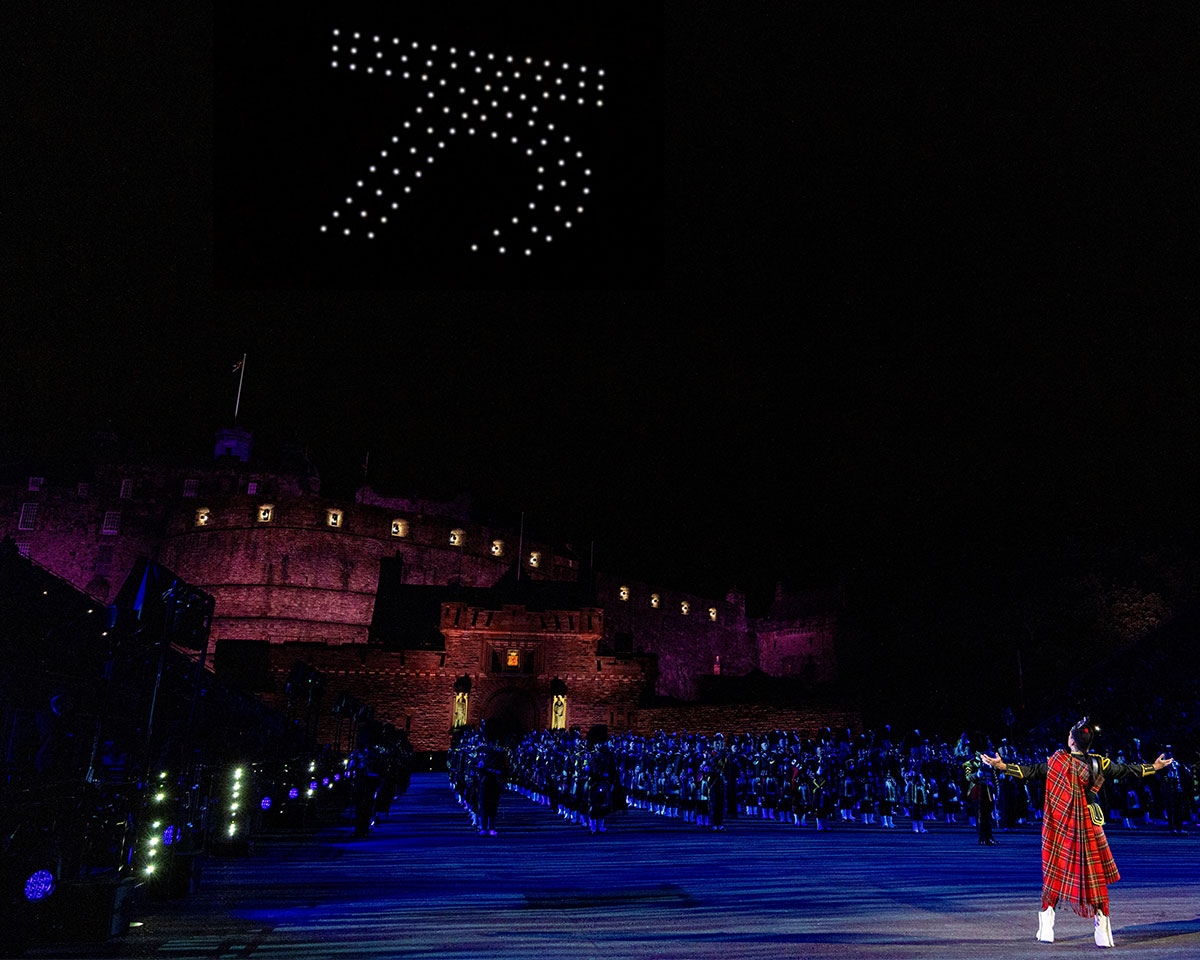
There’s no doubt that drones had a greater presence within the live events landscape in the UK throughout 2025. Whether it was hailing the coming of Oasis to stadiums across the country or their multiple appearances at festival grounds throughout the summer, it seems more creatives are looking to extend their visual canvas into the sky. Another famed event that sought aeronautical excellence in ’25 was the Royal Edinburgh Military Tattoo, with organisers bringing in AeroAVA to add drones into the wider creative conversation.
Discussing the company’s involvement with the project was Tom Rees, Managing Director of AeroAVA. Having first discussed the event challenges with Harry Guthrie, Production Director of the Tattoo, at the PLASA show in 2024, the seed was planted that drones could reliably and safely play a part in the production’s 75th anniversary, with AeroAVA Technical Director, Chris Bradbury, starting to plan site visits in the first part of the year. “We wanted to deliver not only something unique for the show, but also give something to the whole city as part of Edinburgh’s 900-year celebrations,” noted Guthrie. “The Tattoo is a unique event with unpredictable weather conditions, and has a daily audience of 9,000. Everything must work perfectly every single night. AeroAVA truly went above and beyond to ensure this exceptional collaboration went ahead.”
“A big part of this project was a close collaboration with Historic Environment Scotland as well as the ASSU [Aviation Safety and Security Unit within Police Scotland],” explained Rees, who stated that cooperation was vital both in the build-up, rehearsals and during the shows where planned flights took place. “We were in regular contact with all stakeholders throughout the show evolution process, coordinating with the Police when necessary and even had to cancel a small number of shows due to Storm Floris. In fact, one day the entire castle was closed due to the storm, the first time a Tattoo show didn’t happen in 75 years,” explained Rees, highlighting the importance of flying safely and planning for every eventuality.
On that note, one reason why the MD explained AeroAVA presented a good use case for the organisers was the company’s 2:1 separation to audiences. “Up to 50m of flight height, there is a rule of a minimum 50m separation from the audience. For most other drone companies, every extra metre above this height usually means that the crowd also needs to be an extra metre away. But due to our flight analysis and safety systems, we’ve proven a safe separation that works on a 2:1 ratio, meaning drones can fly in closer proximity and as high as 180m.”
Rees emphasised that his company’s involvement with the Tattoo was not to provide a stand-alone drone show, but to complement the overall production. The show featured 100 drones revealing the number “75”, 150m above the Edinburgh Castle Esplanade, synchronised with cast cues, sound and pyrotechnics for full audience engagement. Beginning with a young female piper pointing an illuminated torch skyward, the drones responded by revealing the anniversary motif, then rotating 360 degrees so the entire city could witness this historic milestone for the event.
Additional sequences throughout the display honoured military heritage and Scottish identity through 2D and 3D formations and lighting animations depicting military symbols, the Victoria Cross, musical representations, and Scottish symbolism, including a striking thistle formation representing how Scottish values spread across the world. Each look was designed and sequenced to timecode in line with all the other production departments.
Due to the special aviation clearances issued by the Police Air Safety and Security team, AeroAVA was able to provide two other elements within the overall production. The first was a stand-alone SFX moment separate from the swarm of 100 drones. Nicknamed ‘Tinkerbell’, the company provided a customised drone, with a specialist pilot, that acted as a ball of light, which the narrator of the show appeared to magically conjure up in his hands before soaring skyward.
“We also provided aerial filming services for the BBC broadcast of the event,” stated Rees, explaining the multiple solutions he and his team could provide for the overall project. “While drone display technology is evolving fast, our approach is focused on combining flight resilience, safety and creative boundary pushing,” mused Rees as he and the team look to the future of drone technology and its place within the wider events space. “These drone displays and effects serve the story, not the other way around, and our job is to deliver them to be efficient, reliable and creative. At AeroAVA, we’re also looking at the future of integrating digital technology, how it is evolving across the board with all different kinds of interactions, and what really excites me is what a drone show will look like in two to five years.”
Words: Stew Hume
Photos: AeroAVA

