
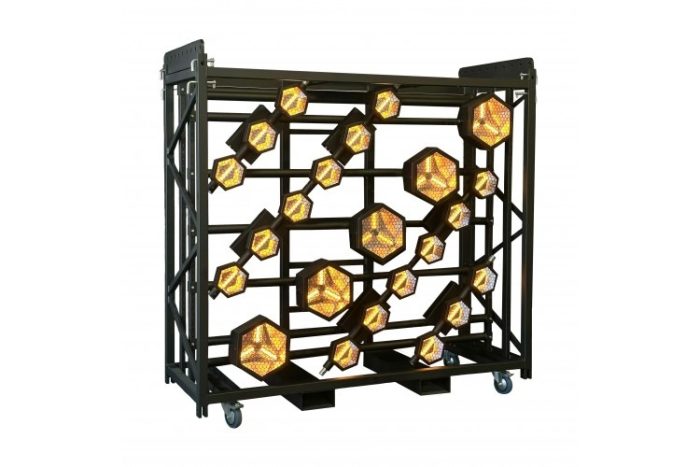
What was the inspiration behind the Lighting Pod?
Like many of our products, the Lighting Pod started with conversations with customers and end users. In this case, the first ideas came from brainstorming with a touring company about how this type of product could be improved. We focussed on where we could add something of our own, both technically and in the way the product could be used during a show. From the start, the idea was that the Pod should make transport and deployment easier, but should also look good enough on stage.
Did you face any challenges bringing it to the market?
One of the key considerations was finding the right balance between transport, handling, structural performance and appearance. The Pod has to work in the truck and backstage, but it also has to work as part of the stage design. In 2026, we developed a custom version together with 4Wall Entertainment. It was made wider and higher, allowing, for example, a two by two arrangement of LED panels to fit inside. We also added extra wheels for easier loading over truck ramps, additional forklift access from several sides, an upper beam for mounting fixtures above the Pod, and dedicated brackets that allow the touring configuration to be built without loose bolts and nuts.
How was the Lighting Pod developed with lighting and touring professionals in mind?
The practical details usually come from the people who have to load the truck, build the show and take it down again every day. Things like where a forklift can enter, how easily a Pod moves over a ramp, or whether you need loose hardware during assembly can make a big difference on tour. 4Wall’s requirements influenced several of the changes, including the extra wheels, multi-side forklift access and bolt-free brackets. The resulting Pods were supplied for The Prodigy Warriors Dance Summer 2026 and Lenny Kravitz’s Live 2026.
How can the Lighting Pod streamline load-ins and enhance visuals?
Instead of unloading equipment, rebuilding a structure and mounting the fixtures again, the Pod can be rolled into position and prepared for use much more quickly. It is designed to remain visible on stage. Pods can stand on the floor, be flown, or be connected horizontally and vertically to create larger configurations. These combinations have been structurally calculated, so they can be used as part of the show design rather than simply as transport equipment. The larger version also makes it possible to integrate LED panels, while the additional upper beam provides an additional position for lighting fixtures.
What has the response been like?
The response has been good, particularly because the product has continued to develop through actual touring projects. The version shown at ISE 2025 introduced the basic concept. The 4Wall project in 2026 took it a step further. Since then, we have seen clear spin-offs. Other customers are now approaching us with similar requests, as well as their own ideas about how they would like to use or configure the Pods. That is also how we expect the product to continue developing: not as one fixed solution, but as a system that can be adapted to different requirements.
This story originally appeared in TPi Magazine #296.

