
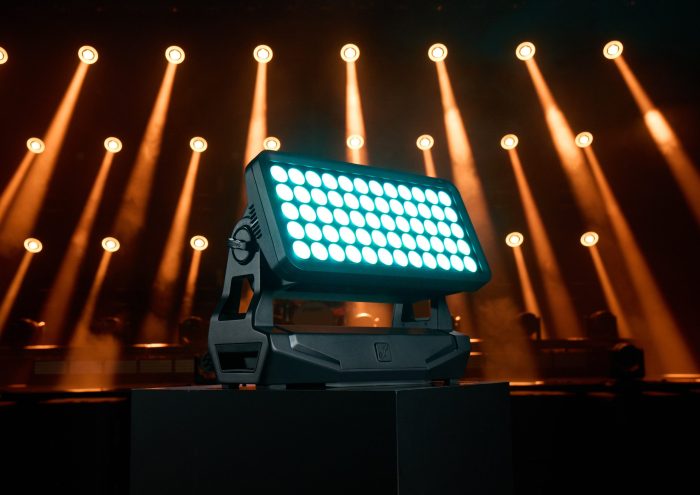
What do the new W1200 G2 and W300 G2 bring to the overall ZENIT product range?
They take the compromise out of the middle. The W600 G2 has become a real workhorse for our rental and dry-hire customers this year. But any fixture sitting in the middle of a range forces someone to compromise: on a big festival stage you hang more of them than you’d like, and on a small truss it’s more fixture than you need. The W300 G2 and the W1200 G2 close exactly those two gaps – one compact and light, one with 45,000 lumens for the really big surfaces. What I’m proudest of, though, is what doesn’t change. All three sizes share the same LED engine, the same colour calibration and the same beam and field angles. So ZENIT G2 is no longer one product with siblings; it’s a system.
What makes both products particularly suited to touring environments?
Touring is less about the show than about the twenty minutes before doors and the two hours after. So we started with weight and handling: the magnesium housing keeps both fixtures remarkably light for their output, and the handles and safety points sit where your hands actually go when you rig – not where they looked nice in CAD.
Also, with Cameo CONNECT you simply tap your phone against the fixture to set it up, check diagnostics or update firmware. Wireless DMX is on board for the days when a data run just isn’t happening, and power is linked through outdoor-rated connectors. And the most ‘touring’ feature of all is probably Legacy Mode. Tours rarely get a perfectly uniform rig, because many rental companies still carry first-generation ZENITs. In Legacy Mode, a G2 drops straight into a G1 patch with the same colours and looks. So a mixed shipment of fixtures is no longer a programming emergency.
What demands did you have from show and lighting designers?
The first was: “Give me fewer fixtures for the same surface.” Large outdoor surfaces – stage wings, scenic backdrops, the facade behind a festival stage – eat wash lights for breakfast. With 45,000 lumens, the W1200 G2 changes the maths on a lighting plot quite quickly. The second was: “And don’t give me a big dumb flood.” Designers didn’t want brute force at the expense of quality. The W1200 G2 has exactly the same colour science as its smaller siblings, from warm candlelight to cool daylight, with smooth dimming and halogen simulation.
Vertical segment control means a single fixture can carry a gradient across a surface instead of just flooding it. Almost every show is filmed today, even if it’s “just” for socials. That’s why the fixture is built to stay flicker-free on camera – no rolling bars on the big screens.
In terms of output, what aspects of each fixture do you think designers will be particularly excited about?
For the W1200 G2 everyone will talk about the 45,000 lumens – fair enough. But I think designers will fall in love with the white. With a CRI of 98 and a TLCI of 95, skin tones still look like skin at the back of a festival stage and on the broadcast feed.
Add segment control for sunrise gradients or split looks, plus the optional SnapMag FX filter – an electronic frost you control from the desk, so you can change the beam spread mid-show instead of from a ladder.
Where as the W300 G2, for me, is the sleeper. 14,000 lumens in a fixture you can comfortably carry, with exactly the same colour science as its big brother. That means you can put the W1200s on the towers and the W300s on the stage floor, and the colours match without a fight.
Cameo has also just introduced the OTOS LC12 IP65 moving bar. How do you see these fixtures working together in a rig?
I think of it as a division of labour. ZENIT paints surfaces, the LC12 draws lines and movement. Each of the LC12’s twelve heads can be tilted and zoomed individually, so a single bar can do curtains, waves, chases and ramps.
A picture I have in mind: W1200 G2s washing the backdrop and set, and a row of LC12s along the stage edge drawing movement in front of it. Both are IP65, so the whole outdoor rig plays in the same league when the weather turns.
The two use different LED engines, so they’re not identical by design. The OTOS family is colour-consistent within itself, and ZENIT gives programmers very precise colour tools to place the wash exactly where the look needs it. I’d rather say that openly than promise a magic match button.
Where will we see the W1200 G2 and W300 G2 in the future?
Festivals, obviously. But I’m more curious about the places where a wash light normally must apologise. Classical open-airs and outdoor TV productions, where colour on camera and operational quality matter as much as output. Corporate formats like annual general meetings and conventions, where the W300 G2 can be a discreet, camera-ready stage wash. Temporary architectural lighting at city festivals, washing facades with the W1200 G2.
I’d really love to hear about the uses we didn’t plan for. With the first generation, some of the most interesting feedback came from places you wouldn’t expect an IP65 wash to end up. In broadcast studios and theatres, nobody needs weather protection, but people chose ZENIT for its colour, its quiet operation and because it simply keeps working.
This story originally appeared in TPi Magazine #296.

