
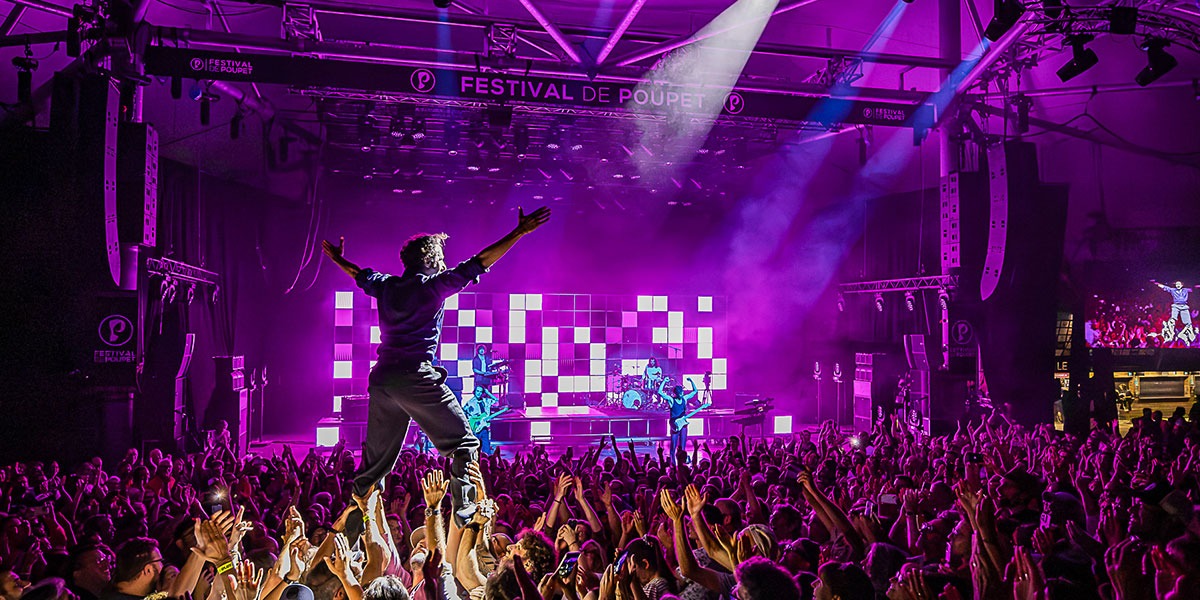
Naostage’s K SYSTEM performer tracking platform was deployed across nine French festivals during the summer 2026 season, at Art Rock, 3iS Fest, Festival de Poupet, Main Square Festival, Les Vieilles Charrues, Les Plages Électroniques, La Route du Rock, No Logo BZH and Festival Roi Arthur.
When the audience applauds the end of a performance, a second show begins offstage. With changeover in full effect, one artist leaves while the next is preparing. And in under 15 minutes, an entirely different production has to be ready to run. Attaching tags to performers, configuring them in software or recalibrating a tracking system between acts may be workable in a theatre with rehearsal time. On a festival stage, those same steps become bottlenecks.
The math of a conventional followspot workflow drives the point home. Five artists across a festival day means five operators, each manually tracking a performer, with the whole process repeated from scratch for every act on the bill. A beaconless system collapses that a single operator working with automated tracking, moving from one artist to the next without wearables, without recalibration and without touching the existing rig.
Art Rock illustrated the scale of the problem. A single stage in Saint-Brieuc hosted 15 separate productions across three days, each with its own artist, lighting designer and creative approach, with up to 10 followspots running simultaneously. A single KAPTA sensor and one KAM camera covered the deployment, working alongside technical partner Art.light. K SYSTEM was installed once before the festival opened. From that point onwards, every visiting lighting designer simply connected to the tracking data and got on with programming their show. There was no recalibration between acts, no performer preparation and no additional hardware necessary for artists.
“At a festival, you never get to touch the artist,” said Olivier Le Doeuff, tracking operator, Art Rock. “Beaconless is the only way to follow guest headliners, act after act, with zero prep and zero turnaround.”
One moment during the festival demonstrated why that matters. When an artist left the stage and ran into the audience, tracking did not stop. Automatic 3D tracking from the stage-facing KAPTA covered the performance area. Meanwhile, manual tracking, using the KAM viewpoint and a SpaceMouse, took over through the crowd and all the way to front of house, keeping the performer lit throughout.
“Set it up once, hand the lighting designers clean PSN data, and let it run the festival,” said Le Doeuff.
3iS Fest posed a different challenge. Staged at 3iS, the Institut international de l’image et du son, the festival ran three to four performances each day across concerts, theatre, rock, pop and electronic music, giving students a real production environment in which to work with performer tracking for the first time. The deployment mounted one stage-facing KAPTA and two KAM cameras on a centre truss at a height of nine metres, covering a 15 by 9 metre tracking area and combining 2D and 3D tracking with PSN and KratOSC integration. With only minutes available between acts, the team created new 3D tracking zones in Naostage’s KRATOS software shortly before each performance rather than rebuilding the setup. Performers frequently left the stage to climb onto the front of house platform, which a beaconless workflow accommodated without any additional preparation.
“The main issue is time, and equipping the performers during the changeover,” said Joshua Kieffer, tracking operator, 3iS Fest.
Across the festival season, Naostage products tracked sets by De La Soul, Babyshambles, Fontaines D.C., Shaggy, Cassius, 47TER, Georgio, Sébastien Tellier, Disiz, Thylacine, Suzane, Bertrand Belin, Jolagreen23, Jasmine Not Jafar, No Pain No Pain and Folie’s, among others, on stages ranging from a student festival to some of the largest events in the French summer calendar. Every one of those performers walked on stage carrying nothing, wearing nothing and having rehearsed nothing with the tracking system.
The signal path behind that is deliberately short. KAPTA sensors and KAM cameras capture movement, a KORE server processes the position data in real time, and KRATOS distributes it as clean tracking data to whatever the production is already running. This is most often a lighting console driving moving heads as automated followspots. The same output can equally feed audio systems, media servers, stage automation or third-party systems over open protocols. At one deployment this summer, the platform drove followspot fixtures positioned at front of house, approximately 80 metres from the stage.
Lighting states shift between acts, haze density varies, artists improvise, and stages increasingly combine CO2 jets, flame effects and LED surfaces that can obscure a camera’s view. KAPTA embeds five cameras, one visible, two near-infrared and two thermal, and a single unit installed at a height of 10 metres covers an area up to 20 metres wide by 15 metres deep. Additional KAM viewpoints can be positioned around a stage to cover blind spots created by scenic elements. K SYSTEM installs in 20 to 30 minutes, tracks up to 64 targets and ships in two flight cases deployable by a single technician.

