
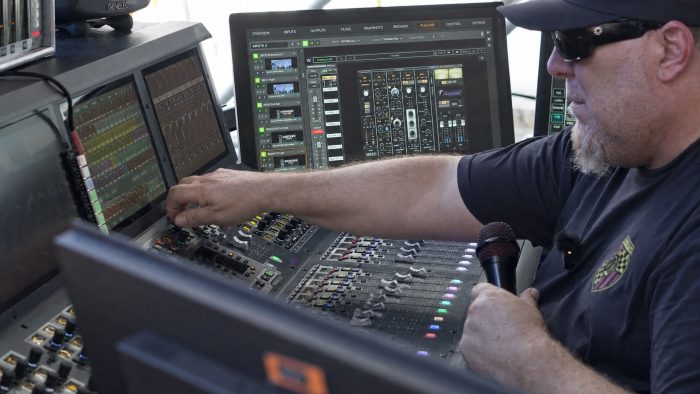
From his position at FOH on Bruno Mars’s world The Romantic Tour, Sean “Sully” Sullivan mixes stadium shows for crowds as large as 80,000. Running alongside his Avid S6L is the Waves LiveBox — a dedicated home for every third-party plugin in his rig — a setup he’s leaned on since he was one of the first engineers to get his hands on a LiveBox unit.
Having mixed live sound for 36 years, Sully’s credit list runs long: Red Hot Chili Peppers, Rage Against the Machine, Shania Twain, Roger Waters, Smashing Pumpkins, Avenged Sevenfold, System of a Down, Beck and others. That’s the experience running his side of the desk today and guiding his choice of gear.
Sullivan runs two dedicated systems side by side, each with its own job. Every native Waves plugin runs directly on the S6L, routed through SoundGrid Rack for VENUE — the Waves/Avid interface built into the console — while every third-party VST that isn’t a Waves plugin runs through the LiveBox, which rides one of three MADI cards feeding the S6L’s E192 engine, passing audio back and forth. “Because Avid and Waves work so well together on the console,” he explains, “all the Waves stuff is done onboard the desk — and then the LiveBox is strictly for third-party, non-Waves plugins. There’s thousands of plugins out there. Waves makes a lot of good ones, but there are other brands as well, and the LiveBox fits that role perfectly.”
Bruno Mars’s lead vocal is the clearest place to see the pieces come together. Sullivan’s chain moves through Soothe Live running on the LiveBox, then onto SoundGrid Rack for VENUE for the Waves CLA-76 compressor into a Renaissance DeEsser, then back to the LiveBox, with Crane Song Phoenix adding tape saturation for harmonic content.
The LiveBox earns its place on problems that are specific to this tour, too. The production is running a new L-Acoustics PA that Sullivan says has “virtually eliminated the distortion in the high-mid band” compared to what he’s used before — but he still wants a hand on the wheel. “I’m using Saturn to give a little bit of care,” he said. “It’s good that the PA isn’t just adding some generic distortion to your whole mix. Now I’m in control of it, and with Saturn I can affect how much of it I want to hear and at what bandwidth.” Elsewhere on the LiveBox: a Joey Sturgis Tones side-widener for psychoacoustic width on guitars, and Parallax adding low-end compression and saturation to his bass rig.
Feedback control has changed the same way. “Before we had newer plugins and software to help deal with artists in front of the PA, we’d EQ the crap out of a microphone to try to make it quiet,” Sullivan says. “Now we have DeFeedback on the LiveBox to try to eliminate the sound of artists being in front of the PA. I wouldn’t say [the old workaround] was a failure — we’ve just got newer tools to make things better and easier for us. And LiveBox plays a key role in enabling me to run the DeFeedback in a reliable way.”
Meanwhile, on the Waves/Avid rack, Sullivan runs Scheps Omni Channel — “my favorite plugin,” he says — on nearly every drum channel and several buses, and he’s been getting acquainted with Atlas, Waves’ newest reverb. “It’s a great-sounding reverb,” he said. “The Atlas UI is not busy, just the crucial knobs you need. It’s very CPU-friendly, and the list of ‘program’ presets is vast.” Mixing in front of crowds that reach 80,000 a night, he says the appeal is speed: “You need tools that work quickly, do what you need without a lot of fuss. It’s pretty much set it, forget it, and Atlas is like that.”
None of it matters if it doesn’t hold up at scale, and that’s the part Sullivan is most concerned about: “We love the LiveBox. It works every night,” he said. “I was probably one of the first ones to get one — started testing it at home when it came out, used it all through last year, and it’s been on the road with me ever since. Not a single issue with it. The workflow is extremely simple. We love it. Great piece.”

