
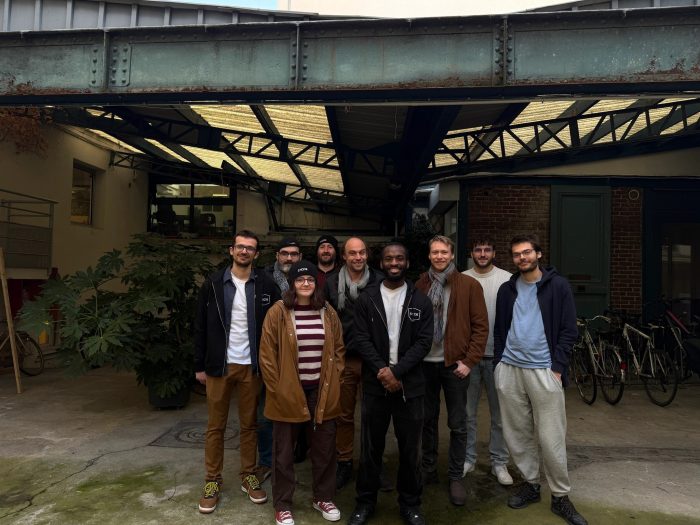
Smode Tech, developer of the SMODE real-time compositing and media server platform, has welcomed four new team members across software development and research roles.
Aurore Bordes joins as a C++ graphics application developer and product specialist. In this dual role, she will contribute to new feature development while also supporting the technical needs of SMODE’s user base. Bordes holds a master’s degree in Arts and Image Technologies and previously worked at a virtual production studio, where she gained hands-on experience across the full pipeline of xR projects, including 3D previsualisation tooling, LED wall calibration and live camera tracking. “What motivated me most about joining Smode Tech is the flexibility of the role,” said Bordes. “I get to grow across multiple domains alongside a team that’s always willing to listen and share knowledge.”
Nicolas Tisserand joins as a senior software developer, where he will focus on the extension and maintenance of the SMODE software suite. He brings more than twenty years of programming experience across a wide range of domains, including music software, 3D reconstruction, virtual and mixed reality and robotics, with expertise in C++, C, Rust and several other languages across desktop, mobile and embedded platforms.
Tisserand has a longstanding connection to SMODE. He studied alongside founder Francis Maes at EPITA IT engineering school, and he has previously contributed to the platform, including work on the macOS port. “Working on a large, complex codebase like SMODE’s is an intellectually motivating challenge,” said Tisserand. “SMODE’s greatest strength is its outstanding flexibility, covering a staggering range of real-time video playback scenarios.”
Manu Cheremeh joins as a CIFRE doctoral researcher, working under a joint contract between Smode Tech and ATI Paris 8 University. He will split his time 50% at Smode Tech and 50% in the lab over the next three years. His work will focus on the research, development and integration of real-time generative AI modules within SMODE. Cheremeh comes to the role well-versed in real-time creative software and was drawn to Smode Tech’s flat organisational structure and its commitment to research and open-source development. “SMODE brings together the functionality of several dedicated real-time visual creativity tools into a single platform,” said Cheremeh. “It’s a genuinely unique tool in that space.”
Finally, Maxime Cots joins as a senior software developer. He will focus on improving how SMODE handles asset input and output, including images and video, to streamline workflows for studio artists. Cots brings experience from Lumiscaphe, a real-time graphics and VR software company, and MPC/The Mill, the visual effects studio, where he developed internal pipeline tools including rigging engines, render submitters and task orchestration systems. “The thing that excites me most is contributing to software that creates real experiences for people, like concerts and immersive events,” said Cots. “I’m really looking forward to having the chance to work alongside the artists who use SMODE.”
The four new hires are unanimous in their early impressions of the company culture, with a resounding feeling that it’s a low-hierarchy environment that encourages open collaboration and shared decision-making, a team that is attentive and generous with knowledge, and that the company has a genuine commitment to ensuring everyone works in the best possible conditions.
All four hires are now actively contributing to the ongoing development of the SMODE platform. “Each new employee brings a distinct perspective and a high level of technical skill to our team,” said Francis Maes, founder of Smode Tech. “Research has always been at the heart of what we do. It’s where SMODE began, and it is what continues to drive its development. As we push the boundaries of real-time compositing and live production, growing our team with developers and researchers who are genuinely passionate about the craft is fundamental to everything we are building here. And our commitment to R&D will only deepen.”

