
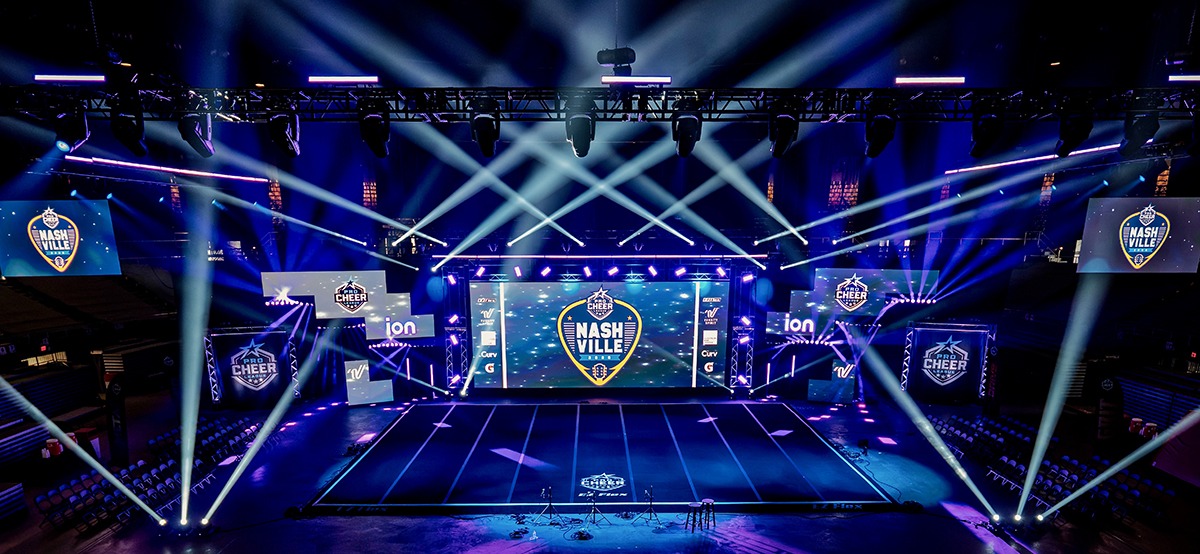
Launching the Pro Cheer League meant more than putting athletes on a floor – it required building a touring production system capable of supporting a new professional sport across arenas and convention centres, while meeting the demands of national broadcast.
For Nashville-based UpLight Technologies, the remit covered the full production ecosystem: lighting, video, rigging, and control. The goal was to create a system that could move quickly, adapt to varying venues, and deliver a consistent, broadcast-ready look night after night. “It’s a brand-new concept,” said David Surbrook, Owner and Production Designer. “We had to create something flexible enough to tour but still feel like a major league production every time it landed.”
The timeline was tight. Initial conversations began in late summer, but the project shifted dramatically in early December when the show was confirmed for national broadcast on ION Television. “When we found out it was going to be live television, we essentially redesigned the entire show in an afternoon,” Surbrook explained. “By mid-December we had the gear specified, built everything right after the new year, and were ready for the first show less than a month later.”
That urgency shaped the design philosophy. “Our prep week was critical,” he added. “We needed something that could go in fast, minimise issues, and still deliver a big look.”
At the heart of the production was a touring LED system built around INFiLED Black Widow AMT 3.9mm panels, each measuring 1000mm by 1000mm with a 256 by 256 pixel resolution. The main display — a 12-by-5 panel centre wall — measured roughly 40ft by 16ft, delivering close to four million pixels in a true 16:9 format. This is complemented by two staggered wing walls (12 panels each) and floor pods (three panels each), creating a layered visual composition around the competition floor.
“The centre screen gives us a clean canvas for broadcast graphics and sponsors,” explained Video Designer and Systems Integrator James Mitchell. “The wings and pods give us depth and visual interest without compromising that format.”
For Mitchell, the touring design was just as important as the visual output. “The touring frames and carts made the setup and strike quick and safe,” he said. “You’re effectively reducing cabling and simplifying the build, which makes a huge difference on a fast-moving tour.”
Surbrook highlights another advantage for broadcast: “The matte finish on the panels absorbs light really well,” he noted. “With athletes performing above the screen, you can’t have reflections coming back into the camera. That was a big factor for us.”
Mitchell’s video infrastructure was designed with full redundancy at every stage. The LED system was powered by two Brompton SX40 processors paired with four XD breakout boxes, with signal routing handled by an Analog Way Zenith 200 switcher.
“All inputs hit the Zenith first, then feed both processors simultaneously,” Mitchell explained. “From there, we’re running eight Cat6a 10G lines out to the XDs, with two handling primary data and the others providing looped backups.”
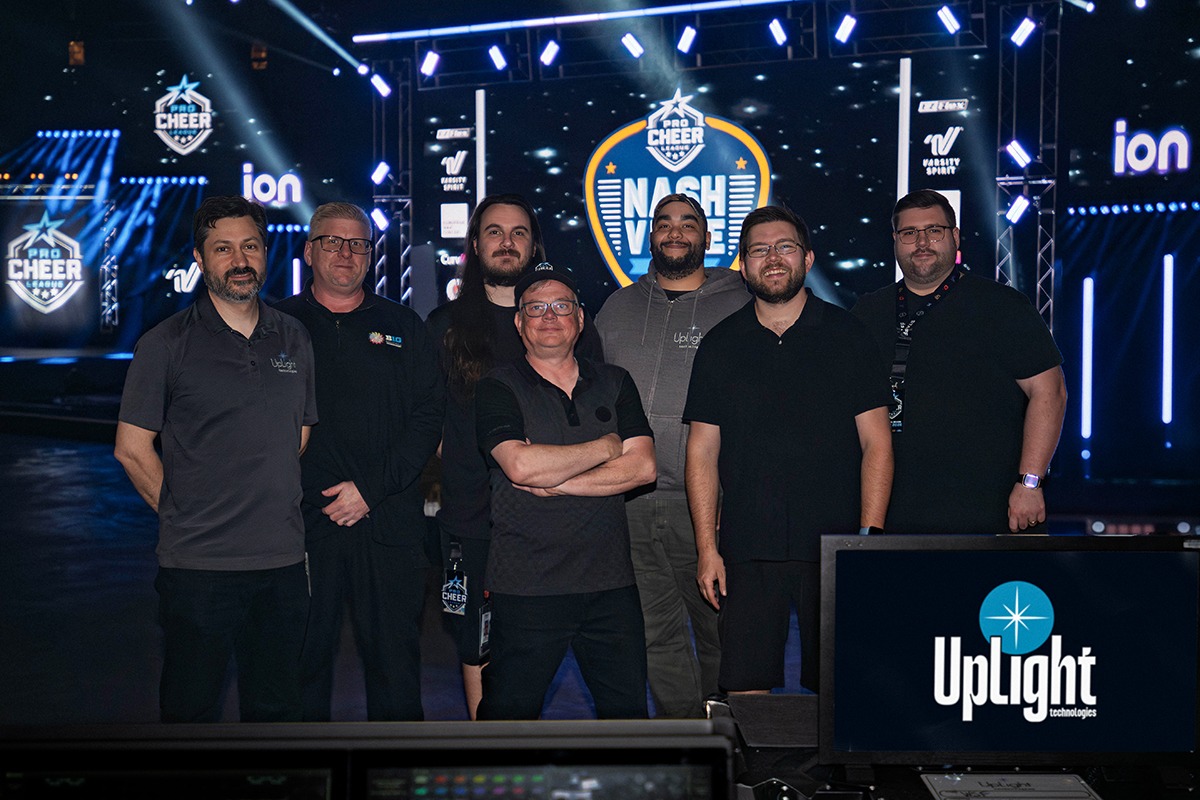
Playback was driven by a 16-inch MacBook Pro (M4) running Resolume Arena with the Stageflow plugin, paired with a Blackmagic Design DeckLink 8K Pro G2 in a Sonnet enclosure. “We tested several media server options during prep,” Mitchell said. “Resolume with Stageflow gave us the flexibility to build looks quickly and manage content in real time, while staying stable for broadcast.”
The system also allowed for seamless switching between primary and backup playback sources via the Zenith, ensuring uninterrupted output. Lighting design was driven by the need to balance broadcast clarity with visual impact. “You can’t light this like a concert,” Surbrook said. “You always have to assume the camera is on the athletes, so the lighting has to support them first.”
The rig featured: 32 Robe BMFL fixtures, providing high-CRI wash across the competition floor; 24 Claypaky Sharpies delivering punchy beam effects; 16 ACME Tornado fixtures for dynamic aerial and pixel-mapped effects as well as 48 PIXEL LINE IP fixtures for linear animation and colour bursts, in addition to 16 Elation Pulse Panels surrounding the LED wall for additional motion and pixel control.
Control was handled via an Avolites D7 console, running more than 32 universes of data. “I’ve been using Avolites since 2011,” says Surbrook. “The programming structure is incredibly efficient, and the D7 gives you everything you need for a show of this scale without taking up a huge footprint at FOH.”
One of the show’s standout features was the physical integration of lighting into the LED structure. Using custom brackets, the team mounted ACME Tornado fixtures directly beneath the LED wing walls, effectively merging the video and lighting layers.
“That’s where the design really came together,” Surbrook explained. “We were able to combine the LED and the fixtures into something that felt like one system, rather than separate elements.”
The Tornado fixtures – featuring pixel-mapped rings, zoom control, and wave effects – became a key visual element, providing movement and energy across the stage. “They’re incredibly versatile,” he added. “You can create a huge range of looks with them.”
Touring between arenas and convention centres introduced a range of rigging challenges, from limited ceiling heights to restricted rigging points. “The design had to be flexible enough to adapt to each venue,” Surbrook said. “But still maintain the same look and feel every night.”
Modular construction, efficient cabling, and extensive prep allowed the system to be deployed quickly, with minimal on-site reconfiguration. With more than five million viewers tuning in during its inaugural season – and a second season already secured – the Pro Cheer League has established itself as a viable new broadcast property.
For UpLight Technologies, the project represents both a creative and technical milestone. “This was about building a system that works – not just for one tour, but for the future of the league,” Surbrook reflected.

