
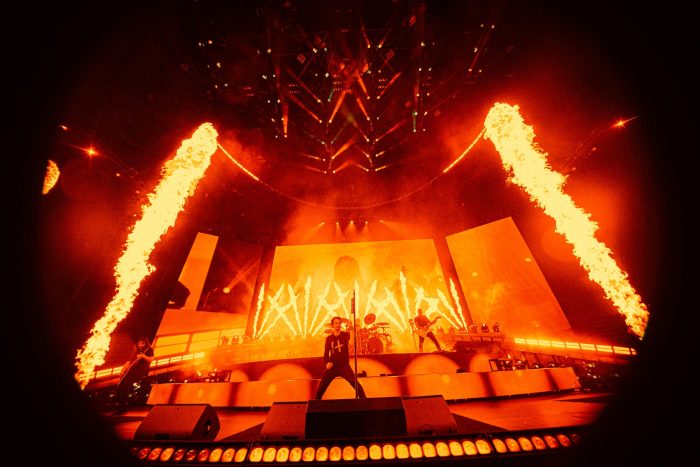
French progressive metal band Gojira has spent over 20 years building a reputation as one of the genre’s most technically accomplished acts. In 2025, their performance at the Paris Olympic Games opening ceremony – playing from the historic walls of La Conciergerie alongside opera singer Marina Viotti – catapulted them to new heights. Their subsequent summer festival run took them to 30 countries.
In November, Gojira returned home for their first French arena tour: a technically advanced production that matched their elevated status. The tour featured a complex video installation and a new sound system capable of delivering the precision and power their music demands. To meet these stringent requirements, Danish production house and Gojira’s longtime touring partner Victory Event deployed a comprehensive L-Acoustics K Series system, marking the company’s first major tour with L-Acoustics. This arena tour represents a significant milestone — Victory Event’s first major L-Acoustics deployment after switching from a competing manufacturer, and one of their most ambitious productions with the brand to date.
“We have spent the past decade developing our expertise in the demanding world of metal touring,” said Victory Event CEO, Jesper Danius Sørensen. “Our relationship with Gojira dates back to 2018, and our work across the heavy metal music scene – including tours for acts like Ghost – has established us as a trusted partner for technically complex productions.”
Ahead of Gojira’s extensive summer tour, Victory Event made a strategic decision to partner with L-Acoustics — a significant shift for the production house. “We wanted an internationally recognised brand that could service all our European tours,” explained Sørensen. “We were also especially conscious about sourcing a system that could meet our very specific size and weight considerations.”
The Gojira arena tour featured a substantial video wall that dominated the visual design and influenced the rigging capacity and placement options for the audio deployment. Front-fill placement became a negotiation between departments: the band wanted Kara II speakers on stage, while the lighting designer required clear sightlines.
The band’s double drum setup — with its exceptionally fast, intricate patterns — also posed specific audio challenges. “Previous systems had proved too muddy for the material,” said Sørensen. “As a result, Gojira’s sound team was clear that they needed a fast system with exceptional transient response capable of handling dense, rapid-fire percussion and layered instrumentation. The combination of K1, K2, and K1-SB was ideally suited.”
With competing priorities across multiple departments — each with different rigging requirements and sightline needs — Victory Event turned to L-Acoustics Soundvision software to resolve conflicts before they reached the venue. The team built a complete venue model in Soundvision, importing architectural drawings, rigging plots, and production elements, then positioned the speaker arrays to predict acoustic coverage with precision.
“We could demonstrate to the broader Gojira team exactly how speaker placement would impact both sightlines and sound quality,” Sørensen explained. “We showed them precise predictions of how the system would look and sound from different seats in every venue — a critical consideration given the size of the video wall. This data-driven approach meant the lighting department could review the acoustic coverage maps, and we could optimise speaker positions to preserve their key sightlines. For a production where every department had different rigging points and priorities, resolving those conflicts in Soundvision before the first load-in saved us days of on-site negotiations.”
The visualisation proved decisive in securing optimal speaker placement that satisfied both sonic requirements and production aesthetics. The final arena tour deployment comprised left and right arrays of 14 K1 with three K2 per side. Behind the main arrays, 10 K1-SB provided the critical low-frequency punch the double drum setup demanded. On the floor, eight KS28 per side flanked a centre array of two KS28, all ground-stacked. Six Kara II positioned atop the subwoofers delivered in-fill coverage that satisfied both the band’s preferences and the lighting designer’s sightline requirements.
For venues requiring additional coverage, 12 Kara II per side provided out-fill. At the Accor Arena in Paris — the tour’s most demanding venue — Victory Event added four delay positions with six K2 each, bringing the total delay deployment to 24 boxes.
The system ran entirely on LA12X amplified controllers, powered via Milan-AVB with audio routed directly from the console to the amplifiers. The network protocol delivered two immediate benefits: sonic quality and operational reliability. “Milan-AVB sounds better and it’s redundant, so it works flawlessly in this deployment,” said Sørensen. “You don’t have to physically move cables.”
This digital infrastructure streamlined operations across the tour. With just one setup day and two rehearsal days, efficiency was critical. Milan-AVB’s plug-and-play networking allowed the crew to pre-configure system files in advance and load them directly onto the LA12X controllers at each venue, eliminating time-consuming manual cable runs and troubleshooting, reducing transport costs, and ensuring identical sonic performance from venue to venue.
On stage, a monitor setup of 12 X15 and two KS21 provided complementary reinforcement on top of in-ears without overwhelming the mix. With no electronic instruments on stage and guitar and bass running direct to stems, the stage remained remarkably clean. “There’s no high frequency coming from the stage,” added Sørensen. “The sound image is the same everywhere.”
FOH engineer Johan Meyer also deployed two X8 and one SB15 to mirror the arena deployment’s sonic signature exactly — giving him a crucial production advantage: he could dial in his mix backstage on the reference system while freeing up valuable house seats for the audience.
“The whole system was also remarkably energy efficient,” Sørensen noted. “This was particularly important to Gojira, who are vocal about our collective environmental responsibility.”
The final deployment was an enormous success, and the response from the audio team confirmed Victory Event’s system choices, ensuring Gojira’s first arena tour met the expectations of their growing fan base.
“The engineers were more than happy,” Sørensen concluded. “In particular, Meyer was over the moon, it was exactly how he wanted it to sound.”

