
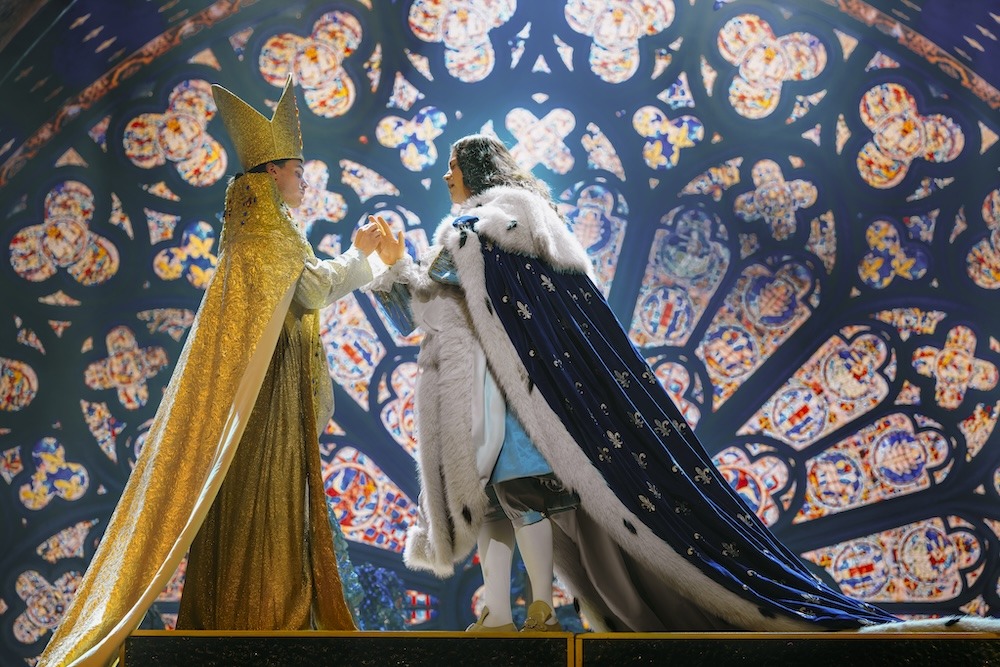
Twenty years after its original debut, Le Roi Soleil has returned to the stage with a completely refreshed production, bringing the story of Louis XIV back to audiences in Paris and across France during a new tour spanning 2025 and 2026. With video now playing a central role in the stage design, the technical team behind the musical turned to SMODE’s real-time compositing and media server platform to manage the majority of the show’s visual environment.
Originally premiering in September 2005 at the Palais des Sports in Paris, Le Roi Soleil tells the story of the young Louis XIV as he navigates political turmoil during the Fronde civil wars before ultimately claiming absolute power as the Sun King. The revived production expands on the original staging with a large-scale visual system combining LED screens, projection mapping and mobile video elements, creating a dynamic digital backdrop that evolves throughout the performance.
At the heart of this system are four SMODE media servers responsible for managing live playback and compositing across the entire video infrastructure. According to SMODE operator Tom Valadoux Midol, video now represents a substantial portion of the production’s stage design.
“SMODE manages all the live media playback, which makes up 80% of the show’s scenery,” said Valadoux Midol. “It also played a major role during pre-production, allowing us to encode modifications and the artistic team’s various requests in real time, and we were able to do so on two machines simultaneously.”
Valadoux Midol was originally brought into the production by technical director Antony Fra to support video encoding for the project alongside Romain Fior and Romain Labat. As the show transitioned into its touring phase, Valadoux Midol assumed responsibility for operating the video system throughout the run.
The video environment for the production is built around a combination of large LED displays and projection surfaces. At the centre of the stage is an 18 x 8 metre Absen LS3.9 Pro LED wall that can split in two to allow scenic elements to pass through, flanked by two additional transparent LST3.9 LED screens measuring 8 x 7 metres a piece.
One of the most distinctive elements of the design is a set of six wireless LED towers, each measuring six and a half metres high by two metres wide. Mounted on battery-powered bases, these towers move around the stage throughout the performance, enabling rapid transformations of the visual environment from scene to scene.
“They move around the stage throughout the show to adapt the scenery for each scene and to create other dimensions, offering dozens of scenographic possibilities,” Valadoux Midol said.
Six 20,000 lumen projectors complete the video setup to map visuals onto a stage frame measuring 28 metres wide by nearly 10 metres high, expanding the visual canvas even further. To coordinate this complex visual environment, the production relies on four SMODE media servers. Two primary machines run in Smode-Net for synchronised playback, while two additional servers provide redundancy. The servers are controlled via a GrandMA console using sACN, allowing the video system to remain closely synchronised with the lighting and broader stage automation elements.
The visual content for the production was developed by Studio A+E, a creative studio founded by Étienne Guiol and Arnaud Pottier that specialises in video design for opera, theatre and live performance. During rehearsals and pre-production, SMODE’s real-time compositing engine played a crucial role in enabling rapid experimentation and refinement of the stage visuals. “The compositing engine was extremely useful on this project, as most of the media was composited directly in SMODE using assets provided under the artistic director’s guidance,” said Valadoux Midol.
The ability to adjust visuals instantly proved particularly valuable during creative development, as the artistic team requested variations to scenic animations and transitions. “During the pre-production period, there was a significant amount of real-time creation,” he added. “SMODE allowed us to present different scenic and animation options to the artistic team and to respond to their requests almost instantly.”
Throughout the show, portions of the visual system run on timecode while others are triggered manually to follow the rhythm of the performance. The revival has also proven highly successful with audiences. Since its return to the stage, the production has sold more than 650,000 tickets, reaffirming the enduring popularity of the musical and introducing the story of the Sun King to a new generation of theatre-goers.
By combining large-format LED displays, projection mapping and mobile video structures under a unified real-time control environment, the production team behind Le Roi Soleil has created a visually immersive and evolutive stage design where digital scenery seamlessly complements choreography, music and narrative, bringing the story of the Sun King to life in an entirely new visual dimension.

