
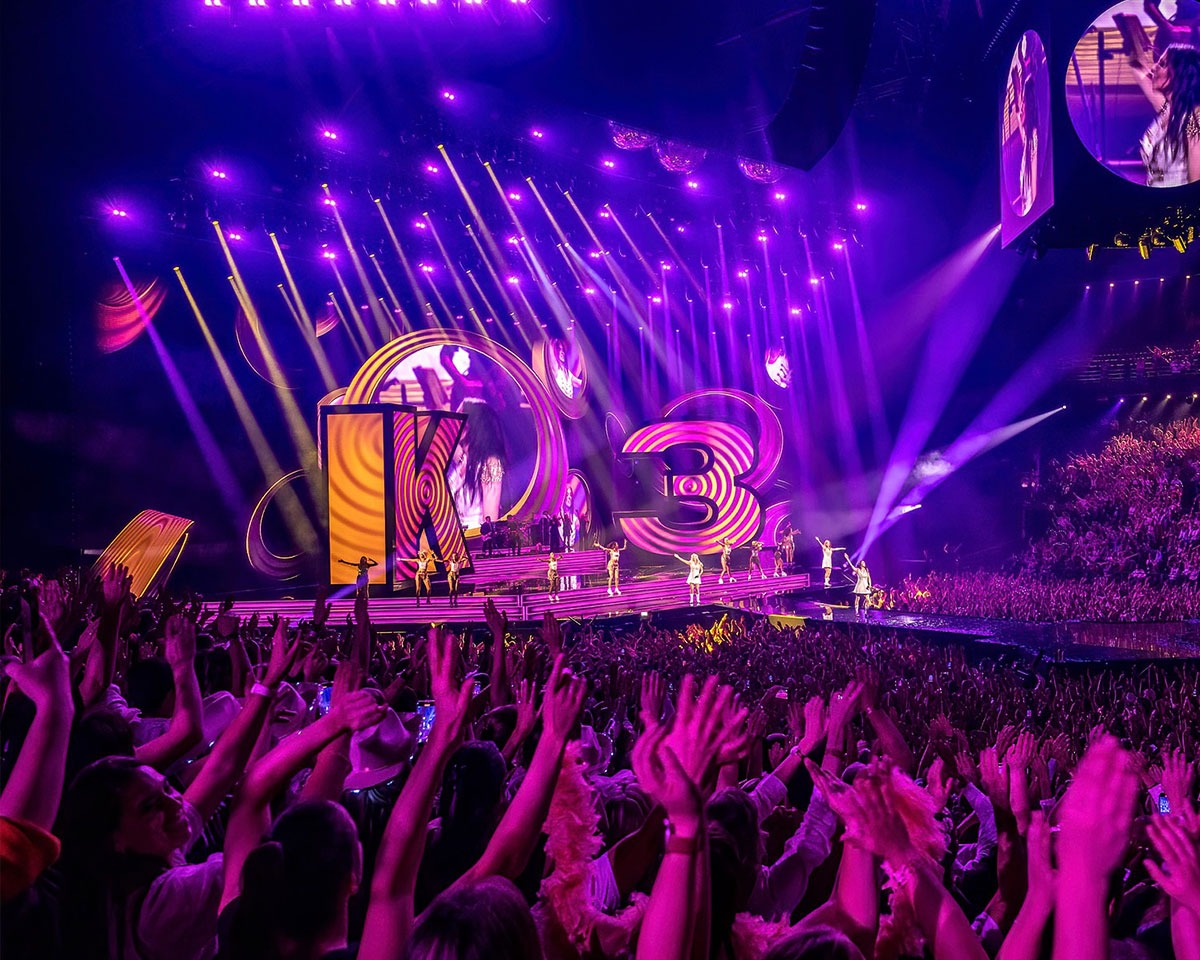
The original K3 lineup has reunited for a series of sensational concerts across Belgium and the Netherlands, spanning 2025 and 2026, with the tour concluding this June. At the heart of the show’s lighting design is the Follow-Me Track-iT performer tracking system, supplied by Painting with Light.
K3 is a beloved Belgian girls’ pop group, originally formed by Karen Damen, Kristel Verbeke, and Kathleen Aerts, and managed by Studio 100. After achieving enormous popularity across Belgium and the Netherlands with their catchy, family-friendly music, the original lineup stepped away over 16 years ago, eventually being succeeded by new generations of K3. The reunion has sparked widespread excitement; fans who grew up with the original trio, now in their 30s and 40s, have flocked to the shows in record numbers. Along with the AFAS Dome, the tour features major dates at Rotterdam Ahoy, totalling 45 shows.
Studio 100 invested heavily in delivering a high-production-value experience worthy of the occasion, including a live band, large cast of dancers, a massive stage spanning over 30 metres, and extensive LED screens, including a giant 3D ‘K’ and ‘3’ built entirely from LED panels that could rotate and move across the stage. PRG supplied the lighting and rigging, with Painting with Light providing the Follow-Me Track-iT system. Luc Peumans, Lighting Designer and founder of Painting with Light, led the creative and technical design, with Arthur Claesen serving as Follow-Me Tech, Jeroen Opsteyn and Tibo Spiessens as Lighting Programmers, and Sam Peumans and Dries Vandormael as Follow-Me Operators.
The scale of the Follow-Me deployment was significant: more than 100 fixtures were connected to the Track-iT system, out of a total rig of approximately 1,300 fixtures. Around 34 Track-iT anchors were distributed across the stage. The Track-iT tags were worn by each of the three performers, tracking them throughout the show, including during a particularly demanding sequence in which they flew over the audience on a flying stage from the main stage to the front of house. The flying system’s PosiStageNet (PSN) data was sent directly to the Follow-Me system and integrated seamlessly.
“The alignment and calibration of the fixtures went very smoothly, and now with the feature that you can make the presets on your desk and transfer them to the Follow-Me system, it worked quite flawlessly,” said Peumans. “Let’s just say nobody had to wait for us. Once it’s set up properly, it’s working very well. It doesn’t fail, and it’s more stable than an average follow spot operator, in my opinion. The big advantage with Follow-Me is that you can make your light design per scene in such a way that it blends into the overall show. It allows you to choose the right fixture in the right position for the right song, so it gives you much more creative flexibility.”
One notable production challenge was the frequency of costume changes. The performers changed outfits approximately every three songs, requiring close coordination with the costume department to integrate the Track-iT tags effectively. “The girls have to be comfortable with it, so you don’t want it to be a hassle for them,” Peumans noted. “We had a good team aligned together with costumes to do the quick changes and integrate the trackers. It just shows you that tracking needs a different kind of skill and attention behind the scenes to make it work.”
In one memorable sequence, all three performers sat on top of the giant 3D ‘3’ as it moved to the centre of the stage and towards the audience. “Tracking them even in these difficult situations, it works very well,” said Peumans.
Reflecting on the broader benefits of the technology, Peumans concluded: “In general, it gives me more creativity. I find it very stable. Because it’s been on some long-running shows, it also has some financial impact — you have to bring in fewer follow spot operators. It’s not just about replacing follow spot operators; it’s about unleashing creative possibilities we never had before.”

