
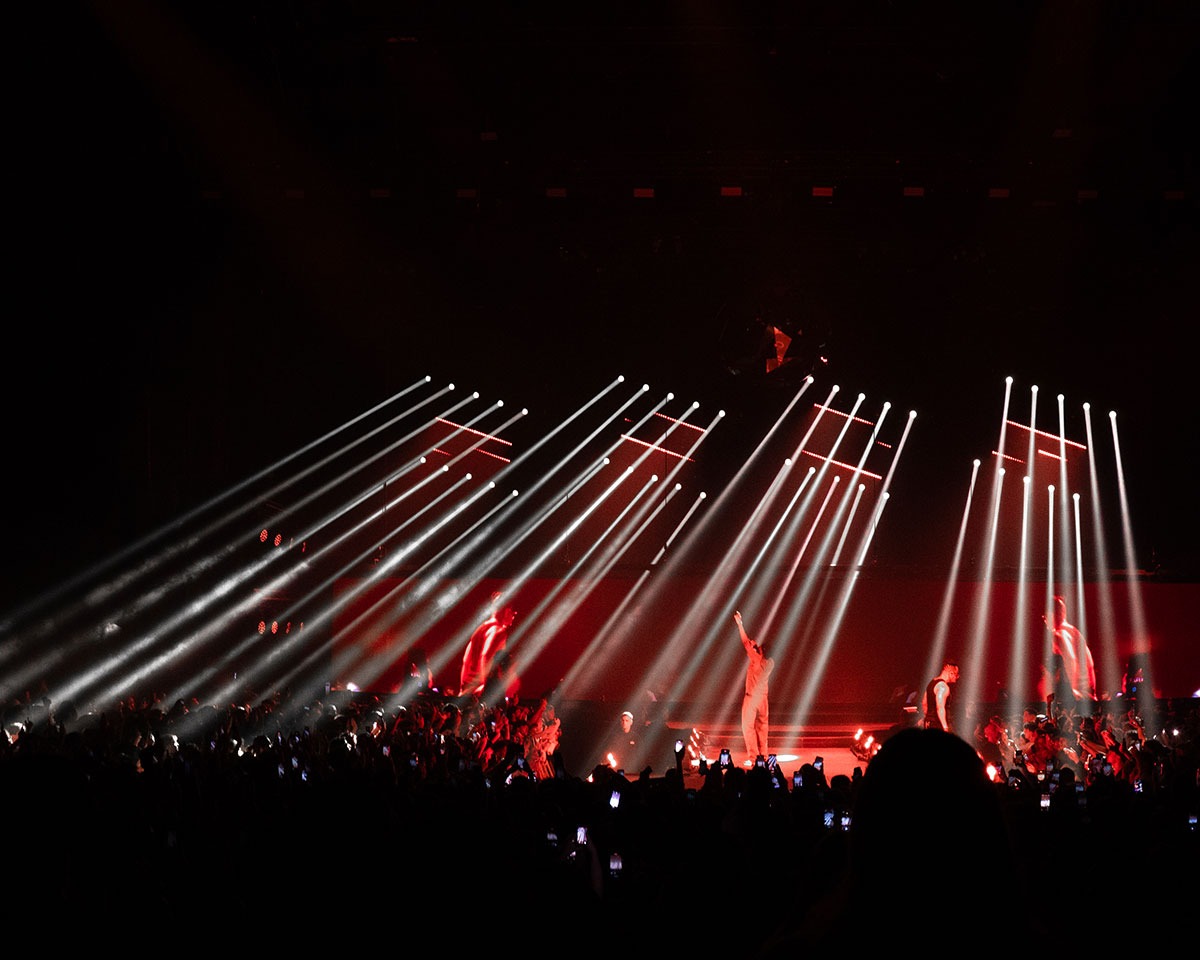
For a publication that showcases the best visual creatives, often encyclopaedic in their knowledge of the latest in event technology, it’s amusing to think that, often, the goal in show design is to hide technology to ‘keep the magic’. However, this seemed to be the goal behind the design for French rapper Tiakola’s latest tour, where the creatives sought to create a truly mobile, integrated stage space that would meld with the rapper’s performance and that of his band.
TPi caught up with Julien Peyrache and Michael Berzon of Alien le studio, who oversaw scenography and lighting design for the project. Having been brought in by Nonstop Productions, the duo began initial conversations with Tiakola’s producers, Morgan Antonutti and Marie-Sandrine Martin, to discuss the show’s vision.
One of the goals from the outset was to “play with verticality,” with both the rapper’s first appearance and his supporting band entering from different directions. “There was also a strong design goal for the band not to be static but truly mobile,” commented the design duo. The solution was to create highly kinetic, modular scenography with musician lifts, as well as a fully automated rear LED screen, along with a custom sphere covered in shards of broken glass representing a ‘star’ iconography that is heavily associated with Tiakola.
With so many automative elements, it was key that the team needed a robust tracking solution to ensure the key moment remained illuminated throughout the show. For both Peyrache and Berzon, the solution came in the form of Naostage, but as TPi soon found, the offering opened more doors than just tracking.
“We’d been following Naostage’s progress on social media, but the real ‘click’ happened in the field,” explained Peyrache and Berzon. “It was during Calogero’s festival tour at the Poupet Festival where Paul [Cales], the founder of Naostage, was there to demonstrate the system.” From that point, they were keen to utilise it in a real-world scenario. “What immediately seduced me was its absolute malleability,” commented Peyrache. “It allows the use of any type of fixture, without any brand or model limitations.”
Berzon continued: “The potential of the system seemed obvious. Our stage was full of moving parts: the motorised video screen, the musicians’ lifts, light pods, and, of course, Tiakola himself, who has incredible stage energy and occupies the entire space. We realised that the true power of Naostage would be to pair real-time tracking these elements with the positioning of our fixtures to generate organic and ultra-precise tableaus.”
The fixture count for the show was notable, with 108 Starway Baracca 360s and 18 FloodLites. There were also 48 CHAUVET Professional Color Strike Ms along with 32 Robe Lighting Tetras, 22 ESPIRITEs, 16 Spiiders, eight LEDBeam 150s and seven FORTEs. Of this sizeable rig, around 120 were calibrated to the Naostage system, with each fixture calibrated individually.
To aid in the process, the production used Naostage’s advanced tracking software, KRATOS. “Calibration consists of defining six reference points on the floor and entering their exact coordinates, which allows the system to orient itself within a 3D space identical to that of our MA Lighting console, ensuring everyone is speaking the same spatial,” the duo stated.
With the spatial information being so vital, the design team began to see the Naostage solution less as a follow-spot tool and more as the “nerve centre of a massive 3D interactive ecosystem”. In total, it handled five human targets and six machinery trackers, for a total of 23 individual PSN Trackers.
“We also had to retrieve PSN (Positional Stage Net) values from our Raynok automation system. This included the altitude of the giant LED screen, and automated sphere, the four musician lifts, and the position of the four light pods above them, which could move up, down, and tilt on the X, Y, and Z axes,” they explained.
To update the precise location of each fixture in real-time within the MA Lighting grandMA3 software, and to make this mountain of data digestible, the team employed the services of Jérémy Dufeux of Carrot Industries to deploy the PSN Toolbox; software that acted as the global brain of the operation. It collected streams from Naostage and Raynok, organised them into a spreadsheet, merged and transformed these values, and then output specific, clean PSN streams to the grandMA3 lighting console and the Smode media server.
“The integration with the Smode server allowed us to perform dynamic generative tracking directly within the LED screen’s video content,” commented Peyrache and Berzon. “We programmed a virtual halo of light that moved in real-time behind Tiakola. Whether he went left or right, this digital halo translated along the 22m screen to stay perfectly aligned with his back, thus merging the physical and digital worlds.”
They continued to describe how the project led them to utilise PSN in “unexpected ways, to sculpt the space”. They elaborated: “We used the system to target virtual points in the void, directly above the audience. By forcing dozens of projectors to converge their beams on these invisible 3D coordinates, we managed to materialise gigantic stars of light in mid-air. These luminous architectures literally moved above the pit. This allowed us to bypass the absence of background video by invading the entire volume of the Zenith, while weaving Tiakola’s cosmic metaphor – the star – right over his fans’ heads.”
After an ambitious collaboration, Peyrache and Berzon gave their final thoughts on the project: “To summarise this tour, we would say it is the victory of a scenography where technology totally disappeared in favour of emotion, poetry and creating a ‘living’ stage. Managing 16 tracking targets simultaneously and making worlds that usually don’t necessarily speak to each other with such fluidity between screen and lift automation (Raynok), optical tracking (Naostage), media servers (Smode), and lighting (grandMA) – was a colossal challenge.
“But the real technical pride is that this complexity served pure ideas. Successfully inverting the perception of light by forcing our 108 fixtures to follow the artist’s heels so that he becomes the light source himself or successfully sculpting 3D stars in the void above the pit to compensate for the lack of a background screen. These are the moments we will remember.”
Words: Stew Hume
Photos: Alien le studio

