
What is the goal of the ConvertIP Series?
“Matrox Video developed ConvertIP with the goal of bridging the gap between traditional baseband video systems and emerging IP-based infrastructures. As a company deeply rooted in both the broadcast and pro AV markets, Matrox Video leveraged its extensive experience with SMPTE ST 2110 to extend this technology to pro AV areas such as live events, medical, military, and government environments. ST 2110 had already revolutionised broadcast workflows by enabling uncompressed, high-quality video transmission over IP networks. With the development of the IPMX standard, an initiative tailored specifically for professional AV applications and supported by Matrox Video among other contributors, the company recognised a path to bring these same benefits to non-broadcast environments.
“ConvertIP was thus designed to make the transition to IP-based workflows accessible and seamless for professionals outside the traditional broadcast world. The goal was to provide a set of products that deliver uncompromised video quality and minimal latency while remaining standards-based and interoperable. In doing so, Matrox Video aimed to empower users to take advantage of the flexibility, scalability, and efficiency of IP technology without sacrificing the reliability and performance of baseband video systems.”
How does a shift to IP-based workflows benefit the live events market?
“The move to IP-based workflows transforms video routing by replacing traditional, proprietary matrix switchers with standard IT network switches. This shift offers significant advantages in cost, scalability, and flexibility. IP switches are widely available and supported by a large pool of IT professionals, making system design and maintenance more accessible. Expanding a setup is as simple as adding more switches or endpoints, allowing productions to scale efficiently based on event size. With video, audio, and control signals all carried over standard network infrastructure, often just a single Cat 5 cable – there’s no need for specialised SDI or HDMI cabling. This move away from proprietary hardware toward open, IT-based systems enables more adaptable, cost-effective, and future-proof workflows, giving live event professionals greater flexibility in routing and signal management.”
How does the development of the ConvertIP range assist with this process?
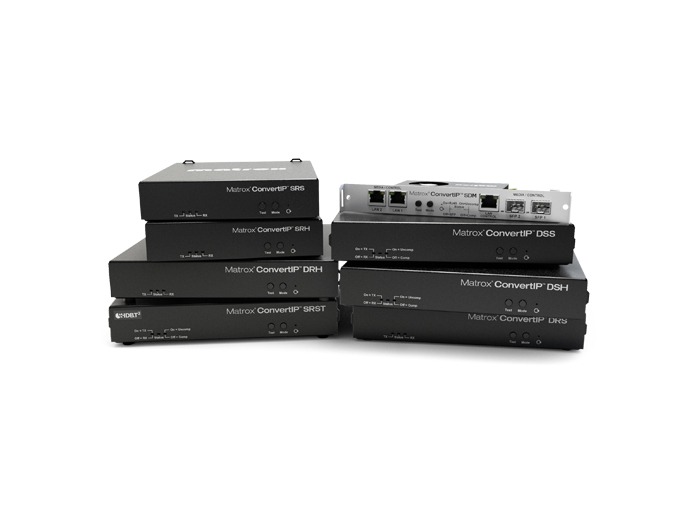
“ConvertIP serves as a flexible bridge between baseband and IP-based environments, offering devices with varying features that can be tailored to different applications. Each ConvertIP model is designed to meet specific workflow requirements, whether for temporary event setups, large-scale installations, or integrated into display systems. The devices convert traditional video formats such as HDMI, SDI, or HDBaseT into IP streams and back, enabling seamless interoperability between legacy and IP-native equipment.
“Depending on the needs of the production, users can choose from configurations that support fiber or RJ45 connections, with options for compressed or uncompressed video, and redundancy for added reliability. For simpler or mobile deployments, a single-cable setup can carry video, audio, and control signals, while more complex installations can benefit from separate control ports and dual network paths. The ConvertIP SDM (Smart Display Module) further enhances flexibility by integrating directly into displays and projectors, reducing cabling and setup time. By offering a comprehensive, standards-based product family that supports both ST 2110 and IPMX, ConvertIP gives users the freedom to build solutions that best fit their performance, scalability, and installation needs using the ‘best of breed’ tools from each manufacturer.”
What has the response been like?
“Feedback from early adopters in the rental and staging market for live events has been overwhelmingly positive, particularly regarding the ConvertIP SDM module. Users appreciate the ability to integrate the device directly into displays or projectors, eliminating the need for external boxes and simplifying setup. For live event professionals, where time and reliability are paramount, this ease of installation translates directly into reduced risk and faster deployment. Matrox Video continues to refine the ConvertIP line, adding features that respond to real-world production needs. For example, the addition of the multi-view allows users to display up to four HD signals on a single screen – an invaluable capability in live environments.
“The new gateway feature enables users to take uncompressed ST 2110 signals and distribute them over 1G networks, making high-quality video more accessible within venues that don’t have high-bandwidth infrastructure. Crucially, ConvertIP is fully standards-based, ensuring interoperability with third-party devices through open protocols like ST 2110, IPMX, and NMOS control. This commitment to open standards is key to enabling flexible, future-proof workflows in the live events market. Productions have noted that this interoperability, once a hallmark of HDMI and SDI – must carry over into the IP world, and ConvertIP was built with that principle.”
Words: Daniel Maloney
Photo: Matrox Video

