
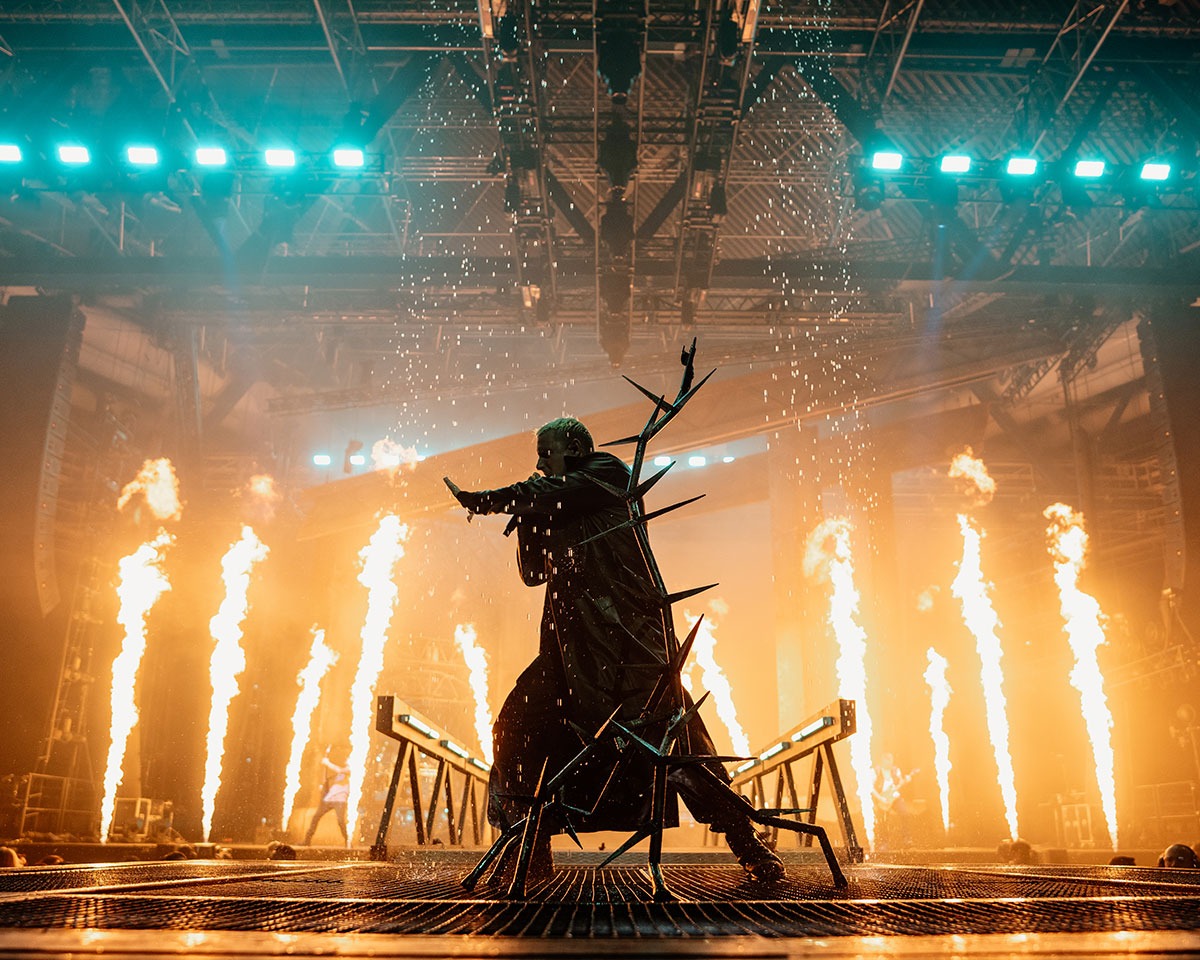
Parkway Drive have long been a mainstay of the alternative music zeitgeist, steadily elevating their production values and becoming certified headliners across festivals and arenas worldwide. For their latest anniversary tour, the Aussie metal group pushed their stage show to new heights, deploying an eye-watering level of pyrotechnics and special effects.
Clips quickly went viral on social media including one moment where pyrotechnics were fired from an automated bridge above the audience while the entire stage was engulfed in flame, firmly capturing the attention of fans and industry professionals alike. With the tour coming to an end, TPi jumped on a call with ER Productions to learn how a show with this much firepower comes together. “We were approached last summer to work on the Australian leg,” began ER’s Dan Mott.
ER Productions had worked with the band previously as well as collaborating with the band’s Lighting Designer, Sam Tozer on several occasions. “Ben Fenwick, the band’s Production Manager, flew to the UK from Australia for a creative meeting that helped set the vision for the tour,” explained Mott, who got to show Fenwick several of the company’s new products, which included FABER Engineering’s new FlamebER.
With the tour kicking off in Australia, ER’s relatively new outpost in the country handled the first iteration of the production. “We only opened our Australian office a few years ago so it was great to bring out a show of this scale from that base,” mused Mott, also commending the work of the entire team making some of the looks achieved possible despite Australia’s stringent health and safety measures.
The road team comprised Michael Morey, Tom Freeman, Matthew Marwick, Ron Spizak, Jay Scrivener and Sam Wakerley. For the UK and European run, Freeman and Marwick stayed on and were joined by Dan Wilce, Michael Attkinson, Gary Sharpe, Paolo Roselli, Eden Mclachlan and Sam Batchelor. “We had six crew out on the road at one time, as well as an arctic worth of equipment,” stated Mott, praising Project Manager, Nina Clements. “Project Managers are often not mentioned but she did a great job,” stated Mott. Despite some slight alterations, the Australian and European shows were very similar with ER providing 80 FlamebERs – a solution created by ER Productions’ FABER Engineering division – 40 G-Flames, 14 Liquid Flames, six Stadium Shots, seven Luminous Hydrotech heads and eight Eco2Jets. ER Productions also provided Low Fog, with effects controlled by Galaxis software and an MA Lighting control surface.
Freeman, one of the key players of the SFX team on the road, walked through how all the looks were choreographed: “It’s a collaborative process between artist, production and ER. Together we design pyro effects and moments that match artist expectations, to fit in the venues and around other supplier equipment, all while being able to fire safely. When all of this comes together in rehearsals, we check that there are no surprises or changes, and that it all will work as planned.”
With the looks set, the team began programming all the pyro cues that created the best visual impact. “We’ll do a couple of band rehearsals without pyro and SFX, so we can see where the band will be at the specific moments. Once we’re happy, we’ll do flame and pyro commissioning for ourselves with a closed stage – only us on stage with our air guitars – to test each individual unit and its direction of effect before putting the band up there for a ‘hot’ rehearsal.”
Freeman stated that it was great working with such a seasoned band that had played their material for many years and knew exactly where to be on stage “and more importantly where not to be,” he said. “There were 77 individual flame fixtures and 20 pyro positions on the stage, most of which were active at the busiest points of the show! There really were only four places on stage that weren’t on fire, and we had a band member in each. Knowing the guys were going to be in the right place was a huge help.”
As will come as no surprise, safety was paramount, with ER deploying a comprehensive package of safeties and E-stops, both at control and at various points around the stage. “Come show time, the audience see a show that hopefully made some memorable moments for the fans, whilst keeping the band safely performing amongst the effects and pyro night after night,” he stated.
For one notable moment during the show, lead singer Winston McCall was elevated high above the crowd on a bridge and then, when it was at a set height, flames shot horizontally above the crowd. For this moment the team taught McCall specific signals that he would give if he was not happy, so they could stop the effects.
Mott highlighted other safety measures incorporated in the package: “We had the Magic FX Safety Arm System on all our flames,” he said. “It’s relatively new and gives operators the ability to have remote E-stops on specific fixtures as well as a warming system when it is about to fire.” He further explained that the E-stop allowed operators to disarm the fixture without it powering down. The protocol also means that a spotter can shut down a specific fixture without losing all the effects in the show.
Mott highlighted the use of timecode to fire the show: “It was a necessity as there were simply too many effects to busk. With the effect firing via timecode, it also meant the team are just focussing on the safety, both with the Magic FX Arm system as well as a DMX safety via the faders on the console.”
He closed by stating that setups like the one deployed on Parkway Drive really showcase the maturity of the industry. “We’ve been using timecode to launch effects for around 10 years but these days it’s becoming the go-to rather than busking. It also requires a different set of skills as an operator. Before we were always looking for people with musical timing but now there is a far bigger focus on the programming side,” Mott added. “It was a pleasure working with the entire team. It was such a unique show, and incredibly exciting to collaborate with an iconic Australian band – first through our Australian office, and then by supporting the same tour and design from our UK office.”
Words: Stew Hume
Photos: @thirdeyevisuals

