
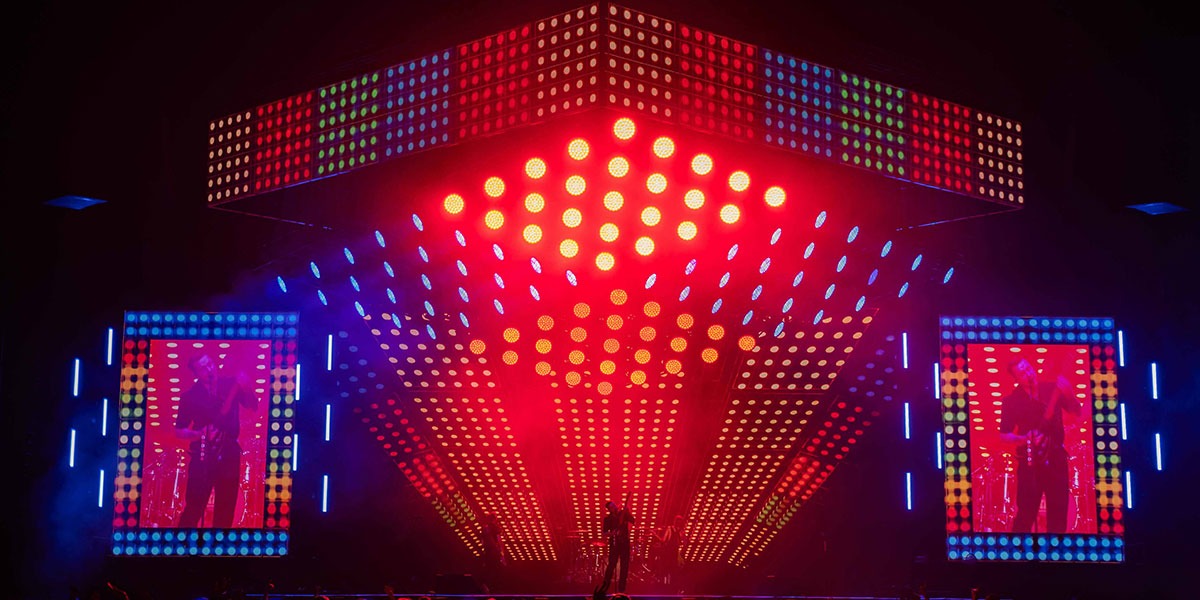
Since forming in the early 2000s, the stories of Busted and McFly have always been interwoven. From the days of Popworld’s Simon Amstell joking that they were so similar, to the later years when the shared camaraderie of the groups was seen as they toured together under the moniker of McBusted. However, for some time behind the scenes, a plan was put in place to create a tour that would pit the two bands against each other for the ultimate co-headline tour.
The difference between Busted vs McFly compared to many other co-headline tours is that instead of flip-flopping who headlined each night, the two bands created a truly shared performance with several ‘face-offs’ and collaborations throughout.
With the show overseen by Production Manager, Iain Whitehead of Production North and creative direction courtesy of David Spearing, the resulting two-month tour, comprising 35 shows, ended up being the biggest arena tour of the UK in 2025.
Greeting TPi at FOH in Manchester’s Co-op Live, Lighting Designer, Sam Parry – who oversaw the visual dialogue for both acts – walked through the creative process for the tour. The LD had crossed paths with both bands, having worked for McFly for several years while working for Busted frontman Charlie Simpson’s other band, Fightstar, during an OVO Wembley Arena performance. “The Fightstar show led to a positive relationship with Charlie and when this tour began to take shape the creative consultants were happy to have me look after both acts,” Parry explained.
Although many departments including backline and audio were split for both bands, Parry and his video counterpart, Media Server Operator, Thomas Hunter, acted as a creative throughline. “We had a long lead-time into this show,” explained Parry. “I still approached the projects as if I was designing for two bands and early on, we knew what the overall look for the stage would be with the massive monolith diamond shape above the band.”
To ensure that both bands were still able to have their own looks during their time on stage, versatility in the fixtures on the rig was at the top of Parry’s list. Via the tour’s lighting, video and automation supplier PRG, the lighting department deployed many Ayrton fixtures including 100 Zonda 9s, 52 Veloce Profiles and 14 Perseo Profiles. “I think we managed to achieve different looks for both bands thanks to how much choice we had with the colour spectrum we had from the fixtures we chose,” commented the LD.
“The 100 Zonda 9s are up in the grid on the four pods and hats off to the team at Ambersphere for helping us source so many.” He further praised the “incredible” Veloces. “It’s almost upsetting as there is nothing to criticise,” he chuckled.
The LD selected 34 “uber-punchy” ROXX Lighting Clusters. “They are not ‘actual’ blinders, which means we are not pulling a lot of dimmers around with us,” stated Parry.
In addition were 14 GLP JDC Burst 1 strobes and 14 impression X5 units. Lining the stage were 20 ACME PIXEL LINE IP striplights. “The PIXEL LINE has been everywhere over festival season. They look incredible and are not too heavy, making them very versatile.”
For key light, Parry used seven Robe iFORTE LTX with PRG’s GroundControl FollowSpot system. “I didn’t know we’d be able to use the GroundControl for the Robe fixtures, but they’ve been great,” stated Parry.
The production had seven stations, with one spare. Two of the lighting crew worked the spots for two of the musicians who went into the audience during the show, with the other spots being looked after by some of the tour’s drivers. “The drivers have all done a great job and they’ve really learned the show, which makes my job much easier,” he commented.
On the topic of crew, the LD was keen to praise the work of his wider lighting team of Aidan McCabe, Adam Hodgson, Tom Begley and George Wilson. “They’ve all been wonderful. I also must give a shout out to our automation team of Ameer El Elryan and Toby Bale.”
The automation in question was a MOVEKET system that gave motion to the four independent square lighting pods, set as a diamond offset to mirror the stage below.
“There is a lot going on up there and although I’ve used MOVEKET before, I never had the chance to push what it would really do,” commented Parry. He went on to point to his favourite looks, such as when McFly singer Danny Jones went right up to the audience and ‘commanded’ the whole rig with all the elements closing right in on the performance. “It was like he was using the force,” he said.
As well as its technical capability, he also enjoyed the back-end software options of MOVEKET. “The software does all the calculations for the loads on each point and gives me a technical previsualisation to show me the gradient and angle relating to those hoists before anything even moves. I can just say what I want the pods to look like, and the software calculates the weights, angles and speeds, which is much easier to work with.”
For control, the LD used MA Lighting grandMA3. “We have two full sizes and a light out with us. The two mains have been from PRG and they have been rock solid. I was thrown into the deep end when I moved onto the MA in 2023 for a McFly tour, but both the software and hardware have been very good.”
To close, Parry gave his thoughts on supplier PRG and its contribution to the project: “We opted to go with PRG as our supplier because they had what I wanted with people that I knew. We’ve had a good relationship for several years and my experience has always been positive. Working with Steve Major and Yvonne Donnelly Smith especially has been great. They deliver what I want every single time I ask for it.”
PARTNER IN CRIME
Sat to the right of Parry at FOH was Thomas Hunter, Media Server Operator and overseer of all the screen content on both the rear wall and the large banner screens. “I’ve worked on a variety of jobs for PRG, but Disguise is not usually my world,” admitted Hunter, who had to learn the entire Disguise system and workflow ahead of this tour. “It’s been fun to see some of the ways it works. The media distribution has been particularly interesting.”
Hunter had roughly a terabyte of video files on one machine, which due to its internal distribution system is then manually backed up. Alongside the two Disguise GX3 machines, Hunter utilised Notch to varying degrees for both bands.
“For McFly, a lot of the Notch effects are quite subtle such as a bit of smoke on the image, but for Busted, there are some more prominent Notch looks including background removal and edge detection that are used to create the ‘punky’ block colour look graphics.”
The rear LED wall was made up of INFiLED AR5.9 with NovaStar MX40 processors. The flown banner LED was made up of ROE Visual Vanish 8T using ROE’s EV4 processors.
“One of my favourite looks for the show happens during the song What Happened to Your Band,” continued Huner. “All the musicians come up on lifts and we use the LED almost like a lighting effect, which provides a silhouette of all the guys on stage. What’s great is that you really can’t capture it on a camera – believe me I’ve tried – which means it’s an experience just for those in the crowd.”
For almost all the bands’ sets, the visual teams took cues from timecode, bar a few songs in McFly’s set – Five Colours in Her Hair and It’s All About You. “They have never played to timecode on those songs,” interjected Parry, explaining that they always want to play them at the pace they are feeling that night. That means it was all hands-on deck for the lighting designer and the media server operator.
Video Director, Chris Keating ensured each element was captured for the IMAG. “It’s been a fantastic tour to be involved with,” stated Keating. “It’s a great crew and it’s good to work with Iain Whitehead again who I’ve known since 1999.”
From the first moments he saw the renderings of the set, Keating knew it was going to be a good show. “The set is quite unconventional and adds an extra layer to the camera shots. It’s a strong visual presentation with the large upstage screen, two portrait IMAG screens and the four-sided overhead banner screen.”
In total there were seven cameras deployed, including two long lenses at FOH and two cameras on track in the pit. “It’s a busy, high-energy show, with lots for the camera guys and myself to play with,” stated Keating. “There’s been a good cohesion between the various visual elements of the show, with lights, video content and cameras. It all makes for a great-looking show.”
Aiding Keating and Hunter in the video department were Video Crew Chief, Steve Jones alongside Brad Baker, Chris Hobson, Matt Heitman, JJ Mikinzi and Gavin Brunton. Closing out the extensive 35-date run at the start of November, Busted vs McFly set the bar for other 2000s nostalgic acts looking to also head out on the road and prove that despite their heritage, productions such as these can still push modern technical innovation.
Words: Stew Hume
Photos: Dylan Swann and Fran Parry

