
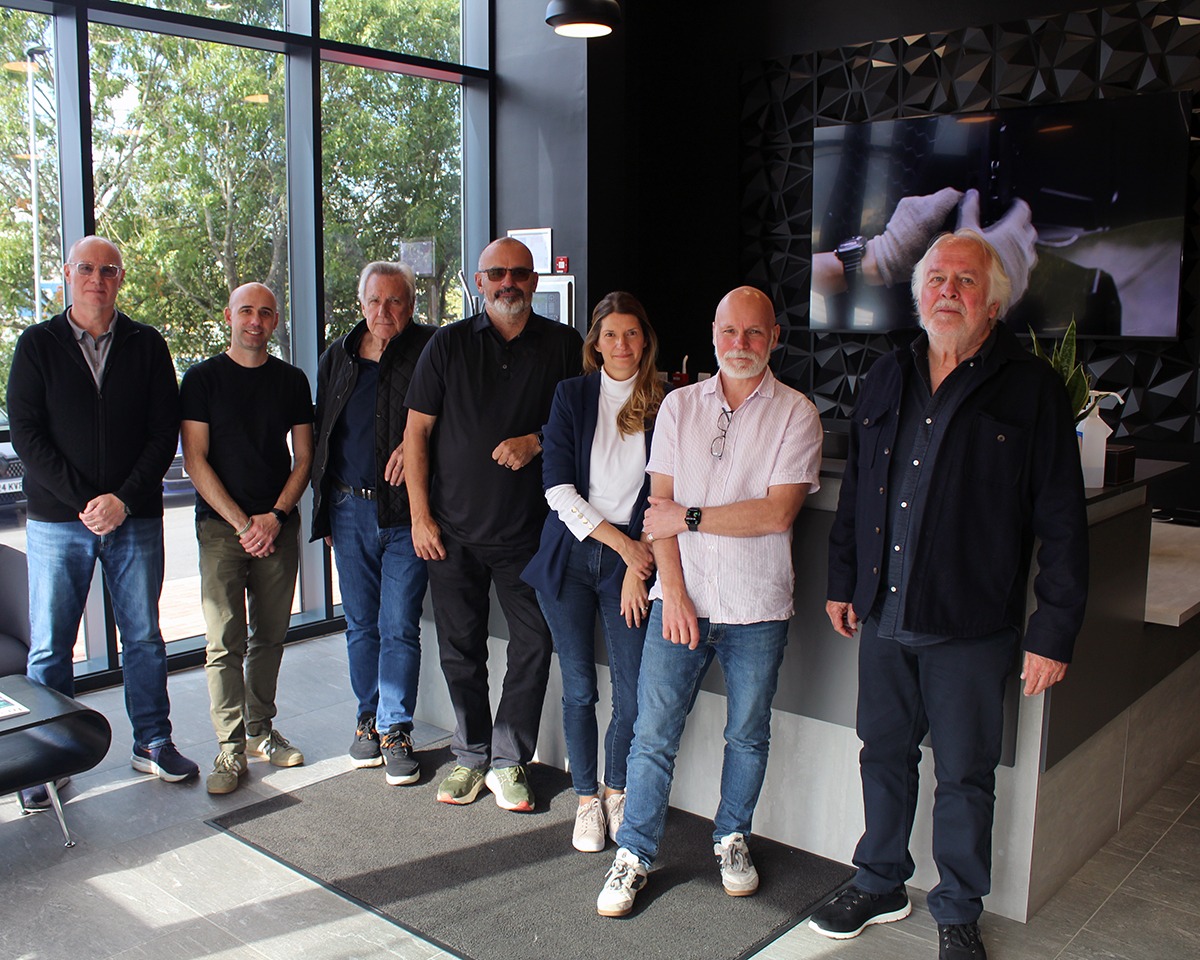
The storied history of Britannia Row Productions can almost be charted through the various facilities the rental house has called home over its 50-year journey. From its Islington birthplace – established to keep Pink Floyd’s equipment in use during their downtime – the company grew as the live industry itself began to professionalise.
With increasing demand came the need for more space, prompting several moves further from central London to ever-larger premises. From Wandsworth, then Twickenham, and most recently, Weybridge, Surrey, on the historical Brooklands site. While the new facility houses the company’s existing stock and staff, it was also designed to accommodate the people and equipment from Eighth Day Sound and Skan PA, companies that have also recently joined Clair Global.
Five decades on, as TPi sat in the company’s new boardroom with founders Bryan Grant and Mike Lowe, it became clear that the real story wasn’t one of bricks and mortar, but of a brand that has successfully walked the tightrope between bespoke service and corporate scale in an ever more complex live events landscape.
A NEW HOME
When it came to selecting the new space, Grant and Lowe, now Non-Executive Directors, were quick to praise the role of the upper management and directors who oversaw the design and fit out of the new premises. “Size was the major element we had to consider,” commented Managing Director, Nicola Amoruso. “Essentially, we were moving three warehouses under one roof – Britannia Row’s Twickenham base, Eighth Day Sound and Skan PA’s operations.”
The new build provides freedom to design the space specifically for the group’s needs. Spanning three levels and 110,000 sq ft of floor space, the site accommodates 150 to 200 people daily – from office staff to crews preparing for shows.
The warehouse has two levels of mezzanine accommodating operations, crew logistics, preparation areas, maintenance and storage serviced by two large lifts. The main warehouse floor also boasts a 10-tonne load capacity rigging gantry, allowing the team to hang a full left-right rig for a small arena and one side of a large A-market arena or stadium show.
Warehouse Director Chris Fitch highlighted the focus on workflow during the build: “One element I was keen to bring from Skan’s Newbury building was having walls around the preparation areas to create actual prep rooms, allowing people to concentrate on the job in hand,” he said.
These prep areas now include small lift platforms so technicians can work on racks at a height that suits them. Another major upgrade came in the form of loading docks. “This is the first time in 50 years we’ve had truck height loading docks,” enthused Sales Director Lez Dwight. “It’s been a real time saver, especially with the incredibly busy summer we’ve just had servicing an ever-increasing number of stadium shows in the UK. Working in this bigger facility certainly made things easier.”
The company has also invested in comfortable office spaces, including dedicated classrooms, a canteen and breakout rooms designed to give staff moments of calm during busy days.
A GLOBAL FORCE
Although TPi’s visit was prompted by Britannia Row’s 50th anniversary, it’s impossible to discuss the company without acknowledging the wider Clair Global group of companies, which it joined in 2017. In an industry familiar with acquisitions, there’s a unique mindset that respects each company’s individual identity and client relationships rather than merging under a single brand.
“Every company that has been acquired globally has its own nuances and reasons why its clients choose to work with it and those nuances and relationships are incredibly important. I believe this is why the Clair Global Group model has been so successful” explained Bryan Grant.
Many familiar faces from those companies remain integral to the operation. Since its acquisition, Skan PA’s Chris Fitch has taken the role of Warehouse Director at Britannia Row alongside Amoruso, Financial Director Christina Bosch, and Lez Dwight. Following the recent acquisition of Plus 4 Audio its former owner, Stewart Chaney also joins the senior management team as Broadcast Director.
Due to the timing of the acquisition, Plus 4 still has its own buildings in Surrey. “We’re working on how we’ll eventually integrate,” stated Chaney. “Our workflows are slightly different, but the process is very positive and the additional resources at our disposal have allowed us to expand our activities this year.”
Discussing how the wider Clair Global network operates for each brand, Bosch added: “We’re incredibly interconnected, with our people in constant contact with the other global teams. This is essential because we operate as part of a global pool of equipment and people, which is now a 3,000-strong international workforce.”
SHARED RESOURCES
The UK warehouse not only houses a vast stock of various PA and console brands but also provides access to global inventory. Operations Supervisor, Joshua Thomas and European Operations Manager, Tim Mole explained how this system works: “We all use a bespoke, proprietary software developed by Clair,” said Mole.
“Let’s say I get an input list with a microphone I’ve never seen before,” added Thomas. “I can search the system and, guaranteed, one of our warehouses will have it. If it’s in Nashville, I can book it, and it’ll be here in the UK within three days.”
This shared database allows the team to access equipment worldwide, ensuring consistent client service. “Although we work under the Britannia Row name, within Operations, we’re fairly brand neutral,” Mole explained. “If a client prefers an Eighth Day Sound-style rack for example we can provide that. It gives clients more choice and flexibility.”
Both praised the benefits of the new facility. “We couldn’t have handled this summer without the extra space,” said Mole. “With the new docks, we can unload trucks in minutes. Being under one roof saves huge amounts of time.”
The same software that tracks equipment also tracks personnel, ensuring the right crew for each tour. Crew Logistics Manager Carlene Annon, who has been with the company since 2006, explained how the system supports her work: “Bryan always used to say that putting a crew together is like casting a play – and he wasn’t wrong!” said Annon. “There are so many personalities with different abilities and skillsets it’s impossible to always get it right but having long-term and loyal relationships with a lot of our crew helps us to know who works well together and how to get the balance right.”
Annon’s system tracks skills, qualifications, and work history, allowing for global crewing flexibility. “Of course, there are multiple conversations outside of the booking system, too. You can’t rely on data alone when your job is to know people.”
She also pointed out the company’s focus on crew welfare. “There are some gruelling schedules out there coupled with incredibly long working days. Combined with being away from family and friends back home, it can be a huge strain on mental health regardless of how experienced you may be. In the UK, we have invested in Mental Health First Aid Training – staff and crew alike, which is delivered through Music Support. We also have a great Crew Management Team that are on the end of the phone for our touring crews should they encounter any issues.”
This ‘people first’ culture not only helps to build strong relationships with freelancers but also aids long term staff retention and recruitment in a business that is consistently growing and changing.
EDUCATION
With ever-expanding workloads, nurturing new talent has never been more vital. Britannia Row continues to develop its apprenticeship programme, taking on eight recruits twice a year for a two-year training scheme.
“We’ve always done training because we have had to,” reflected Lowe, who developed Britannia Row Training. “There never used to be colleges providing courses geared towards the live events industry, and even now, most people graduate with the basic skills but not the specialised knowledge that we need for our niche industry.”
Amoruso added: “The scale we work at is fast paced. Our apprentices can find themselves on large, international shows soon after qualifying.”
Fitch agreed: “When they’re out in the field, they represent us and our brands, so professionalism is key.”
Marcel Van Limbeek, who joined Britannia Row eight years ago, oversees the delivery of the company’s in-house training programme. “During the first year and a half, trainees rotate through different departments and cover all the fundamentals, both practical and theoretical. In the second half of year two, they are allocated to any technical role on an event by the crew logistics team, where they are monitored and mentored by the crew chief.”
Every apprentice rotates through all departments in the warehouse during their training. “They’re the backbone of the company and they make up a third of our warehouse staff,” said Fitch.
The entire training process took on a new dimension in 2020, when in-person classroom sessions were not possible due to COVID-19. This led Limbeek and his team to record online training sessions for remote learning. “These visual aids are available to all our apprentices,” commented Limbeek, explaining that when trainees rotate through the various departments, they can watch the relevant training videos as an additional training tool. While on site, TPi met Julia Bochenska and Louis Briggs, two Live Audio Technician Apprentices currently progressing through the course. Like several of the trainees, Bochenska started out working in the warehouse to gain some hands-on experience before applying for the apprenticeship. Briggs, meanwhile, learned about the course when a freelance engineer visited his university to give a guest lecture and encouraged him to apply. The roles are full time, paid placements.
“Everyone has an idea of what they want to do when they start, but it doesn’t really matter, as you end up coming through each department twice and begin to specialise,” explained Bochenska, adding that since starting the training, she’s been particularly drawn to the world of RF. “I’ve been really intrigued by the topic and how complex it is,” she continued. “It feels like the technology is advancing constantly, and the industry is always coming up with new solutions.”
Both apprentices have already gained some hands-on field experience, with Briggs working as a Monitor Tech on JADE’s set at Glastonbury this summer, while Bochenska joined the RF department for a major League of Legends event at The O2 arena.
“One of the best parts of the programme is getting to see the whole process – from prepping the job in the warehouse to seeing the end product out in the field,” said Briggs. “Being trained across all departments also means that when we finish the course, we’ll be very flexible in the shows we’re able to cover.”
GOING THE EXTRA MILE
Another pillar of Britannia Row’s service is its in-house engineering design team, led by Josh Lloyd, Head of Engineering and Events Support, alongside Laurie Fradley and Nick Boulton. The department advises production teams on the technical design and deployment of systems ranging from innovative and bespoke comms solutions to audio system configurations for arenas, stadiums and large-scale events.
“Everyone in our department is ex-touring,” explained Lloyd. “We tend to look at projects as ‘the whole’ rather than being just PA or desk specialists. We’re also fairly brand-agnostic – it’s about using the right tools for the job.”
Lloyd went on to explain the growing need for the company to provide a more specialised design service reflecting the overall evolution and demands of the industry. “The industry has matured massively in so many ways, even just in my time at Britannia Row. The shows we’re designing now are far more complicated, and even on a relatively straightforward arena tour there’s an elevated level of technology being used and expected. These days, systems are all integrated and communicate with one another in multiple formats.”
The sheer demands placed on an audio system have also changed fundamentally in modern shows. “One of the things artists now need to be aware of is that they’re not just performing for the in-person audience,” he explained, referring to those watching live footage captured on phones in the crowd.
“We now have the tools to make audio systems far more consistent, but it means we’re doing a lot more pre-planning. On most arena tours we’re looking at every individual venue to optimise the PA design, rather than creating a cookie-cutter setup.”
He also noted that almost all shows now incorporate staging elements such as catwalks or in-the-round setups, which of course need to be considered from a system design perspective. Although, unfortunately not always the case, Lloyd recalled numerous occasions where the PA design had been central to the early creative discussions. “There’s an in-the-round show we’re working on at the moment where the PA was the first thing plotted!” he enthused.
Continuing the conversation, Lloyd discussed some of the upcoming innovations he and his department are exploring. “Audio networking is a big focus for the company, and for projects such as Adele in Munich alongside audio, we also provided communications and data services, becoming critical to the entire production communicating and operating safely It’s opened up new levels of flexibility and helped streamline workflows.” He also commented on the increasing sophistication of RF solutions in a landscape of tightening bandwidth restrictions, with productions demanding ever more from their systems.
“You look at a show like Black Sabbath: Back to the Beginning, which we worked on this summer – with so many incoming artists all arriving with different setups, it led to an incredibly complex RF plan to keep the show running smoothly.”
Lloyd went on to say that in this area, he believes AI and machine learning will play a major role in the future – helping determine optimal frequencies and streamline system setup for large-scale productions.
HERE’S TO THE NEXT 50
In many ways, Britannia Row Productions mirrors the evolution of the modern live events industry – from its beginnings in the ‘70s to today becoming a key part of an international network with vast global resources. Despite its scale, the company remains rooted in artist relationships. “We always keep an eye on who’s coming up,” said Dwight. “Bryan instilled in us that every engineer you meet could be a future client. Investing in support acts is also something we’ve tried to do as they could be the next big thing. Our work with productions such as The BRIT Awards, which we’ve worked across for 30 years, has also helped us connect with emerging talent.”
He explained that spotting the next wave has become trickier amid venue closures and the rise of artists breaking through online. “But whatever happens,” he concluded. “The key to the future is to stay aware.”
Words: Stew Hume
Photos: TPi, Britannia Row Productions, DiGiCo (The BRIT Awards), Jill Furmanovsky (David Gilmour), Belinda Enthoven (Robbie Williams).

