
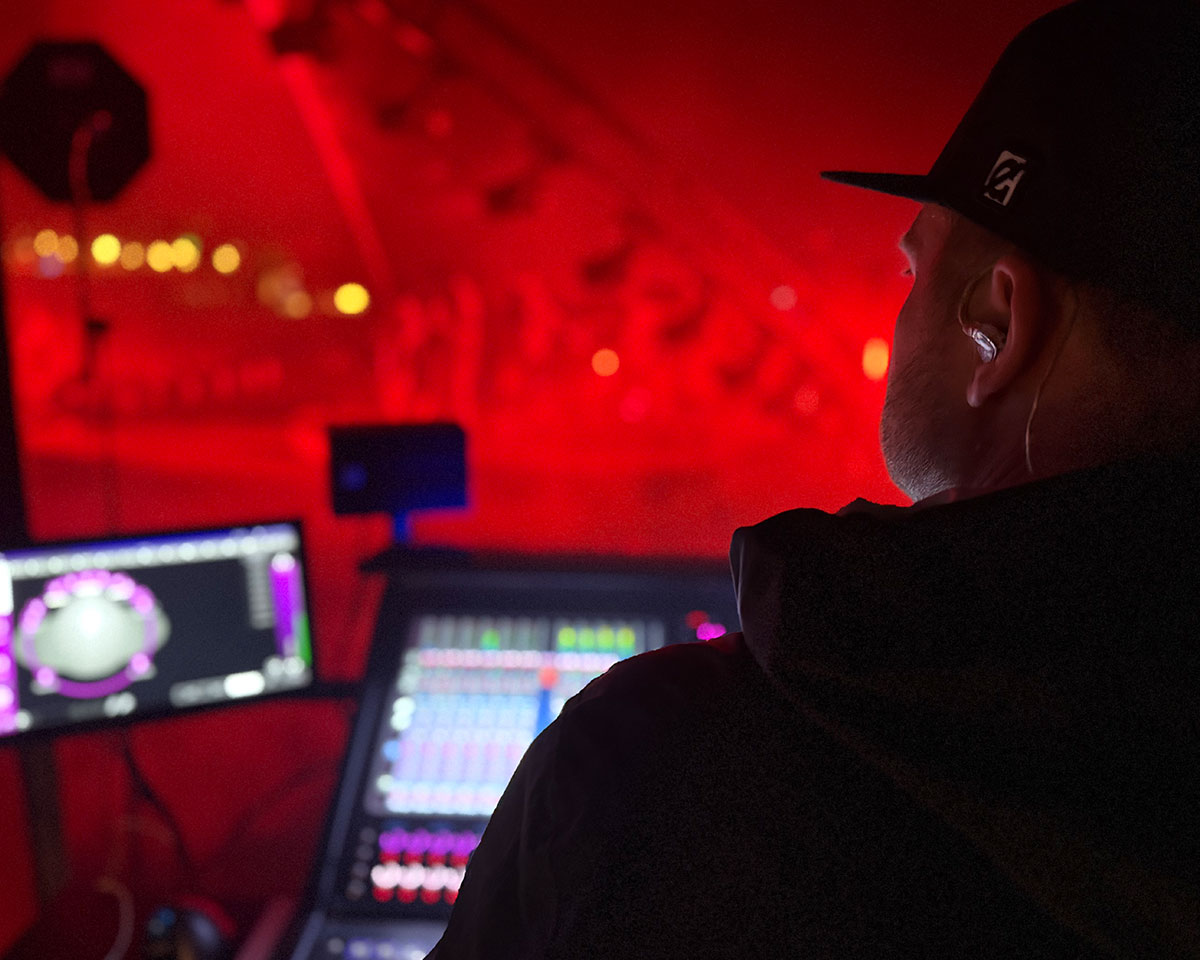
Arve Gotfredsen was introduced to his latest client, a Danish pop artist with an eight-piece band, he was told that they had experienced monitor issues. He knew that first impressions would be everything. Having tried a demo, he turned to KLANG to deliver the space he needed for each element of the mix, instinctively knowing this could help to resolve his client’s issues.
“I wanted to make sure we had bandwidth to allow the whole mix to interact effectively and work together. I work a lot with immersive sound in general, and I was intrigued by the possibilities KLANG offers. I tried the online demo, where it’s possible to switch between a spatialised and a stereo mix. I instantly thought the spatialised mix was exactly what I’d been missing for in-ear monitoring,” Gotfredsen said.
The ability to A-B test the mix was the most convincing part for Arve, an immersive audio specialist with deep knowledge of room acoustics and electroacoustics. Hearing the potential, he introduced KLANG to his client, using a DMI-KLANG card integrated into a DiGiCo Quantum 326. He appreciated the seamless console integration, which gave him the flexibility to focus on the musician’s needs.
“I didn’t say too much to the musicians because I handled the mix from the console. I just explained that we had a tool that could potentially create more room in their mixes,” he recalled. “Mixing for monitors is rarely just about creating a perfect sounding mix, it’s about giving the artist what they need. For instance, one of our musicians was used to a very compressed, studio-like feel in his in-ears. So, while he appreciated the open and spatial mix, he missed that tight, compressed sound. We ended up heavily processing key elements, and placed them centrally within the KLANG spatialised mix, which gave him an immersive experience while still delivering the cues he needed to perform confidently.”
Every musician has an idea of how their own instrument should sound, but sometimes a different sound is needed for the instrument to blend with the full band. Traditionally, engineers would duplicate input channels to be able to provide a sound for the individual and another for the band with different processing. With KLANG, Gotfredsen said, that is no longer necessary.
“Normally, I would need to do a channel split on almost all my input channels and create individual mixes for each musician,” he explained. “If someone thinks the hi-hats and overheads are too bright, for instance, and they want it darker, KLANG allows me to move those elements around in their mix, maybe lowering them on the vertical plane to change the sound and meet their needs. When you fully exploit the spatial placement within KLANG, you rarely need to input-split, which is pretty neat. You almost feel like you have an input split of all channels for all mixes!”
KLANG’s immersive in-ear-monitoring systems have been a natural progression for Gotfredsen’s monitoring techniques. As he concludes, having seen the benefits and the difference it can make to performers, he is positive that he will include it in all his future projects.
“Immersive sound is the next layer for audio and should be as integral as using reverb,” Gotfredsen concluded. “If you hear a vocal coming out of a PA system and you add reverb, it delivers a whole new dimension. It’s the same with immersive sound, and I’m sure it will become increasingly prevalent. I work a lot with immersive techniques, with loudspeakers, sound placement, and moving objects. For me, the level and the sound quality of KLANG is high enough to make me want to do it again. I’m sure I will come to rely on it.”

