
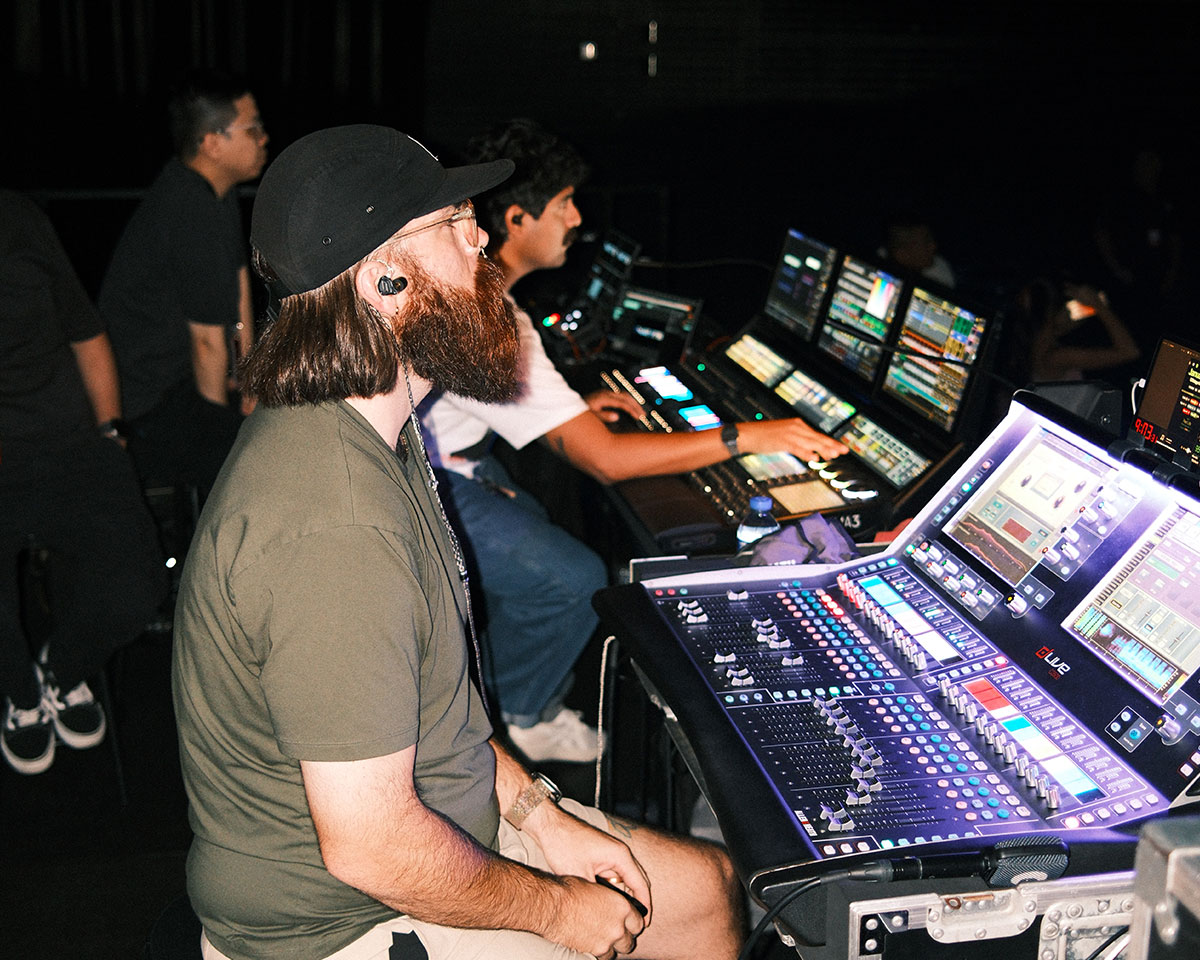
Brent Washburn’s first experience working in sound was mixing punk shows in his basement around 15 years ago. “I had an old analogue console with full D-sub output to a computer for recording,” he recalled. “I met a lot of great artists from that experience, and started touring with a few of them.”
After touring for a while, Washburn started looking for a more consistent experience at each venue. “I got tired of the console du jour, and having to dial in IEM mixes each time,” he explained. “It left me less time to work on my front of house mix before we actually hit the stage.”
Seeing influential engineers like Drew Thornton mix big acts on compact control surfaces inspired his next move. “That seemed to make a lot of sense,” he recalled. “I heard how great their mixes sounded, and started seeing more and more people go that route.”
In 2020, Washburn decided to invest in his own compact touring rig – featuring an iPad running the dLive MixPad app, a DM0 dLive MixRack, and two DX168 stageboxes. Eventually, Washburn also added a dLive C1500 control surface for more hands-on mixing. “I’ve been yelling about dLive at the top of the mountain ever since,” he joked. “I can’t say enough good things about the system.”
His compact rig did face some skepticism from other engineers on the road, however. “I’ll never forget walking into the first arena show I mixed with my C1500,” he recalled. Washburn was mixing Juno Award-winning Canadian Pop artist JESSIA at the time, supporting OneRepublic. “The headlining front of house guy looked at me and said: ‘there’s no way you’re about to tour like this.’ It was the most punk-rock thing he’d ever seen.”
Washburn’s compact touring rig worked perfectly. “It’s been rock solid from day one,” he said. “I’ve taken this system all across North America, Europe, Asia it’s great that such a small form factor has the ability to scale up to 128 inputs.” Washburn’s current tour with pop artist Elijah Woods includes his own compact rig, plus a second dLive mixrack for monitors connected in a digital split over Dante.
In addition to the system’s portability, Washburn appreciates how dLive’s workflow can be customised. “You can very easily change how the console feels and how you can access your different channel types,” he explained. “It’s all very intuitive and user-friendly.”
Washburn has also been taking advantage of some newly released features in dLive firmware V2.1. “The group-to-group routing is a complete game-changer,” he explained. “I previously had to use some workarounds to accomplish that type of complex routing, and now it’s completely streamlined.”
dLive V2.1 also introduced a new CompStortion compressor model that Washburn immediately started implementing. “Elijah (Woods) records with a similar processor in the studio,” he explained. “The dLive version got his stamp of approval that it sounds just as good as the hardware.”
Washburn also inserts dLive’s powerful DYN8 processor for Woods’ lead vocal channel, which is a combination Dynamic EQ and Multiband Compressor. “I actually double-patch the channel to get 8 bands of Dynamic EQ,” he explained. “I use it a lot in the upper bands to duck out cymbals and snare and any bleed from the drums.”
For Washburn, investing in dLive wasn’t just about choosing a console – it was about choosing reliability and consistency. From small clubs to major arenas across three continents, the system has proven itself to be a lightweight, rock-solid, and endlessly flexible partner. “It gives me the confidence to walk into any venue knowing I’ll deliver the best possible mix,” he said. “At this point, I can’t imagine touring without it.”

